

TL;DR
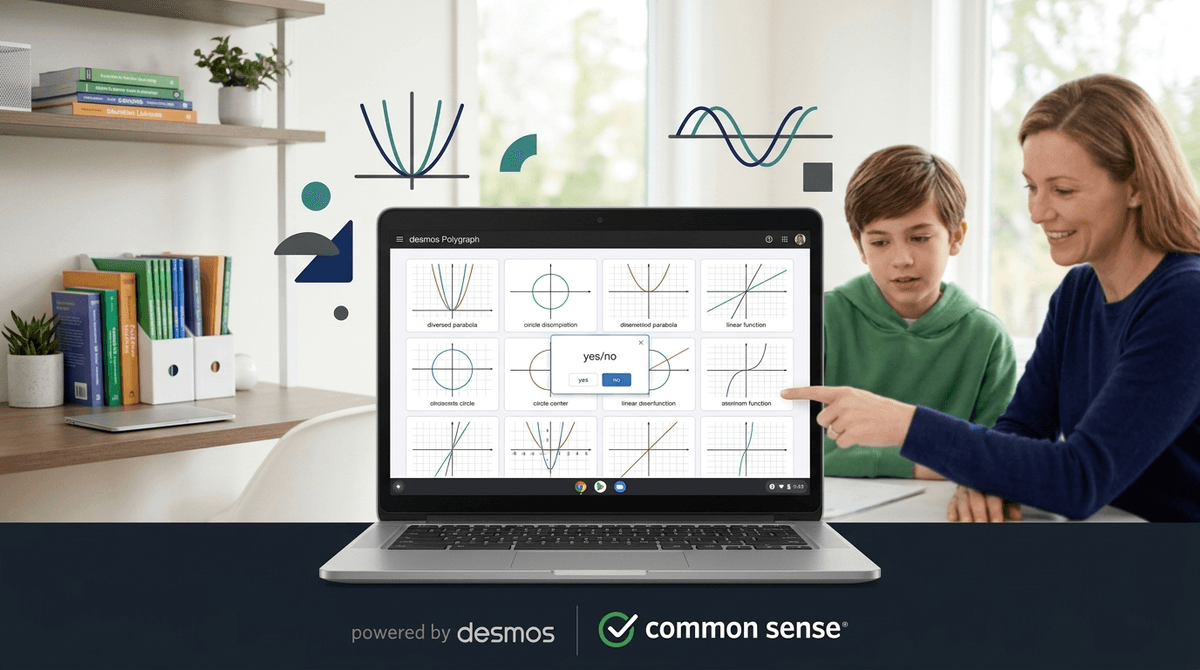
Desmos Polygraph is essentially a digital, math-themed version of the classic Guess Who? board game. Instead of asking if a character has a mustache or wears a hat, students ask if a graph has a positive slope or if a shape is a quadrilateral. It’s a free, browser-based tool that turns "boring" math vocabulary into a high-stakes (but fun) game of deduction. It’s one of the few digital tools that actually encourages kids to talk to each other about math rather than just staring silently at a screen.
Quick Links for Math-Minded Parents:
- Best for Algebra/Geometry: Desmos Polygraph
- Best for Gamified Drills: Prodigy Math
- Best for Conceptual Visuals: Mathigon
- Best for Early Math Logic: DragonBox Algebra 5+
If you’ve spent any time looking at your kid’s Chromebook recently, you’ve probably seen the Desmos logo. It’s the gold standard for graphing calculators these days, but their "Classroom Activities" are where things get interesting.
Desmos Polygraph is an interactive game designed for the classroom (though you can play it at home if you have two devices). Here’s the setup:
- The computer pairs two students together.
- The "Picker" is shown a grid of 16 different graphs or shapes and chooses one.
- The "Guesser" sees the same grid and has to ask yes-or-no questions to narrow down which one the Picker chose.
- As the Guesser eliminates options, they click on the graphs to hide them until only one remains.
It sounds simple, but the magic is in the language. In the first round, a kid might ask, "Is it a wiggly line?" By the third round, they realize "wiggly" doesn't help when there are four different sine waves on the screen. Suddenly, they want to know what "periodicity" or "amplitude" means because they want to win the game.
We talk a lot about "brain rot" content—those mindless YouTube shorts or repetitive clicker games that seem to turn kids into zombies. Desmos Polygraph is the literal antidote to that.
Kids love it because it’s competitive and social. It has that "Skibidi" energy of being fast-paced and slightly chaotic in a classroom setting, but the "grind" here is intellectual. It’s not about how fast you can click; it’s about how smart your question is.
Unlike Roblox, where the goal is often to flex skins or spend Robux, the "flex" in Polygraph is correctly identifying a parabola using terms like "vertex" and "concavity." It gives kids a sense of mastery over a language that usually feels like a foreign dialect.
Learn more about the difference between educational games and "edutainment"
In the world of middle schoolers, everything "weird" or "bad" is "Ohio." If a kid sees a weirdly shaped graph, they might initially describe it as "an Ohio graph." Polygraph shuts that down real fast.
The game forces a transition through three stages of learning:
- Stage 1: Informal Language. "Is it pointy?" or "Does it go up?"
- Stage 2: The Need for Precision. "Wait, they all go up. Is the pointy part on the y-axis?"
- Stage 3: Academic Fluency. "Does the function have a minimum at the origin?"
This is why teachers love it. It’s not a multiple-choice test. It’s a strategic puzzle. If your kid is playing this in class, they aren't just "playing a game"—they are practicing logic and communication. It’s closer to Codenames than it is to a standard math worksheet.
Not all "math games" are created equal. If you’re trying to figure out where Desmos Polygraph fits in your family’s digital diet, here’s the breakdown:
Prodigy is a massive hit because it looks like a fantasy RPG (think Pokémon). However, it can sometimes feel like the math is just a "toll" you have to pay to keep playing the fun adventure game. Polygraph is the math. There are no pets to collect or worlds to save—the fun is the deduction itself.
Khan Academy is the reliable, sturdy station wagon of the digital math world. It’s great for instruction, but it’s not exactly "fun." Polygraph is the supplement that makes the Khan Academy lessons stick.
These are "speed" games. They’re great for quick recall (like multiplication tables), but they don’t encourage deep thinking. Polygraph is the "slow food" version of a classroom game. It rewards accuracy and thoughtful phrasing over fast fingers.
If your kid is a visual learner, Mathigon is an incredible "textbook of the future." It’s highly interactive and beautiful. Polygraph is more of a social tool, while Mathigon is a solo exploration.
Check out our full guide on the best math websites for every grade level
Ages 5-9: Desmos Polygraph might be a bit too heavy on the reading and coordinate plane logic for the younger crowd. For this age, I’d recommend DragonBox Numbers or Zearn.
Ages 10-14 (Middle School): This is the "sweet spot." This is when kids are moving from basic arithmetic to the "alphabet soup" of Algebra. Polygraph helps demystify the vocabulary of functions, lines, and angles.
Ages 15-18 (High School): Still very relevant. Desmos has advanced Polygraph sets for Calculus and Trigonometry that will challenge even the "math is easy" kids.
From a digital wellness perspective, Desmos Polygraph is about as safe as it gets.
- No Public Chat: Students can only send the yes/no questions and answers. There is no open-text chat where they can share personal info or be bullied.
- Teacher-Moderated: Usually, the teacher "starts" the session and can see all the questions being asked in real-time.
- No Data Mining: Desmos is widely respected for its privacy standards in schools. They aren't trying to sell your kid a subscription or show them ads for the latest Squishmallows.
The only real "risk" is the frustration of being paired with a partner who isn't trying, but that’s a life lesson in group projects, not a digital safety concern.
If your kid says they are "playing games in math class," don't panic. Ask them if it's Desmos. If it is, they are actually doing high-level cognitive work.
One thing to watch for: some kids can get "stuck" on the digital interface. If you see them struggling, it’s usually not the math—it’s the vocabulary. This is a great opportunity to step in (without being "cringe") and say, "Hey, I think the word you’re looking for is intercept."
Desmos Polygraph is a rare win in the world of educational technology. It’s a tool that uses the "Guess Who" mechanic to solve the age-old problem of kids hating math vocabulary. It’s free, it’s safe, and it actually works.
If you want to support your kid's digital math journey without adding to their "brain rot" quota, this is a platform to get behind. It’s not about mindlessly solving for X; it’s about learning how to describe the world through a mathematical lens. And if they can do that without calling everything "mid" or "Ohio," that’s a parenting win in my book.
Next Steps
- Check their history: See if they've been using the Desmos Graphing Calculator for homework.
- Try a family version: If you have two laptops, go to the Desmos site and try a "Basic Shapes" polygraph with your kid. It’s surprisingly humbling.
- Explore alternatives: If they find Desmos too "school-ish," check out Brilliant.org for more puzzle-based learning.