

TL;DR
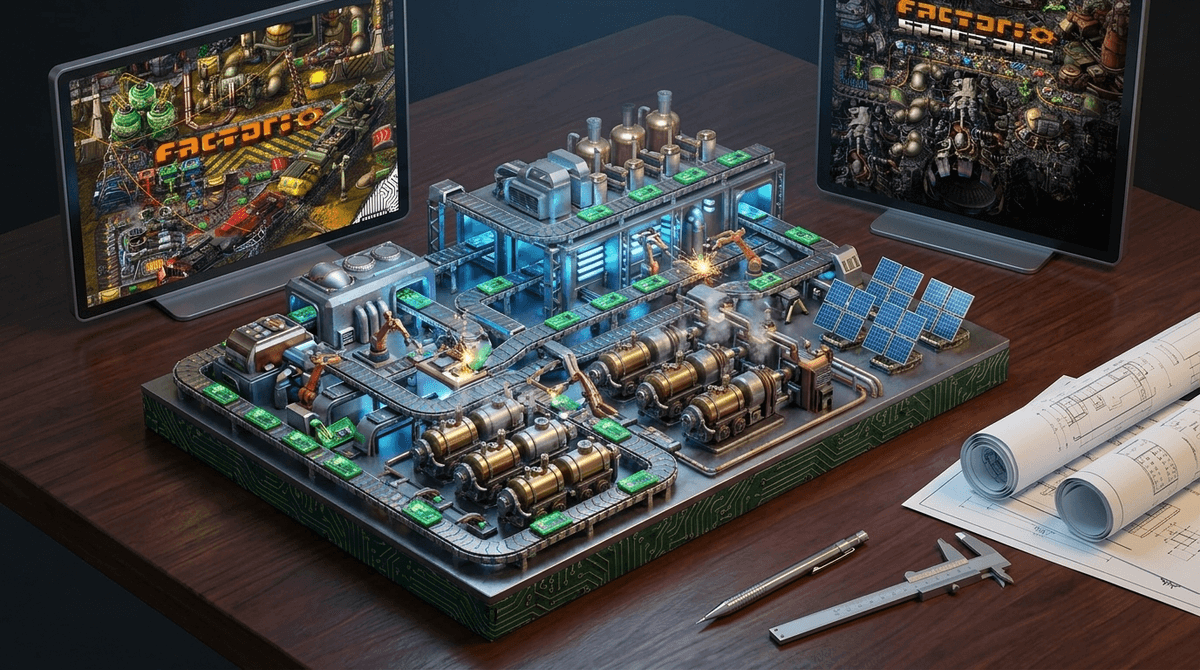
If your kid is obsessed with Factorio, they aren’t just "playing a game"—they’re essentially completing a master’s degree in systems engineering and supply chain management. It is arguably the most "productive" game on the market, but it comes with a massive "one-more-minute" addiction factor known in the community as "Cracktorio."
- Best for: Ages 10+ (due to complexity, not content).
- The Vibe: High-level logic, automation, and "the factory must grow."
- Safety: Very safe. No predatory loot boxes, and multiplayer is usually private.
- Educational Value: Off the charts. Logic, ratios, and troubleshooting.
Check out our full breakdown of the best engineering games for kids
Imagine your kid is an engineer who has crash-landed on an alien planet. To get home, they have to build a rocket. But they can’t just "build" it. They have to mine iron, smelt it into plates, turn those plates into gears, use those gears to build conveyor belts, and eventually build a sprawling, massive automated factory that covers miles of digital territory.
The game is a "sandbox" builder. There are no levels, just one giant problem to solve: How do I automate this? If they need more power, they build steam engines. If the steam engines need coal, they build a train line to a distant coal mine.
Recently, the game released a massive expansion called Space Age. It’s basically Factorio 2.0, allowing players to leave the planet and build factories in orbit and on other moons. If you hear your kid talking about "Vulcanus" or "interplanetary logistics," they’ve officially entered the deep end of the new update.
There is a specific kind of "brain itch" that Factorio scratches. It’s the satisfaction of taking a chaotic mess and turning it into a perfectly synchronized machine.
For kids who find school a bit slow or "mid," Factorio offers a level of challenge that actually respects their intelligence. It doesn’t hold their hand. It says, "The power is out because you ran out of coal. Figure it out."
It’s also surprisingly trendy. While some kids are into the "brain rot" of Skibidi Toilet or the chaotic energy of Roblox, the "Factorio kid" is usually the one who loves Minecraft Redstone and wants something more complex. It’s a bit of a "flex" in certain gaming circles to have a massive, efficient factory.

You’ll hear the term "Cracktorio" used by fans. This isn't because the game is "bad" or "evil," but because it is designed around a perfect feedback loop.
In most games, you finish a level and stop. In Factorio, you never "finish." You just find a new bottleneck.
- "I’ll stop as soon as I get the copper running."
- "Wait, now I don’t have enough electricity for the copper."
- "Okay, I’ll just build two more solar panels... oh, now I need more iron for the panels."
This is a "flow state" game. It’s great for cognitive development, but it’s a nightmare for "dinner is ready in five minutes."
It is genuinely educational. If your kid plays this for 100 hours, they will understand:
- Ratios: "I need 3 copper wire machines to feed 2 electronic circuit machines."
- Bottlenecks: Identifying exactly where a system is failing.
- Resource Management: Planning for the future so you don't run out of supplies.
- Logic Gates: Using "circuit networks" (basically basic programming) to tell machines when to turn on or off.
Read our guide on how video games can teach coding and logic
Ages 8-10
Most kids this age will find the UI (User Interface) overwhelming. It looks like an Excel spreadsheet had a baby with a circuit board. However, if you have a particularly tech-savvy kid who has mastered Scratch or complex LEGO Technic sets, they might enjoy it with a parent’s help.
Ages 11-14
This is the sweet spot. They are old enough to handle the math and the long-term planning. This is also the age where they might start playing multiplayer with friends. Factorio multiplayer is great because it’s collaborative, not competitive. They aren’t shooting each other; they’re working together to build a bigger engine.
Ages 15+
At this point, they’re probably better at the game than you are. Don’t be surprised if they start talking about "optimizing throughput" or "main bus designs." They are basically practicing for a career in software development or industrial engineering.
The "Violence" Factor
There are enemies in Factorio called "Biters." They are giant alien bugs that attack your factory because of the pollution you produce. You defend yourself with turrets, tanks, and lasers.
- The Reality: It’s very low-res and "top-down." It isn't gory or scary.
- The Pro-Tip: You can turn enemies off entirely in "Peaceful Mode." Many players (including adults) prefer this because they just want to build without the stress of being attacked.
Multiplayer Safety
Unlike Fortnite or Roblox, there is no "public lobby" where strangers can easily scream at your kid. Multiplayer is usually done by sharing a specific server address or joining a friend through Steam. It’s very controlled.
Monetization
One of the best things about Factorio is that it is "old school." You buy the game once, and you own it. There are no "skins" to buy, no "battle passes," and no "gems." The only additional purchase is the Space Age expansion, which is a massive, one-time-buy piece of content.
Learn more about avoiding predatory monetization in games
If your kid is playing Factorio, you should be happy they’ve chosen a "high-calorie" game over "brain rot" YouTube shorts. However, you need to be the "External Clock."
Because the game is so engaging, kids (and let’s be real, husbands) will lose track of time. This is not a game you can "just finish a round" of.
How to talk about it: Instead of saying "Get off that game," try asking:
- "What’s the biggest bottleneck in your factory right now?"
- "Are you playing with Biters on, or are you in peaceful mode?"
- "How close are you to launching the rocket?"
When they explain it to you, it will sound like gibberish, but the fact that they can explain it shows their brain is working hard.
If the $35 price tag or the complexity is a bit much, here are some "Factorio-lite" options:
Think of this as Factorio mixed with a tower defense game. It’s much simpler, often free or very cheap on mobile, and focuses more on the combat side of automation.
This is the "pure" version of automation. There are no enemies and no player character. You just process geometric shapes. It’s very zen and great for younger kids (8-10) to learn the basics of conveyor belts.
If your kid says Factorio looks "ugly" (the graphics are intentionally gritty and 2D), Satisfactory is the 3D, first-person version. It’s beautiful, bright, and involves building massive factories on a lush alien planet.
Check out our guide on the best building games for kids
Factorio is the "Gold Standard" for educational gaming that doesn't feel like "educational gaming." It rewards patience, logical thinking, and long-term planning.
The Verdict: It’s a "Yes" from us, but with a strict timer. The "Space Age" update has made the game even more complex and rewarding, so if your kid is diving back in, just make sure they remember to eat and occasionally look at a real-life tree.
- Ask for a tour: Have your kid show you their factory. If it looks like a "spaghetti mess" (that's a real term), they are still learning. If it looks organized, they might be a genius.
- Set a "Hard Stop": Because of the flow state, give them a 15-minute warning before they need to get off. They often need that time to "finish one last belt."
- Encourage Peaceful Mode: If you notice they are getting stressed or frustrated by the bug attacks, suggest turning them off so they can focus on the building.