

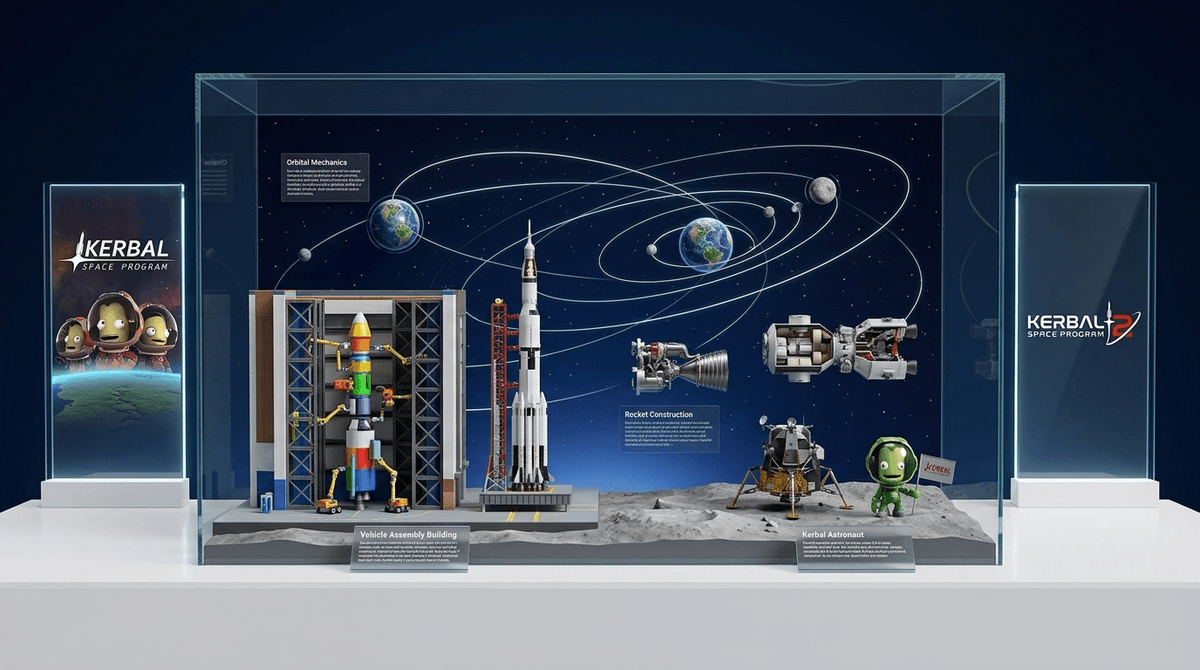
TL;DR: Kerbal Space Program is the ultimate "stealth learning" game. It’s a physics-based space flight simulator that is as challenging as it is hilarious. If your kid is tired of the mindless grind in Roblox or Minecraft, this is the "prestige TV" equivalent of gaming. It teaches actual orbital mechanics, engineering, and—most importantly—how to fail gracefully.
Quick Links for Future Astronauts:
- The Game: Kerbal Space Program
- The Sequel: Kerbal Space Program 2
- For Younger Kids: SimpleRockets 2
- Deep Dive: Is Kerbal Space Program too hard for my 10-year-old?

At its surface, Kerbal Space Program (often called KSP) is a game about building rockets for a race of small, green, bug-eyed aliens called Kerbals. You run their entire space program: you design the craft, assemble the stages, pilot the launch, and try to navigate the vacuum of space without running out of fuel or accidentally slinging your brave pilots into the infinite void.
But here’s the kicker: the physics are real. Well, real-ish. The game uses a "patched conic approximation" of Newtonian physics. This means that if your kid wants to get to the "Mun" (the Kerbal version of our Moon), they can’t just point the rocket at the big white circle in the sky and press "go." They have to understand gravity wells, escape velocity, and Hohmann transfer orbits.
It sounds intimidating, but because the Kerbals are goofy and the explosions are spectacular, the game turns "rocket science" into a series of hilarious, high-stakes puzzles.
Kids love KSP because it treats them like they’re smart. In an era of "brain rot" content where everything is flashing lights and 5-second dopamine hits, KSP is slow, deliberate, and deeply rewarding.
There is a specific kind of "gamer's high" that comes from KSP. It’s the moment after four hours of failed designs, three mid-air disintegrations, and one tragic fuel miscalculation, when your kid finally manages to touch down on a foreign planet. The sense of accomplishment is genuine because the game didn't "let" them win. They earned it through math and persistence.
Also, let's be real: the explosions. When a rocket design is top-heavy or lacks enough "struts" (a running joke in the community is that the answer to every problem is "more struts"), it wobbles and eventually disintegrates in a fiery ball of glory. KSP makes failure funny, which lowers the barrier to trying again.
We talk a lot about "screen time quality," and Kerbal Space Program is basically the gold standard for high-quality digital engagement.
1. It Builds Resilience
In KSP, your first ten rockets will likely fail. Your eleventh might reach the upper atmosphere before the engine falls off. This teaches "iteration." Instead of getting a "Game Over" screen and quitting, kids learn to go back to the Vehicle Assembly Building, look at their design, and ask, "Why did that happen?" That is the scientific method in action, disguised as a video game.
2. It’s a STEM Powerhouse
NASA employees and SpaceX engineers famously play KSP. It’s one of the few games that can actually help a student ace a high school physics test. Concepts like "Delta-V" (change in velocity) and "Apoapsis" (the highest point in an orbit) become second nature.
3. It’s a Safe Sandbox
KSP is primarily a single-player experience. There’s no voice chat with strangers, no toxic "Ohio" memes being screamed in the lobby, and no predatory loot boxes. It’s just your kid, a bunch of parts, and the laws of physics.
Find the best STEM games for middle schoolers
While the game is rated E for Everyone, the "mental age" for KSP is a bit higher due to the complexity.
- Ages 7-9: They will likely need a parent or older sibling to sit with them. They’ll love building "silly" rockets and watching them explode. At this age, it’s about play, not necessarily reaching orbit.
- Ages 10-12: This is the sweet spot. They are old enough to grasp the logic of the tutorials and start experimenting with real missions.
- Ages 13+: They can dive into the world of "modding" (adding community-created content) and complex interplanetary travel.
A quick note: The sequel was released in early access and had a rocky start with bugs and performance issues. While it looks prettier and has better tutorials, many "purists" still prefer the original Kerbal Space Program because it’s a finished, stable product with thousands of free mods available.
The Learning Curve is a Vertical Wall
Don't be surprised if your kid gets frustrated in the first hour. The game doesn't hold your hand. If they are struggling, suggest they watch a few "Scott Manley" videos on YouTube—he’s the unofficial patron saint of KSP and explains the physics in a way that’s actually understandable.
It’s a Time Sink
Because KSP requires "planning, building, and executing," it’s not a game you play for 15 minutes. Missions can take an hour or more. If you have strict 30-minute screen time limits, KSP might be difficult to enjoy. You might consider "project-based" screen time for this one—letting them play until they finish a specific mission (like landing on the Mun).
The Community
The KSP community is one of the most wholesome on the internet. It’s full of space nerds and engineers who love helping "newbs." If your kid is looking for designs or help, the KSP forums and subreddits are generally much safer and more intellectual than your average gaming community.
If you want to engage with your kid about KSP, don't ask "Are you winning?" (Because in KSP, there isn't really a 'win' state). Instead, try these:
- "What’s the goal of your current mission? Are you trying to orbit or land?"
- "I saw that explosion—what part of the rocket failed?"
- "How much Delta-V do you need to get back home, or are those Kerbals stranded forever?" (Note: "Stranding" Kerbals on the moon and then having to launch a rescue mission is a rite of passage).
Learn more about how to support your child's interest in space and engineering
If your kid is diving deep into Kerbal Space Program, they might enjoy these as well:
The ultimate "engineering under pressure" movie. It shows exactly why the math in KSP matters.
A bit more mature (check the rating for language), but it’s essentially "Kerbal Space Program: The Movie." It’s all about using science to solve life-or-death problems.
A great, safe place for younger siblings to explore space concepts while the older kids are busy calculating reentry angles.
A fantastic way to show the human side of the math that powers the rockets they're building in the game.
Kerbal Space Program is one of the few games where you can walk away feeling like your kid’s brain is actually bigger than it was when they started. It’s challenging, it’s funny, and it turns the most complex concepts in the universe into a playground.
If your family is trying to move away from "junk food" gaming and toward something more "nutritious," KSP is the steak and broccoli of the digital world—except it tastes like candy.
- Watch the trailer with your kid to see if the humor and building style click.
- Check the specs: KSP can be taxing on older laptops. Make sure your computer can handle it.
- Set a "Mission Goal": Instead of a timer, try setting a goal for the weekend, like "Design a satellite that can stay in orbit."
- Take the Screenwise Survey to see how KSP fits into your family’s overall digital wellness profile.