

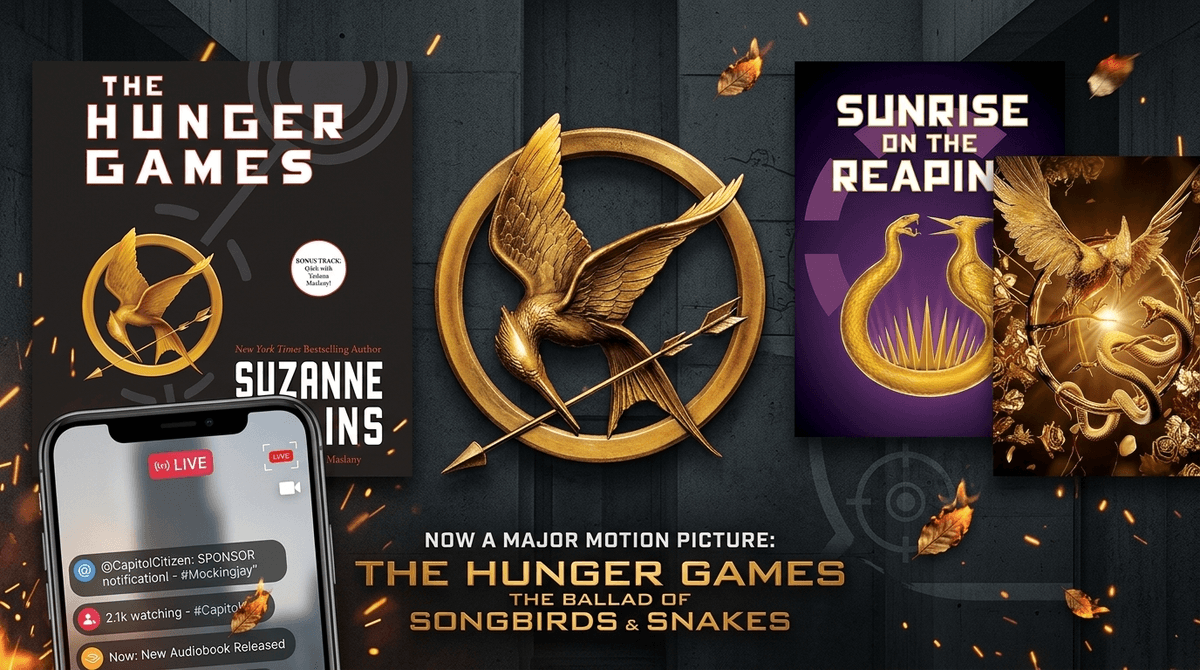
TL;DR: Panem is having a massive moment again. With the 2025 release of the new prequel book, Sunrise on the Reaping, and the recent success of the The Ballad of Songbirds and Snakes movie, your kids are likely diving into this world for the first time—or obsessively revisiting it. It’s violent, politically heavy, and cynical, but it’s also one of the best tools we have for teaching media literacy. Best for ages 12+.
Quick Links to the Panem Universe:
- The OG Trilogy: The Hunger Games, Catching Fire, Mockingjay
- The Prequels: The Ballad of Songbirds and Snakes, Sunrise on the Reaping
- The Movies: The Hunger Games movie, The Ballad of Songbirds and Snakes movie
- Deep Dive: Is The Hunger Games too violent for my middle schooler?
If you missed the first wave in 2012, here is the vibe: North America has collapsed into "Panem," a totalitarian society where the wealthy Capitol forces twelve outlying districts to send two "tributes" (kids aged 12-18) to fight to the death on live television.
In 2026, the franchise is shifting from Katniss Everdeen’s story to the history of the Games themselves. The new book, Sunrise on the Reaping, takes us back to the 50th Hunger Games—the one won by Haymitch Abernathy (played by Woody Harrelson in the original films).
It’s not just "another YA series." It’s a critique of how we consume tragedy as entertainment. If your kid is on TikTok or watching MrBeast challenges that feel increasingly high-stakes, the themes of The Hunger Games are going to feel eerily relevant to them.
It’s easy to dismiss this as "kids killing kids," but that’s not why they’re reading it.
- Agency in a Broken World: Teens feel like they’re inheriting a mess (climate change, economic weirdness, AI). Katniss is the ultimate "I didn't ask for this, but I'm going to fix it" icon.
- The "Shipping" Wars: Even though the world is ending, there’s still the Peeta vs. Gale debate. It gives them a safe place to navigate romantic tropes.
- High Stakes: Everything in a teen's life feels like life or death. Suzanne Collins just made it literal.
- The Aesthetic: From the "Girl on Fire" dresses to the brutalist architecture of the Capitol, the series has a visual language that thrives on social media.
Ask our chatbot about why dystopian fiction is peaking again
This is the mandatory starting point. The books are written in a tight, first-person present tense that makes them incredibly fast reads. Katniss is a prickly, traumatized, but deeply relatable narrator.
- The Books: The Hunger Games, Catching Fire, Mockingjay.
- The Movies: Generally very faithful. Jennifer Lawrence carries these, and the supporting cast is top-tier.
This is the "villain origin story" for President Snow. It’s longer, more philosophical, and honestly, a bit darker. It asks why we have governments and why humans are drawn to chaos. The movie version is visually stunning but leans heavily into the psychological manipulation.
Coming in 2026, this book will cover the "Second Quarter Quell." Since we know the protagonist (Haymitch) survives, the tension will be about how he survives and what it cost him. Expect this to be the "it" book of the summer.
This is a "Young Adult" series, which in publishing terms usually means 12 to 18. However, because the movies are rated PG-13, a lot of 9 and 10-year-olds are trying to jump in.
Ages 9-11 (The "Maybe" Zone)
If you have a particularly mature reader, they might handle the books. However, the concept of kids being forced to kill each other for the amusement of adults can be genuinely haunting at this age. The movies are quite visceral—seeing a "tracker jacker" attack or a spear hit a character is different than reading about it.
- Parent Tip: If they really want dystopian vibes but aren't ready for the gore, try The Giver or City of Ember.
Ages 12-14 (The Sweet Spot)
This is when most kids have the emotional distance to understand the satire. They can handle the "love triangle" and the political rebellion. They will likely want to binge the movies after the books. This is a great age to talk about how the Capitol uses "sponsors" and "makeovers" to make the tributes more "likable"—just like influencers do today.
Ages 15+ (Deep Dive)
At this age, they’re ready for the prequels. Songbirds and Snakes is a bit of a slog for younger kids because it’s so heavy on political theory, but for high schoolers, it’s a masterclass in how propaganda works.
Let’s be real: people die in these books. Often. And often in creative, terrible ways.
- The Books: The violence is descriptive but serves a purpose. It’s never "cool." It’s always framed as a tragedy or a horror.
- The Movies: The "Blood Bath" at the start of the games is shaky-cam heavy to keep the PG-13 rating, but it’s still intense.
- The Psychological Aspect: The series deals with PTSD, grief, and the "lesser of two evils" in war. If your child is currently struggling with anxiety about the state of the world, this might be a "wait a year" series.
The most important thing to know is that The Hunger Games isn't about the fighting; it’s about the cameras.
In the story, the tributes have to "perform" to get gifts (medicine, food) from the audience. If they aren't charming or "ship-able," they die.
This is a direct parallel to the current digital economy. We are all, in some way, performing for an audience on Instagram or TikTok to get "likes" (the modern-day sponsor gift).
Conversation Starters:
- "Why did the Capitol make the tributes look like celebrities before sending them into the arena?"
- "Katniss and Peeta pretend to be in love to survive. Do you think people on social media pretend to be happier or different than they are to get more followers?"
- "In the new book Sunrise on the Reaping, we see how a younger Haymitch handled the pressure. How do you think being 'famous' for something terrible affects a person?"
The Hunger Games is a rare franchise that actually respects a teenager’s intelligence. It doesn't pull punches about how difficult the world can be, but it also shows that individual choices matter.
If your kid wants to read the books or watch the movies, say yes (if they're 12+), but be prepared to actually talk about it. This isn't "brain rot" like some Skibidi Toilet rabbit hole; it’s a foundational text for understanding how the modern world uses media to manipulate us.
Next Steps:
- Check the shelf: If they haven't read the original The Hunger Games, start there.
- Pre-order: Sunrise on the Reaping is going to be the biggest book of 2025. If they’re a fan, get on the list.
- Watch together: The first movie is a great Friday night watch that actually leads to some "real" conversations.