

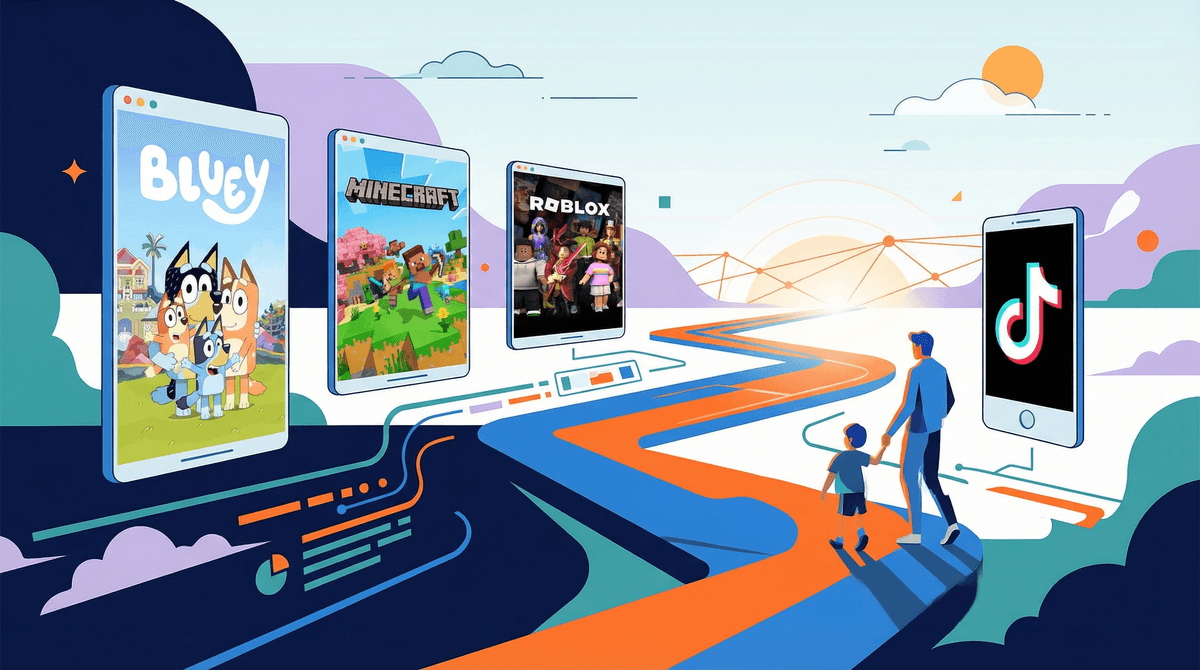
Raising Healthy Kids in the Digital Age: A Parent's Roadmap
Look, if you're reading this, you're probably already doing better than you think. The fact that you're even thinking about how screens affect your kid's development puts you ahead of the curve. But let's be real: parenting in 2026 feels like trying to raise humans in an experiment we're all running in real-time.
The question isn't really "screens or no screens" anymore. That ship sailed around the time the first iPad landed in a preschool classroom. The real question is: how do we raise kids who can handle the digital world without letting it mess with the crucial developmental stuff they need to become functioning adults?
Here's the thing: the research on screens and development is honestly kind of messy. Not because scientists aren't trying, but because it's hard to study something that's changing every six months. Instagram in 2015 is not Instagram in 2026. Roblox five years ago didn't have voice chat or the same social pressures it has now.
But there are some things we know pretty solidly:
Before age 2-3, excessive screen time can genuinely interfere with language development, attention span, and social-emotional growth. Babies learn by watching faces, not Cocomelon. Their brains are literally wiring themselves based on human interaction.
During elementary years (ages 5-12), kids need massive amounts of unstructured play, physical movement, face-to-face social practice, and boredom (yes, boredom is actually developmentally useful). Screens aren't evil here, but they can crowd out these essential experiences if we're not careful.
In the tween/teen years (ages 11+), the concern shifts. Now we're talking about identity formation, social comparison, sleep disruption, and the genuinely documented mental health impacts of social media. The data on teenage girls and Instagram is... not great, folks.
Every hour your kid spends on a screen is an hour they're not doing something else. This isn't about judgment—it's just math. And some of that "something else" matters a lot for development:
Physical development: Kids need to move. Like, a lot. Climbing trees, running around, learning how their bodies work in space. The rise in childhood myopia (nearsightedness) is literally linked to less time outdoors and more close-up screen work.
Social skills: Your kid learns how to read facial expressions, navigate conflict, share, take turns, and deal with awkwardness by... doing those things in person. A lot. Minecraft multiplayer is not the same as figuring out playground politics.
Executive function: Boredom teaches kids to self-entertain, plan, problem-solve, and regulate their attention. When every idle moment gets filled with a device, they miss out on building this mental muscle.
Sleep: The blue light thing is real, but honestly the bigger issue is that devices are stimulating. Watching YouTube at 9pm means your kid's brain is still fired up at 10pm when they should be winding down.
Okay, so what do we do with all this? Here's the framework that actually makes sense:
Ages 0-5: Minimal and Co-Viewed
- Under 18 months: Basically none, except video chatting with grandma (which is actually beneficial because it's real social interaction)
- 18 months to 5 years: High-quality content only, always co-viewed when possible, maximum 1 hour per day
- Shows like Bluey or Daniel Tiger are designed with development in mind
- The key word is "co-viewing"—watch with them, talk about what you're seeing, make it interactive
Ages 6-12: Building Digital Literacy with Guardrails
- Screen time: 1-2 hours of recreational screen time on school days, more flexibility on weekends
- Content matters more than time: 2 hours of Mario Kart with siblings is different from 2 hours of YouTube shorts
- No social media yet: Most platforms require age 13 for good reason. Their brains literally aren't ready for the social comparison and validation loops
- Prioritize creation over consumption: Scratch coding, making videos, building in Minecraft—these are way better than passive scrolling
- Device-free zones: Bedrooms, dinner table, car rides (sometimes)
Ages 13+: Gradual Independence with Check-ins
- Less about time limits, more about habits: Is their screen use interfering with sleep, schoolwork, friendships, activities they used to love?
- Social media with training wheels: If you're allowing it, start with one platform, keep it public (or follow them), have regular conversations about what they're seeing
- Teach them to notice their own patterns: "Hey, how do you feel after 30 minutes on TikTok vs. after playing Stardew Valley?"
- The goal is self-regulation: By 16-17, they should be making most of these decisions themselves with your coaching
Regardless of age, some things should just be table stakes:
- Phones don't sleep in bedrooms (get them a $15 alarm clock)
- One screen at a time (no TV + iPad simultaneously)
- Real-world stuff comes first: homework, chores, family dinner, sports practice—then screens
- You get to spot-check: If they're on a device in your house, you can see what they're doing. Privacy increases with age and trust, but you're still the parent
- Model what you preach: If you're doomscrolling at dinner, they're learning that's normal
Not all screen time is created equal, and not all kids respond the same way. Here are the red flags that mean it's time to make real changes:
- Sleep disruption: Trouble falling asleep, tired all the time, sneaking devices at night
- Social withdrawal: Choosing screens over hanging out with friends they used to enjoy
- Mood changes: Irritable when devices are taken away, anxious about missing online content
- Declining performance: Grades dropping, activities suffering, responsibilities ignored
- Physical symptoms: Headaches, eye strain, repetitive stress injuries (yes, really)
If you're seeing multiple red flags, it's not about being a "bad parent"—it's about recognizing that your particular kid needs more structure around screens.
Healthy child development in the digital age isn't about achieving some perfect balance. It's about being intentional. It's about recognizing that screens are tools—incredibly useful ones—but they're not neutral. They're designed to be compelling, and kids' developing brains are especially vulnerable to that design.
Your job isn't to protect your kid from all screens forever. It's to make sure they're getting enough of the real-world experiences they need to develop properly, while gradually teaching them to navigate digital spaces in healthy ways.
Some weeks you'll nail it. Some weeks your kid will watch way too much YouTube because you were in survival mode. That's called being human.
Start with one change: Pick the lowest-hanging fruit for your family. Maybe it's phones out of bedrooms, or no screens during dinner, or switching from YouTube to Bluey for your preschooler.
Talk to your kids: Ask them what they like about their favorite games and shows. Learn about Roblox instead of just dismissing it. Understanding their digital world helps you guide them through it.
Get community context: Wondering what's normal for your kid's age? Screenwise can show you what other families in your community are actually doing—not the Instagram version, the real version.
Keep learning: The digital landscape will change. New apps, new concerns, new research. Stay curious and adjust as you go.
You've got this. And on the days when you don't? That's what the rest of us are here for.