

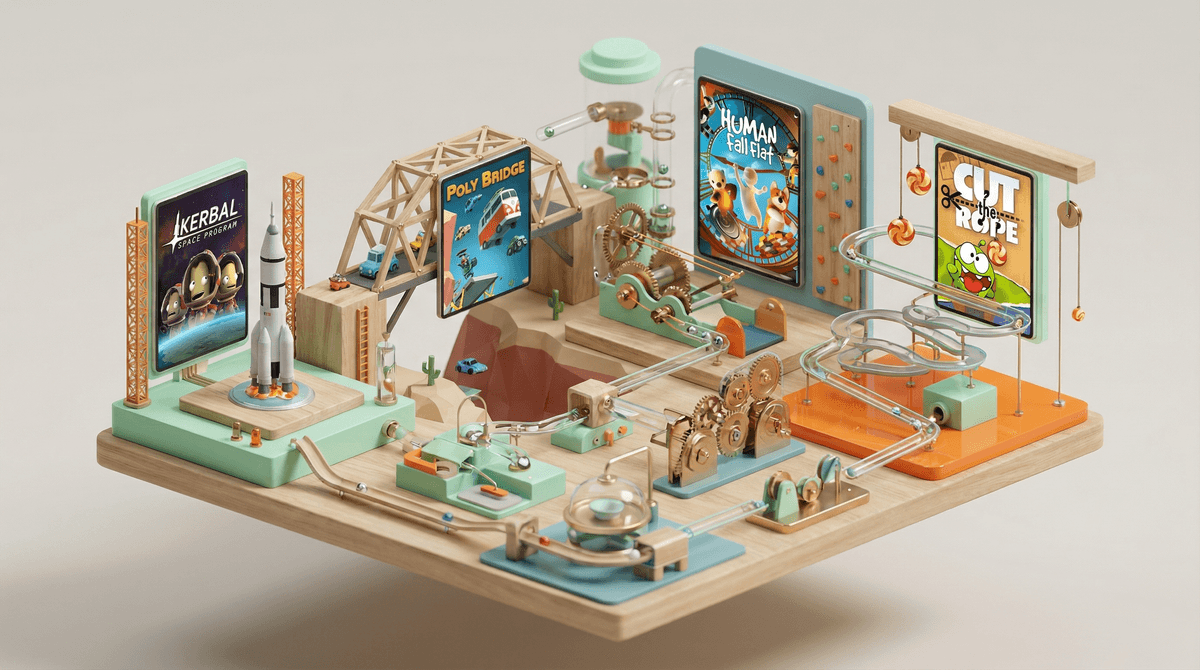
These are puzzle games where the core mechanic revolves around real-world physics concepts—gravity, momentum, trajectory, force, friction. Think Angry Birds, Cut the Rope, Where's My Water?, and newer entries like The Incredible Machine or Human Fall Flat.
The premise is simple: figure out how to get the bird to hit the pig, the candy to reach the monster, or the water to flow to the alligator. But the execution requires understanding—or at least intuiting—how objects behave in space. Kids aren't just button-mashing; they're experimenting with cause and effect, testing hypotheses, and iterating on failures.
And here's the thing: these games actually teach physics concepts, often without kids realizing they're learning anything at all.
Physics games hit a sweet spot in game design. They're:
- Instantly understandable - You can grasp the goal in seconds
- Endlessly tweakable - Every level is a new puzzle with multiple solutions
- Satisfying - There's something deeply gratifying about nailing that perfect trajectory or watching a Rube Goldberg-style chain reaction play out
- Low-stakes - Failure just means trying again, and trying again is actually fun
Unlike a lot of mobile games that rely on timers, energy systems, or pay-to-win mechanics, classic physics games are about pure problem-solving. Sure, Angry Birds has in-app purchases now, but the core gameplay loop doesn't require them.
For younger kids (ages 5-8), these games offer accessible entry points into logical thinking. For older kids (ages 9-14), they can get genuinely complex, requiring planning, spatial reasoning, and even basic trigonometry (though they'd never call it that).
Let's be clear: playing Angry Birds won't replace a physics class. But it does build intuitive understanding of concepts that kids will encounter later in formal education:
- Trajectory and angles - Launching a bird at different angles produces different results. Kids learn through trial and error that a 45-degree angle often gives maximum distance.
- Gravity and momentum - Objects fall, roll, and bounce in predictable ways. Cut the Rope teaches timing and gravity as you figure out when to cut ropes so candy swings into stars.
- Force and impact - Heavier objects cause more destruction. Different materials react differently to force.
- Cause and effect chains - Many physics games involve chain reactions where one action triggers multiple consequences.
Research on game-based learning shows that experiential learning through play creates stronger conceptual understanding than passive instruction. When kids tinker with physics in a game, they're building mental models they'll draw on later.
And honestly? It's just good critical thinking practice. These games reward experimentation, pattern recognition, and persistence—skills that transfer way beyond STEM.
Ages 4-7:
- Cut the Rope - Simple mechanics, adorable character, clear goals
- Where's My Water? - Fluid dynamics made fun
- Toca Builders - More freeform physics sandbox
Ages 8-12:
- Angry Birds (original or sequels) - The classic for a reason
- Bad Piggies - From the Angry Birds universe, but you build vehicles
- Incredible Machine - Rube Goldberg contraptions
- World of Goo - Bridge-building with personality
Ages 13+:
- Portal / Portal 2 - First-person physics puzzles with momentum and spatial reasoning
- Human Fall Flat - Hilarious ragdoll physics, great for co-op
- Poly Bridge - Actual engineering challenges
- Kerbal Space Program - Legit rocket science (seriously)
The good:
- These games encourage problem-solving and persistence
- They're generally ad-free or have minimal ads (compared to other mobile games)
- Many have no violence or very cartoonish violence (birds hitting pigs)
- They work well for short play sessions—perfect for car rides or waiting rooms
- Some (like Portal 2 or Human Fall Flat) offer great co-op experiences
The watch-outs:
- In-app purchases - Angry Birds and similar games often sell power-ups or level unlocks. Set up parental controls or use Apple/Google Family Sharing to require purchase approval.
- Ad-supported versions - Free versions may have ads between levels. For young kids, consider paying for ad-free versions ($3-5 is typical).
- Frustration factor - Some kids get genuinely upset when they can't solve a level. This is actually a good opportunity to talk about persistence and growth mindset
 , but be ready to step in if frustration turns to meltdown.
Co-playing tip: These games are fantastic for playing together. You're not just watching your kid play—you can actually collaborate on solutions, talk through strategies, and model how to approach problems. "What if we tried launching from a higher angle?" or "I wonder what happens if we cut both ropes at once?"
Physics games are about as close to "educational screen time" as you can get without it feeling like homework. They're genuinely fun, they build problem-solving skills, and they create intuitive understanding of how the physical world works.
Are they going to turn your kid into the next Neil deGrasse Tyson? Probably not. But they're a hell of a lot better than mindless auto-runners or loot-box-driven games.
If you're looking for games that feel good to say yes to, physics puzzlers are a solid choice. And if your kid gets really into them, consider exploring alternatives to Minecraft that focus on building and engineering, or check out our guide to STEM-focused games for more options.
Start here: Download Cut the Rope or Angry Birds and play a few levels together. See if your kid gravitates toward the experimentation and problem-solving.
Level up: If they love it, explore more complex physics games like World of Goo or Human Fall Flat.
Connect to real life: When your kid is playing, ask questions that bridge game mechanics to real-world physics: "Why do you think the heavy block broke through but the light one didn't?" or "What angle do you think will make it go farthest?"
And if you want to understand more about how gaming can actually support learning (and when it doesn't), explore our guide to educational gaming.