

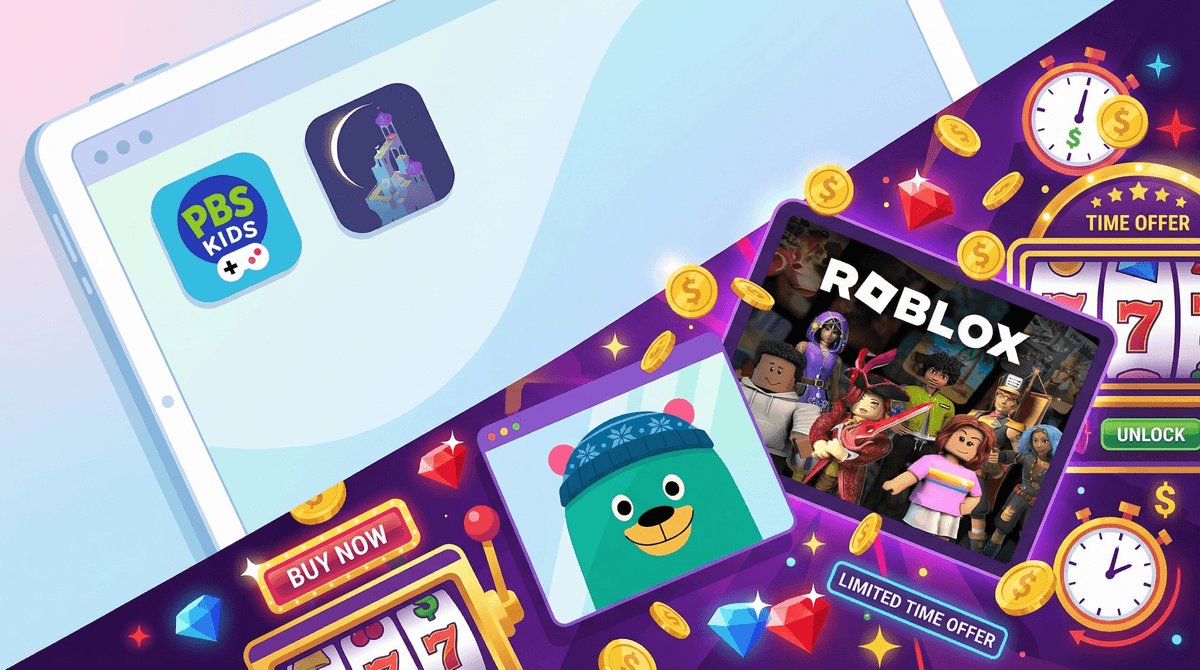
Let's be real: there's no such thing as a free app. That adorable penguin game your 6-year-old downloaded? Someone's making money off it. The question isn't whether you're paying—it's how you're paying.
When you see that beautiful $0.00 price tag in the App Store, you're looking at one of three business models: in-app purchases, advertising, or data collection. Often it's all three at once. And here's the thing—these aren't just minor inconveniences. They're specifically designed to extract maximum value from your family, and kids are exceptionally vulnerable to these tactics.
In-App Purchases: The Endless Money Pit
Remember when you bought a game and that was it? Yeah, those days are over. Modern "free" apps are built around what the industry calls "monetization friction"—making the free experience just annoying enough that spending money feels like relief.
Here's what that looks like in practice:
- Wait timers that can be skipped for $1.99
- Premium currency (gems, coins, Robux) that obscures real costs
- Loot boxes that are literally gambling mechanics for kids
- Battle passes that create FOMO around limited-time content
- Pay-to-win mechanics that make free players feel inferior
The average "free" game on a kid's device generates about $2-5 per month in spending. Doesn't sound like much? That's $24-60 per year, per app. And most kids have multiple games installed. One parent I know discovered $347 in charges from Roblox before they realized their daughter had saved the password.
Advertising: Your Kid's Attention for Sale
Free apps supported by ads are essentially selling your child's attention to advertisers. And not in some abstract way—in a very literal, calculated, psychologically-optimized way.
Kids under 8 can't reliably distinguish ads from content. Even older kids struggle with native advertising and influencer marketing embedded in apps. You'll see:
- Video ads that play between levels (often 30 seconds, unskippable)
- Rewarded ads that give in-game benefits for watching
- Playable ads that are mini-games leading to app store downloads
- Cross-promotion to other apps (often age-inappropriate)
The average free kids' app shows an ad every 2-3 minutes of use. Do the math: that's 10-15 ads in a 30-minute session. Your kid's brain is getting interrupted and redirected constantly, and they're being trained to see consumption as the solution to every problem.
Data Collection: The Invisible Tax
This one's harder to see, but it might be the most expensive. "Free" apps are often harvesting data about your child—their interests, behavior patterns, friend networks, location, and more. This data gets sold to advertisers, used to train AI models, or stored in ways we don't fully understand yet.
The FTC's COPPA rules are supposed to protect kids under 13, but enforcement is spotty and many apps operate in gray areas. Even "educational" apps have been caught collecting way more data than necessary and sharing it with third parties.
Kids' brains aren't fully developed when it comes to impulse control and understanding delayed consequences. They're also still learning about money, which makes premium currency particularly insidious. When your kid spends 500 gems, do they understand that's $5 of real money? Probably not.
The apps know this. The game designers know this. The whole system is built on it.
Kids also experience social pressure around these apps. When everyone at school is talking about their Fortnite skins or their Adopt Me pets, your kid feels left out if they can't participate. The "free" app becomes a gateway to social belonging that costs money.
Read the app permissions before downloading. If a kids' coloring app wants access to your contacts, location, and camera, that's a red flag. Learn more about app permissions and what they actually mean .
.
Set up purchase controls immediately. Both iOS and Android let you require a password for purchases. Use it. Also consider setting up a separate Apple ID or Google account for your kids with no payment method attached.
Check your credit card statements. Set a calendar reminder to review charges monthly. Many parents discover unauthorized purchases months later when it's too late to dispute them.
Talk about the business model. Even young kids can understand "this app is free because they want you to watch ads" or "they make money when people buy gems." Making the invisible visible helps kids develop critical thinking about digital products.
Consider paid alternatives. A $5 app with no ads or IAP is often a better deal than a "free" app that nickel-and-dimes you. Apps like Toca Boca games or Monument Valley have one-time costs and no ongoing monetization.
Ages 4-7: Stick with truly free apps from trusted sources (PBS Kids, Khan Academy Kids) or paid apps with no IAP. Young kids have zero impulse control around "buy now" prompts.
Ages 8-11: This is when kids start wanting the same apps as their friends. Set clear rules: they can have free apps but can't spend money without asking. Use it as a teaching opportunity about advertising and data.
Ages 12+: Consider giving them a small monthly budget for in-app purchases ($5-10) and let them manage it. When the money's gone, it's gone. This teaches real financial literacy while giving them some autonomy.
Free apps aren't evil, but they're not free. You're paying with money, attention, data, or all three. The key is going in with eyes open and teaching your kids to be critical consumers.
Some free apps are genuinely great—Duolingo, Khan Academy, and many PBS Kids apps offer substantial value without predatory practices. Others are essentially slot machines dressed up as games.
Your job isn't to ban all free apps. It's to understand what you're actually agreeing to, set appropriate boundaries, and help your kids develop the critical thinking skills to navigate this landscape themselves.
- Audit what's already installed. Go through your kid's device and check each app's business model
- Set up parental controls for purchases if you haven't already
- Have a family conversation about how "free" apps make money
- Consider alternatives to the most problematic apps on their device
And if you're wondering whether a specific app is worth the hidden costs, Get a breakdown of an app's safety of its monetization practices and age-appropriateness.