

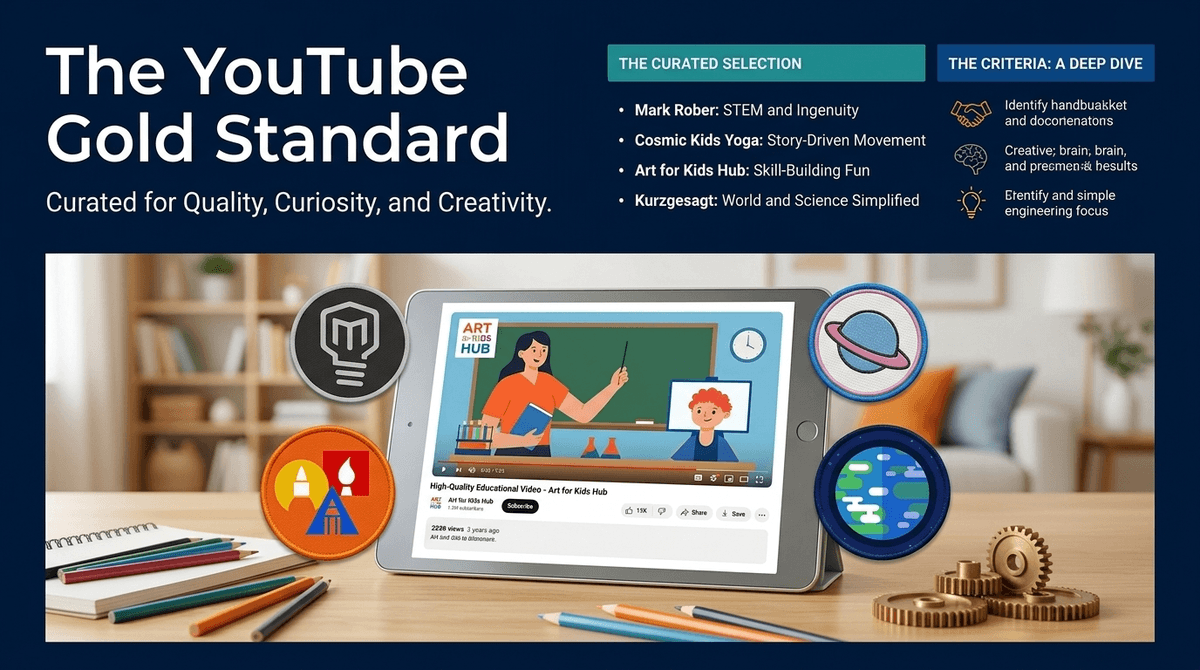
TL;DR: The Quick List
If you’re in the middle of school pickup or trying to get dinner on the table and just need to know what to put on that won't melt your kid's brain, here are the gold standards for 2026:
- Best for Movement: Cosmic Kids Yoga
- Best for Creativity: Art for Kids Hub
- Best for Science/Engineering: Mark Rober
- Best for Math/Logic: Numberblocks
- Best for "Big Questions": Kurzgesagt – In a Nutshell
- Best for Animal Lovers: National Geographic Kids
Check out our full guide on managing YouTube screen time
Let’s be real: YouTube is the undisputed heavyweight champion of "I just need ten minutes to drink my coffee while it's still hot." But it’s also a chaotic digital wilderness. One minute your kid is watching a cute video about hamsters, and three clicks later they’re deep in the lore of Skibidi Toilet or watching some "Ohio" meme that makes absolutely zero sense to anyone born before 2010.
The goal isn't to ban YouTube—that’s a losing battle in 2026. The goal is to curate the feed so it's actually adding value to their lives instead of just being "brain rot." We want content that sparks a "hey, I can do that" moment rather than a "zombie stare" moment.
We’ve all been there with Cocomelon. It’s bright, it’s repetitive, and it’s basically digital catnip for toddlers. But research into "high-arousal" content suggests that the rapid-fire pacing of some of these shows can actually make kids more irritable when the screen finally turns off.
When we talk about "family-friendly" in 2026, we’re looking for creators who respect a child’s attention span rather than exploiting it. We're looking for slower pacing, real-world applications, and—crucially—content that doesn't make parents want to hide in the laundry room to escape the soundtrack.
Ages: 6-16 If there is a patron saint of intentional screen time, it’s Mark Rober. He’s a former NASA engineer who builds "glitter bombs" to catch porch pirates and creates massive science experiments. Why it’s great: He explains complex engineering principles (like potential energy or fluid dynamics) in a way that is genuinely thrilling. It’s the kind of content that leads to kids asking for cardboard boxes and duct tape to build their own "inventions." It turns passive consumption into active curiosity.
Ages: 4-12 This is a family-run channel where a dad (Rob) draws alongside one of his kids. Why it’s great: It’s incredibly grounding. They show the mistakes. They show that two people drawing the same thing will end up with different results. It’s a fantastic way to use the iPad as a tool for a physical activity. If your kid is going to have a screen in front of them, having a sketchbook next to it is a huge win.
Ages: 3-8 Jamie, the host, takes kids through yoga poses by telling stories (often using themes like Minecraft, Star Wars, or Frozen). Why it’s great: It solves the "sedentary" problem of YouTube. It’s high-energy, helps with emotional regulation, and actually teaches mindfulness without being "woo-woo" or boring for a five-year-old.
Ages: 10+ (and adults, honestly) The name is German for "in a nutshell," and the animation is some of the most beautiful on the internet. They tackle big topics: black holes, the immune system, climate change, and even "the Fermi paradox." Why it’s great: It’s intellectually stimulating without being dry. For your older kids who think they’ve "outgrown" educational content, Kurzgesagt feels sophisticated. It’s "smart" YouTube.
Ages: 3-7 Don't let the simple animation fool you. This channel (from the BBC) is arguably the best math teacher on the planet for early learners. Why it’s great: It treats numbers as characters with personalities. It teaches subitizing (recognizing groups of objects without counting) and multiplication in a way that sticks. It’s one of the few channels where the "educational" tag isn't just marketing fluff.
Ages: 12+ Derek Muller goes deep into "the elements of truth." This is for the kid who is always asking "why?" and isn't satisfied with a simple answer. Why it’s great: It’s investigative journalism for science. He’ll spend 20 minutes explaining why a specific physics experiment failed or how a certain technology actually works. It’s the antithesis of the 30-second TikTok attention span.
Learn more about the impact of short-form video on teen brains
We have to talk about MrBeast. In 2026, he is essentially the sun around which the YouTube planet orbits. The Good: He’s pioneered a kind of "philanthropy entertainment" that can be genuinely inspiring. He builds wells, gives away houses, and funds surgeries. The "Eh": The pacing is insane. It’s designed to keep eyes glued to the screen with a cut every 1.5 seconds. It can be incredibly overstimulating. The Verdict: He’s generally safe, but he’s "junk food" YouTube. Fine in moderation, but if that’s all they watch, their brains might start to feel a little fried.
YouTube has two main flavors: YouTube Kids and YouTube (Standard) with Supervised Accounts.
- For Under 7: Stick to YouTube Kids. You can set it to "Approved Content Only," which means they can only see the channels you specifically whitelist (like the ones listed above). This is the "set it and forget it" safety mode.
- For Ages 8-12: Transition to a Supervised Account on the main YouTube app. This gives them a more "grown-up" interface but allows you to filter out content based on age ratings and—more importantly—turns off the comments section, which is where the real toxicity usually lives.
- For 13+: This is the age of "Digital Mentorship." They’re going to see everything anyway. The goal here is to talk about the algorithm. Ask them: "Why do you think YouTube showed you that video next?" or "Do you think that creator is being authentic or just chasing clicks?"
You’ll hear kids use the term "brain rot" to describe low-effort, weird, or nonsensical content (like the aforementioned Skibidi Toilet). While it sounds scary, most of it is just the 2026 version of "The Three Stooges" or "Ren & Stimpy"—it’s just weird humor.
The real "brain rot" to watch out for is Content Farms. These are channels that churn out hundreds of videos using AI or cheap animation, often featuring popular characters (like Elsa or Spider-Man) in bizarre or slightly inappropriate situations to trick the algorithm. The Red Flag: If the title is a string of random keywords like "Learn Colors Finger Family Surprise Egg Superhero Fun," RUN. That is a bot-generated content farm.
Instead of "Get off YouTube," try:
- "Show me the coolest thing you learned on YouTube today."
- "I saw a Mark Rober video about bird feeders—want to watch it together?"
- "That video seems a little 'Ohio' (weird/cringe)—let's find something actually interesting."
YouTube doesn't have to be the enemy. In fact, it’s arguably the greatest library of "how-to" knowledge in human history. The difference between a kid who spends three hours watching unboxing videos and a kid who spends three hours learning how to animate in Scratch isn't the device—it's the curation.
By steering them toward creators who value quality over clicks, you're teaching them how to be intentional consumers. You’re moving them from being a "user" of an app to being a "student" of the world.
- Audit the Subscriptions: Sit down with your kid and look at who they actually follow. If it’s all "loud-screaming-gamers," suggest adding one "how-it-works" channel.
- Turn Off Autoplay: This is the #1 way to stop the "just one more" cycle.
- Move the Screen: Try to keep YouTube viewing in common areas. It’s much harder to fall down a weird rabbit hole when Mom or Dad is walking past the couch.