

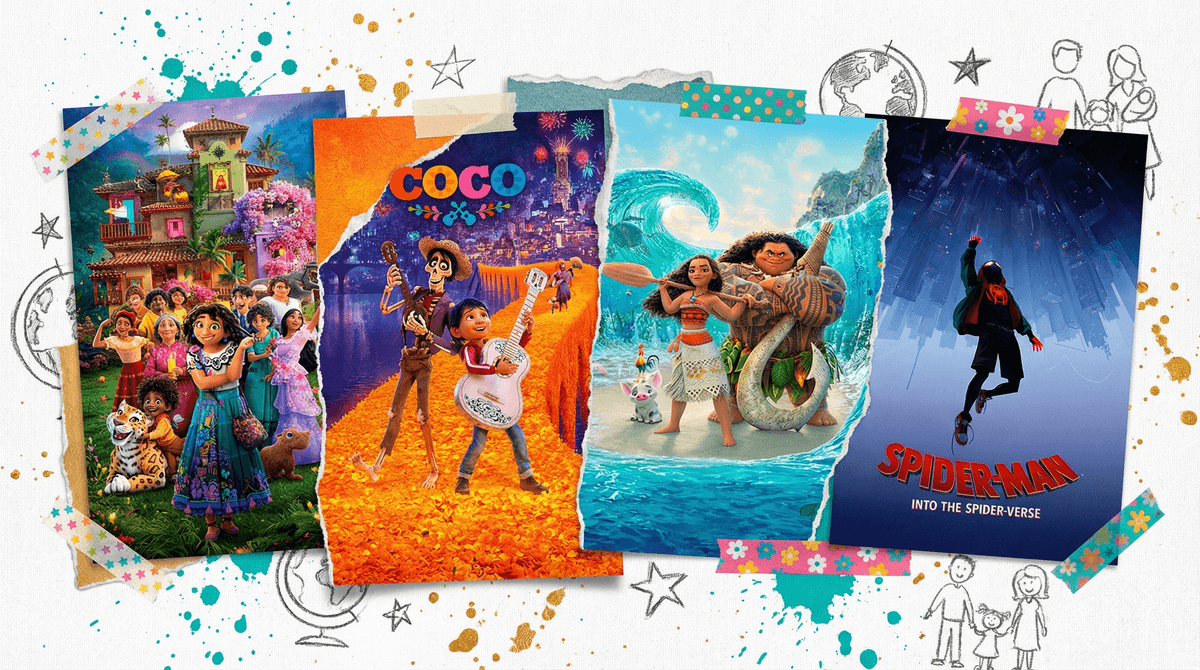
Look, we need to talk about representation in kids' movies. Not because it's trendy or because someone's going to judge your Netflix queue, but because the movies our kids watch are literally teaching them who gets to be the hero, who's allowed to be smart, who belongs in the story of the world.
And here's the thing: if every protagonist looks the same, talks the same, comes from the same kind of family? Kids absorb that. They learn that this is what "normal" looks like, what "main character" looks like. Everyone else is a sidekick, a villain, or just... not there.
This isn't about checking boxes or being performatively woke. This is about your kid developing empathy, seeing themselves reflected on screen, and understanding that the world is bigger and more interesting than one narrow slice of humanity.
For kids who see themselves: Representation is validation. When a kid sees a character who looks like them, has a family structure like theirs, speaks their language, or navigates their disability—it sends a message: You belong in this story. You can be brave, funny, smart, the hero.
Research consistently shows that kids who see positive representation of their identity develop stronger self-esteem and a clearer sense of belonging. It's not subtle—it matters.
For kids who don't: This is where it gets really interesting. When your kid watches Encanto or Coco or Turning Red, they're learning that Colombian families, Mexican traditions, and Chinese-Canadian experiences are normal. Not exotic. Not "other." Just... part of the world they live in.
Empathy is a learned skill. And stories—especially visual, emotional stories like movies—are one of the most powerful tools we have for teaching it. When kids see characters navigating challenges they'll never personally face, they build the neural pathways for understanding perspectives beyond their own.
Here's what's wild: for decades, the "default" protagonist in kids' movies was a white, able-bodied, straight kid (usually a boy) from a two-parent household. And that taught everyone something.
It taught white kids that they're the center of every story. It taught kids of color that they're supporting characters in someone else's narrative. It taught disabled kids that adventure isn't for them. It taught queer kids that their families don't exist in stories.
None of this was intentional or malicious—it was just... the water we were swimming in. But your kids are growing up in a different era, and they have access to stories that actually reflect the world they're living in. Stories where the protagonist uses a wheelchair (Finding Nemo with Nemo's "lucky fin"), where families have two dads (The Mitchells vs. The Machines), where being Black or brown or Asian isn't a plot point—it just is.
1. Representation ≠ Perfection
Not every diverse movie is going to be a masterpiece. Raya and the Last Dragon has some pacing issues. Wish was... fine. That's okay! The point isn't that every movie with diverse characters has to be flawless—it's that kids get to see a range of stories with a range of characters.
2. "I don't see color" isn't the goal
You'll hear people say "I just want my kids to see everyone as the same!" But that's not actually helpful. The goal isn't colorblindness—it's seeing and celebrating difference. When your kid watches Moana, they should notice that she's Polynesian, that the ocean is sacred in her culture, that her story is specific to her people. That specificity is what makes it beautiful.
3. Representation behind the camera matters too
Who's telling the story? Spider-Man: Into the Spider-Verse is incredible partly because it was created by people who understood Miles Morales's world. Elemental resonates because director Peter Sohn drew from his own immigrant experience. Authenticity shows up on screen.
4. Start early, keep going
Representation isn't a one-and-done conversation. It's baked into your family's media diet. Mix it up. Don't just watch "diverse" movies during heritage months. Make it normal to watch Soul, Luca, The Boy and the Heron, and Strange World alongside whatever else is in your rotation.
Ages 3-7: At this age, representation is absorbed more than discussed. They're noticing who looks like them, who looks like their friends, what kinds of families exist on screen. Focus on variety. Watch Doc McStuffins, Dora the Explorer, Bluey (which casually includes diverse families in the background).
Ages 8-12: Now they can start connecting the dots. After watching a movie, ask: "Did you notice anything about the characters? Who was the hero? What was their family like?" This is also the age where they might start noticing absence—"Why are all the princesses thin?" or "Why don't any characters look like my friend's family?"
Ages 13+: Teens can handle (and benefit from) more complex conversations about representation, stereotypes, and who gets to tell stories. They're also old enough to seek out diverse creators on YouTube, TikTok, and streaming platforms. Encourage it.
Diverse movies aren't a chore or a lesson plan—they're just better storytelling. They're more interesting, more authentic, more reflective of the actual world your kids are growing up in.
And here's the thing: if you're a parent who doesn't "see the big deal" because your kid has always seen themselves on screen? That's exactly why it matters. Your kid gets to grow up assuming they belong in every story. Every kid deserves that.
So yeah, queue up Encanto. Let your kids watch The Proud Family: Louder and Prouder. Check out Nimona. Not because you're trying to win a parenting award, but because you're raising a human who's going to live in a diverse world, and stories are how we learn to navigate it.
- Audit your queue: What does your family's watch list look like? If it's all one type of story, mix it up.
- Ask questions after movies: "What did you notice about the characters? Did anyone remind you of someone you know?"
- Follow diverse creators: On YouTube, TikTok, wherever your kids are watching. Representation isn't just in movies—it's everywhere.
- Check out our guide to inclusive family movies for age-specific recommendations that go beyond the Disney defaults.