

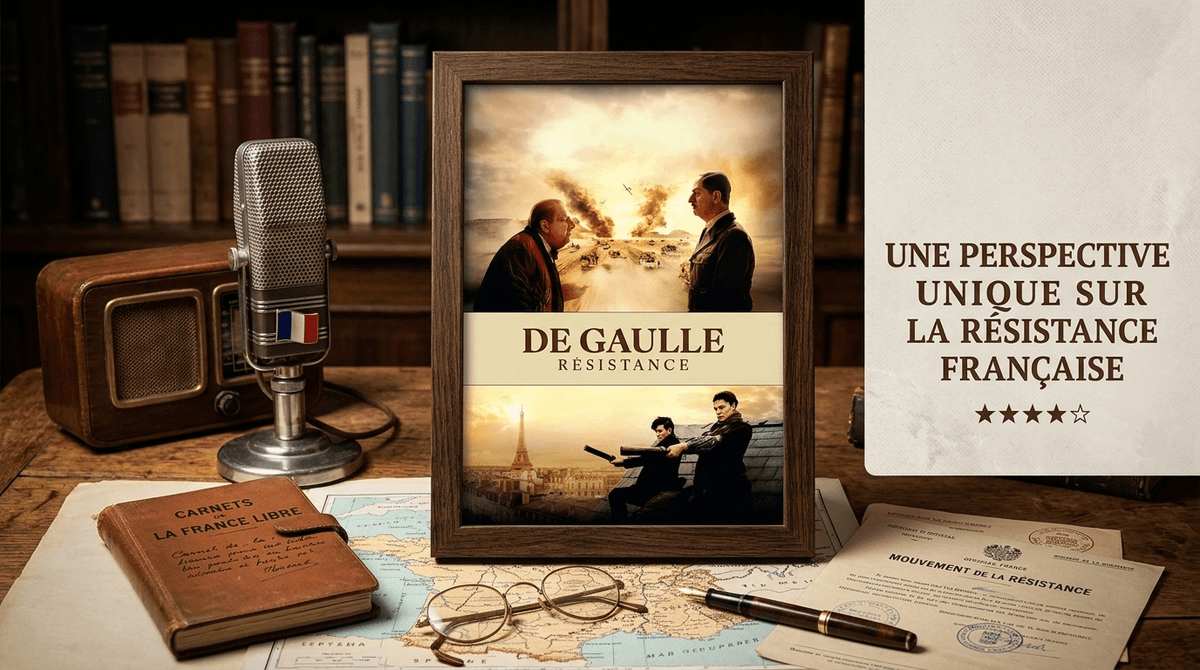
De Gaulle: Résistance is a sprawling, 160-minute wartime drama with desert battles, student protesters shot in the street, and a heavy execution scene near the end — making it a strong pick for teens around 13 and up who have the patience for subtitles and geopolitical tension, or 12-year-olds watching alongside a parent.
Directed by Antonin Baudry, De Gaulle: Résistance (originally titled La Bataille de Gaulle: L'Âge de fer) is the first half of a massive French two-part historical epic about General Charles de Gaulle fleeing to London in June 1940 to build the Free French Resistance. While unrated in the US (and carrying a 15 rating in the UK and a 12 in France and the Netherlands), it lands best for ages 13 to 16, or 12 with an adult on the couch. If your teen likes high-stakes wartime history with real political teeth, pair this with Darkest Hour or Christopher Nolan's Dunkirk.
Because the film is unrated in the US as of October 2026 (ahead of its December 4 US release date), international ratings give the clearest picture of the content: France and the Netherlands rate it 12+, while the UK's BBFC slapped both Part 1 and its sequel, De Gaulle: Liberté, with a strict 15 certificate.
The violence isn't wall-to-wall gore, which is why the French rating sits at 12, but the moments that do hit carry real historical weight. There are three specific sequences to have on your radar:
- An assassination and a firing squad near the end: This is the hardest sequence in the movie. A man is shot at point-blank range, followed shortly after by a young man executed by firing squad. The camera holds tight on the condemned man's face right up until the order to fire. You don't see the bullet impact, but you do see him afterward in a coffin with a bloodstained shirt.
- Parisian students under fire: A protest by young people in occupied Paris turns tragic when soldiers open fire into the crowd, leaving young protesters falling onto the cobblestones. For kids around the same age as the students on screen, this hits closer to home than standard battlefield action.
- War in the desert: A long desert battle features explosions, heavy gunfire, soldiers with bloodied faces, and a dying man on the ground. Wounds are visible, though the camera doesn't linger on gory close-ups.
Beyond the combat, characters smoke constantly (accurate to 1940s Europe), drink alcohol, and drop occasional curse words when tempers flare. There is also a romantic subplot between two young resistance fighters, Fernand (Florian Lesieur) and Livia (Anamaria Vartolomei), which sticks to kissing and romantic gestures.
A lot of World War II movies treat history like a museum exhibit where the outcome is already guaranteed. Baudry's film — adapted from historian Julian Jackson's biography A Certain Idea of France: The Life of Charles de Gaulle — plays more like a geopolitical thriller.
In June 1940, the French army collapses and signs the armistice with Nazi Germany. Brigadier General Charles de Gaulle (played with stiff, towering conviction by Simon Abkarian) is basically a nobody with no army, no backing, and zero leverage. He flies to London anyway, declared an enemy of the state by his own government, operating on the sheer, irrational belief that France hasn't finished fighting.
What keeps a two-hour-and-forty-minute bilingual movie moving for a teenager is the dynamic between Abkarian's de Gaulle and Simon Russell Beale's Winston Churchill. Instead of dry war-room lectures, their scenes play like a prickly, fiery wartime bromance. They argue, clash, and grate on each other, bringing actual humor to the political maneuvering while rebellious students, soldiers, and figures like Jean Moulin (Félix Kysyl) and Admiral Darlan (Mathieu Kassovitz) scramble in the background.
The real hurdle for a 12- or 13-year-old here isn't even the firing squad scene — it's the runtime and the historical density. The movie clocks in at 158 to 160 minutes, jumps between French and English (meaning subtitles are required), and drops you straight into the political chaos of September 1939 and June 1940 without holding your hand.
Before hitting play, spend two minutes setting the stage: explain that France surrendered in the summer of 1940, split into occupied zones and a collaborationist Vichy government, and that de Gaulle went to London with basically just a microphone and an attitude. Giving them that baseline keeps them from spending the first forty minutes wondering why French officials are trying to arrest a French general. You can also give a quick heads-up that there's a heavy execution scene toward the end.
After the credits roll, skip the pop-quiz history questions. The meat of the movie is psychological: What makes one person refuse to go along when literally everyone in authority says the fight is over? De Gaulle comes across as stubborn and borderline impossible to work with — ask your teen whether a reasonable, polite person could have pulled off what he did.
If De Gaulle: Résistance clicks, you have an easy follow-up in the second half of the diptych, De Gaulle: Liberté, which released in France a few weeks after Part 1 and carries the story through to the Liberation of Paris in 1944.
For other angles on the exact same summer of 1940, or stories about young people pushing back against fascism, try these:
If your teen loved Simon Russell Beale's scenes as Churchill, Gary Oldman's Oscar-winning turn covers the British side of those exact same weeks in May and June 1940, when Britain was debating whether to negotiate a peace treaty with Hitler or fight on alone.
For kids who want less political arguing in Whitehall corridors and more visceral survival on the ground, Christopher Nolan's PG-13 thriller covers the evacuation that happened right as France was collapsing. Almost no dialogue, maximum tension.
If the subplot with the young resistance fighters is what grabbed your kid, this YA historical novel about a young Scottish spy captured by the Gestapo in occupied France and her British pilot best friend is phenomenal — intense, brilliantly plotted, and unforgettable for readers 13 and up.
For more ideas tailored to your kid's exact age and interests, Build a WWII historical movie and book list for teens or browse our best movies for kids list.
Q: What age is De Gaulle: Résistance appropriate for?
Ages 13 and up on their own, or 12 and up watching with a parent. That lines up with the 12+ ratings in France and the Netherlands, while accounting for the intense execution scene near the end and the complex political history that makes more sense once kids have covered World War II in school.
Q: Why is De Gaulle: Résistance rated 15 in the UK?
The British Board of Film Classification (BBFC) gave both De Gaulle: Résistance and De Gaulle: Liberté a 15 certificate primarily due to realistic wartime violence, bloody battle injuries, a point-blank assassination, and an emotional firing-squad execution sequence.
Q: How long is De Gaulle: Résistance, and is it in English?
The film runs 160 minutes (2 hours and 40 minutes) and is bilingual, filmed in both French and English. Because much of the story takes place in London alongside Winston Churchill and Allied leaders, there is plenty of English dialogue, though you will still be reading subtitles for the French scenes.
Q: Do you need to watch De Gaulle: Liberté right after?
De Gaulle: Résistance tells a complete chapter of the story — establishing the fall of France and the birth of the Free French movement — so it works fine on its own, though it is Part 1 of a two-part epic. Part 2, De Gaulle: Liberté, picks up the fight and takes it through to the 1944 Liberation of Paris.
De Gaulle: Résistance treats teens like smart viewers who can handle subtitles, moral complexity, and the real human cost of refusing to surrender. Give a 12- or 13-year-old a quick two-sentence history primer before you start, watch it together, and check out our digital guide for middle school or our digital guide for high school for more picks that reward growing attention spans.