

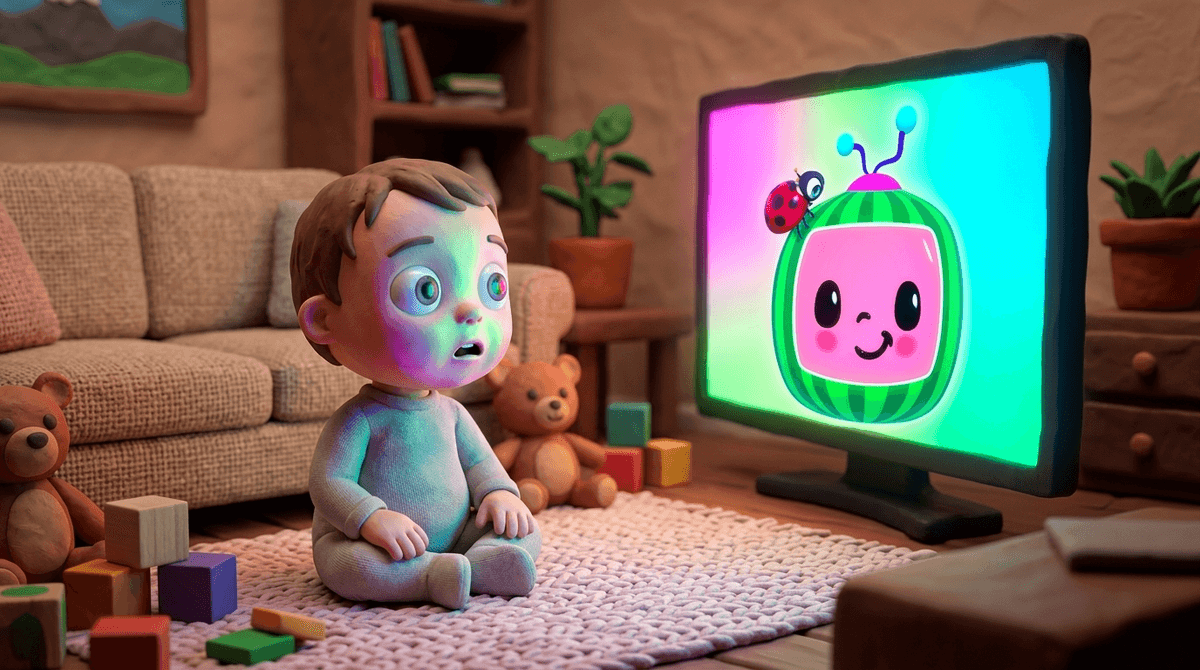
TL;DR: Cocomelon is effectively "digital candy"—engineered with fast cuts (every 1-3 seconds), bright colors, and repetitive loops that can overstimulate a toddler’s developing brain. This often leads to the "zombie stare" and epic meltdowns when the screen goes dark. If you're looking to lower the temperature in your living room, consider a "slow-media" diet with shows like Bluey, Puffin Rock, or Trash Truck.
Ask our chatbot for a personalized "slow-media" transition plan
If you have a toddler, you know the Cocomelon trance. You turn it on to clip their fingernails or finally drink a cup of coffee while it's still hot, and suddenly your child is a statue. They aren't just "watching" a show; they are locked in.
The "conundrum" is the trade-off. Cocomelon is incredibly effective at keeping a child still, but it comes with a heavy sensory price tag. Critics and child development experts point to the show's pacing as the primary culprit. While a classic like Mister Rogers' Neighborhood might hold a single shot for 10 or 20 seconds, Cocomelon frequently cuts to a new angle or scene every 1 to 3 seconds.
For a brain that is still learning how to process basic visual information, that's a relentless firehose of data.
It’s not a mystery why kids are obsessed. The show is designed using the same principles that make Vegas slot machines addictive:
- Constant Novelty: Every few seconds, something new happens. A camera pans, a character jumps, or the scene shifts. This triggers a tiny hit of dopamine in the brain.
- High-Frequency Audio: The songs are pitched at a level that is impossible for a human ear to ignore.
- Hyper-Saturation: The colors are brighter and more "neon" than anything found in the real world.
Essentially, it’s a sensory shortcut. It bypasses a child’s need to use their own imagination or focus and just does the work for them.
Recent research, including studies from 2024 and 2025, suggests that high-stimulation media during the "sensitive period" (ages 0-3) can have long-term effects.
- The "Zombie" Effect: When a child is overstimulated, they aren't engaging with the content; they are just reacting to the flashes. This is "passive" screen time at its most extreme.
- Behavioral Fallout: The biggest red flag for parents is the "Cocomelon Meltdown." Because the show provides such a high level of stimulation, when it’s turned off, the real world feels boring and "slow" by comparison. The brain experiences a literal dopamine crash.
- Executive Function: A famous 2011 study (and subsequent follow-ups) showed that just nine minutes of fast-paced programming can temporarily impair a child’s executive function—the skills they need for self-control and following directions.
Learn more about the science of toddler brain development and screens
If you’re ready to move away from the hyper-stimulation of Cocomelon or Blippi, you don't have to go cold turkey on screens. The goal is to switch to "slow media"—content with natural pacing, muted colors, and realistic physics.
Ages 2+ The gold standard. Bluey is fast-paced enough to be funny, but the shots are longer, the colors are natural, and it focuses on imaginative play. It’s a show that actually gives kids ideas for what to do after the TV is turned off.
Ages 2+ This is the ultimate "chill" show. The animation is gorgeous and hand-drawn, the narrator is soothing, and the stories are about nature and family. It’s the visual equivalent of a warm blanket.
Ages 2+ A sweet, slow-paced show about a boy and his best friend (who happens to be a trash truck). It captures the quiet, observational wonder of being a toddler without the frantic energy of YouTube-first content.
Ages 3+ Stop-motion animation is naturally "slower" than CGI. Tumble Leaf encourages scientific thinking and problem-solving in a world that feels tactile and real.
Ages 2+ The spiritual successor to Mister Rogers. It’s repetitive in a good way—using "strategy songs" to help kids manage big emotions like anger or disappointment.
Ages 2+ A 90s classic that still holds up. The music is classical, the stories are simple, and there are zero "jump scares" or flashy transitions.
You can't just swap Cocomelon for a nature documentary and expect your toddler to be cool with it. They are essentially "coming down" from a high-stimulant environment.
- Use "Bridge" Shows: Move to something like Bluey or Trash Truck first. They have enough humor and energy to keep them interested but lack the "crack-like" pacing of Moonbug shows.
- The "One More" Rule: Always give a 5-minute and 1-minute warning. For toddlers, use visual cues: "When this episode is over, the TV goes to sleep."
- Active vs. Passive: If you need 15 minutes of peace, try an interactive app like Khan Academy Kids. Because they have to touch the screen and solve problems, their brain stays in an "active" state rather than sliding into a passive trance.
- Audio Only: Try switching to a podcast or a Yoto Player. Kids often just want the "noise" and the story. Wow in the World or Circle Round are great for this.
There is a lot of guilt in the parenting world about screen time. Let’s be clear: using Cocomelon to survive a long flight or a stomach flu does not make you a bad parent.
The concern is the "default" state. If Cocomelon is the background noise of your life, your child’s brain is being conditioned to expect a level of stimulation that the real world (and school) simply cannot provide.
Check out our guide on "Low-Stimulation" vs "High-Stimulation" content
Cocomelon is unwatchable for most adults for a reason—it’s sensory overload. If you notice your child becoming aggressive, "spaced out," or unable to play with blocks after watching, it’s time to audit the digital diet.
You don't have to be a "No Screens" family to be a Screenwise family. You just have to be the one choosing the pace, rather than letting an algorithm do it for you.
- Audit your TV: Watch three minutes of Cocomelon and count the camera cuts. Then do the same with Puffin Rock. The difference will shock you.
- Set a "Slow Sunday": Try a day where only "slow media" or physical board games are allowed.
- Talk about it: Even with a 3-year-old, you can say, "That show makes our brains feel too buzzy. Let's watch something that makes us feel calm."
Ask our chatbot for more age-appropriate show recommendations