

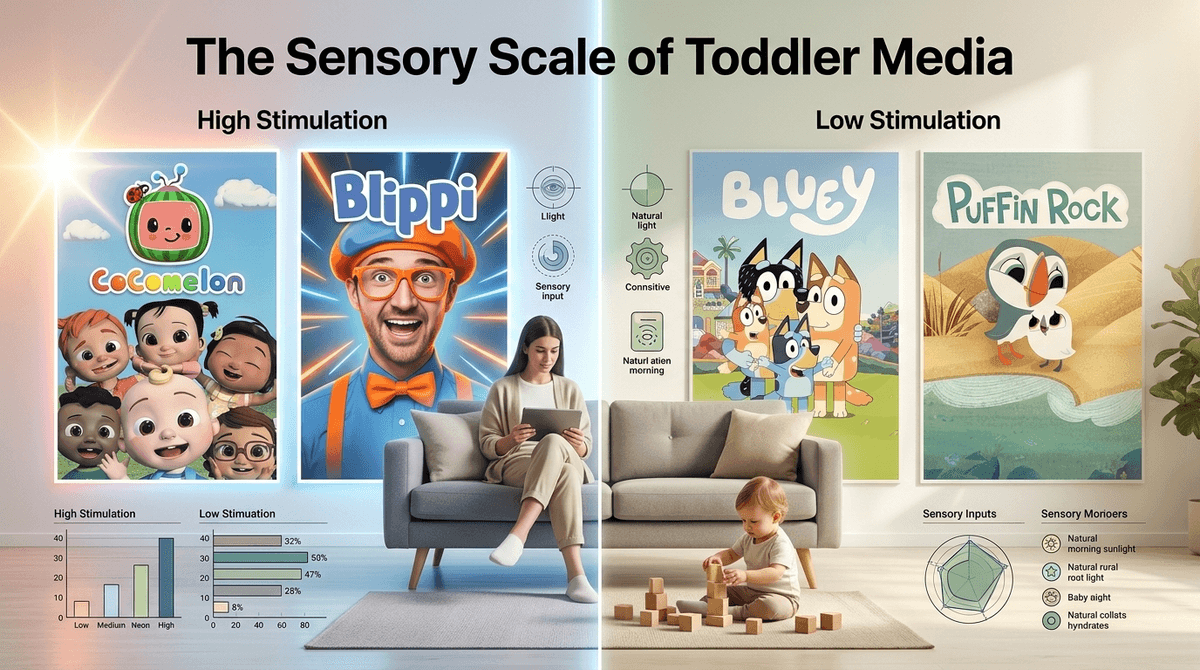
TL;DR: High-stimulation shows like Cocomelon use rapid-fire scene changes (every 1-3 seconds) to keep toddler brains in a constant "dopamine loop." This makes it hard for them to look away and even harder to transition back to the real, "slow" world without a meltdown. To keep the peace, aim for "low-stimulation" alternatives like Bluey, Puffin Rock, or Trash Truck.
If you’ve ever watched a toddler stare at Cocomelon or Blippi, you’ve seen the "trance." They aren't just enjoying a story; they are physically locked in. This is often called the "Cocomelon Effect," and it’s less about the catchy nursery rhymes and more about the pace of the editing.
In the world of child development, we talk about the "blink test." If you watch a show and count the seconds between camera cuts, most high-stim content features a scene change every 1 to 3 seconds. For a developing brain, this acts like a constant "ping" of novelty. Each new cut triggers a hit of dopamine. When the show finally ends, the real world—which does not change scenes every two seconds—feels incredibly boring and frustrating by comparison. That’s where the legendary "screen time tantrums" come from.
Learn more about the science of digital dopamine in kids
It’s not a mystery why these shows are the most-watched content on Earth. They are engineered to be un-pausable.
- Visual Saturation: The colors are dialed up to 11. Everything is bright, neon, and high-contrast.
- Audio Cues: The music is constant, high-pitched, and repetitive. There is very little "dead air" or silence.
- The Algorithm Loop: On platforms like YouTube Kids, the autoplay feature ensures that as soon as one high-energy song ends, another begins, never giving the child's nervous system a chance to reset.
While these shows are marketed as educational, the reality is that the brain is often too busy processing the sensory input to actually absorb the "lesson" about colors or numbers. It’s the digital equivalent of a sugar rush.
Not all screen time is created equal. If you need 20 minutes to cook dinner or take a shower, you don't have to feel guilty—you just need to choose content that won't leave your kid in a heap on the floor when you turn it off.
High-Stimulation (The "Digital Candy")
These are the shows most likely to cause "zombie mode" and post-watch meltdowns. Use these sparingly, if at all.
- The gold standard of high-stim. Rapid cuts, bright colors, and constant noise.
- High energy, loud vocalizations, and fast-paced editing. It’s a lot for a little nervous system.
- Specifically designed to be addictive through repetition and high-contrast animation.
Medium-Stimulation (The "Balanced Meal")
These have faster moments but generally include more human interaction or slower narrative beats.
- While it has some quick cuts, Ms. Rachel uses "motherese" (slow, melodic speech) and pauses for the child to respond, which is great for language development.
- The classic. It has transitioned to a faster pace over the years, but it still prioritizes social-emotional learning and human/muppet interaction over pure sensory overload.
Low-Stimulation (The "Gold Standard")
These shows use a "natural" pace. The camera stays on a scene for 5-10 seconds or more. The colors are muted/natural, and the stories are gentle.
- The GOAT of modern kids' TV. It’s funny for parents, but the pacing is respectful of a child’s attention span. It focuses on play rather than flashing lights.
- Narrated by Chris O'Dowd, this show is the ultimate "chill" vibe. Beautiful Irish landscapes, gentle stories, and a very slow pace.
- A sweet, slow-paced show about a boy and his best friend (who happens to be a garbage truck). Very low-stress.
- An older show, but still one of the best for low-stimulation. No frantic music, just gentle adventures.
Check out our full guide on the best low-stimulation shows for toddlers
The American Academy of Pediatrics (AAP) generally recommends no screen time (aside from video chatting) for children under 18-24 months.
By age 2, the recommendation is no more than one hour per day of "high-quality programming" watched with a parent. The "watched with" part is key—co-viewing helps kids translate what they see on the screen into the real world.
If you have a 3 or 4-year-old who is used to the high-intensity world of Cocomelon, switching to Bluey might result in them saying "this is boring." That’s actually a sign that their "dopamine baseline" has been set too high. It takes a few days of a "digital detox" to reset their expectations.
The hardest part of baby sensory content isn't the show itself; it's the ending. When you go from 100mph sensory input to 0mph (the living room floor), the brain rebels.
To manage this, try the "Transition Bridge":
- The 5-Minute Warning: Even if they don't fully understand time, the verbal cue helps.
- The Narrative Bridge: Ask them a question about the show as you turn it off. "What color was the bus?" This moves their brain from "passive consumption" to "active thinking."
- The Physical Reset: Immediately move to a different sensory activity—bubbles, a snack, or going outside. This helps "drain" the leftover stimulation.
Cocomelon isn't "evil," and you aren't a bad parent if it's the only thing that lets you clip your kid's fingernails in peace. But if you're noticing that your toddler is increasingly irritable, has trouble playing independently, or throws massive fits when the TV goes off, the type of content is likely the culprit.
Moving toward "slow media" like Puffin Rock or Little Bear is one of the easiest ways to protect your child's developing attention span and your own sanity.
- Audit the Queue: Take a look at your YouTube Kids or Netflix history. How many "high-stim" shows are in the mix?
- Try the 3-Day Switch: Replace all high-stim content with low-stim alternatives for three days and watch the difference in behavior.
- Use Screenwise: If you aren't sure where a show falls on the sensory scale, Get an analysis of a specific show's pacing.