

TL;DR
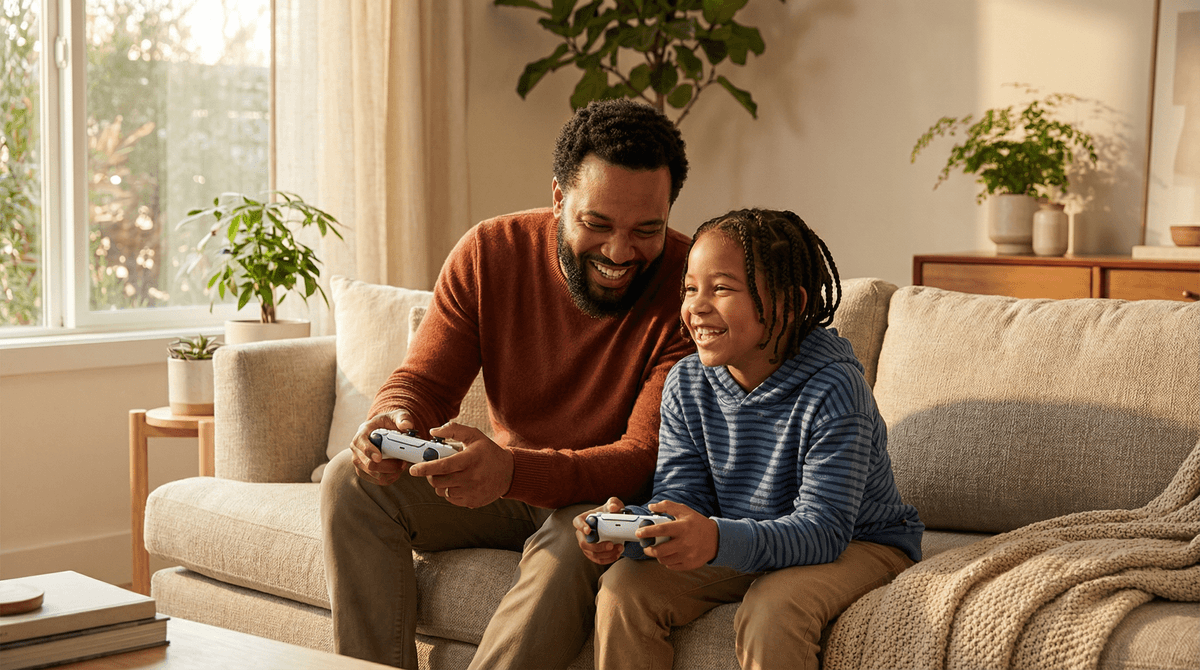
Co-playing isn't about becoming an e-sports pro; it’s about entering your child’s digital world so you aren't just a "policeman" of their screen time, but a participant in their play. It builds massive trust, teaches sportsmanship, and helps you spot red flags before they become "Ohio-level" problems. Top Recommendations for Co-Playing:
- Ages 5-8: Super Mario Odyssey (The "Cappy" mode is a lifesaver for beginners)
- Ages 8-12: Minecraft (Build a world together, literally)
- Ages 10+: It Takes Two (The gold standard for cooperative play)
- Quick & Casual: Heads Up! or Uno
Ask our chatbot for a personalized co-playing recommendation based on your kid's interests
We’ve all been there: you’re making dinner, and your kid is shouting something about a "Skibidi" toilet or how their Roblox avatar just got "scammed." You nod, you smile, and you secretly count the minutes until the iPad goes in the drawer.
Co-playing is the intentional choice to stop being a spectator and start being a teammate. It’s sitting down, picking up the second controller (or the second tablet), and actually engaging with the mechanics of what they’re doing. It’s moving from "How much longer are you going to be on that?" to "Wait, how did you craft that diamond sword?"
Most of our digital parenting is reactive. We set time limits, we block apps, and we yell when it’s time to get off. This creates a dynamic where the "screen" is the prize and the parent is the obstacle.
When you co-play, you flip the script. You’re showing them that you value their interests. Research shows that parents who engage in "joint media engagement" (the academic term for co-playing) have kids who are more likely to come to them when they encounter something weird or scary online. If you know how Fortnite works because you’ve played it with them, they don’t have to spend twenty minutes explaining the basics when a stranger tries to chat with them—they can just tell you what happened.
Super Mario Odyssey (Ages 5+)
This is the ultimate entry point. In the two-player mode, one person plays as Mario (the hard part) and the other plays as Cappy, Mario's hat. Cappy is invincible and can fly around to collect coins or hit enemies. It’s perfect for a parent who wants to help their kid navigate the level without the frustration of "dying" every five seconds. It’s pure, polished Nintendo magic.
Minecraft (Ages 7+)
If your kid is in elementary school, Minecraft is their town square. Playing together in "Creative Mode" is basically like playing with a never-ending bucket of digital Legos. You can build a house together, farm some sheep, and talk about digital boundaries while you're at it. If you want to understand why they’re obsessed, read our guide to Minecraft for parents.
It Takes Two (Ages 10+)
I’m going to be blunt: this is one of the best games ever made, period. It requires two people to play. The story is a bit heavy—it’s about a couple going through a divorce who get turned into dolls—but the gameplay is a masterclass in cooperation. You literally cannot progress unless you work together. It’s a fantastic way to teach communication and patience.
Stardew Valley (Ages 8+)
If you want something low-stress, this is it. You run a farm together. You plant parsnips, you fish, you talk to the townspeople. It’s the digital equivalent of a rainy Sunday afternoon. It’s "cozy gaming" at its finest, and it’s a great way to bond without the adrenaline of a shooter.
Rocket League (Ages 8+)
It’s soccer, but with cars. It’s fast, it’s loud, and it’s actually really hard to master. Playing on a team with your kid against other people (or just against bots) is a great lesson in handling frustration. When you miss an easy goal and lose the match, it’s a "teachable moment" for how to not be a sore loser—or a sore winner.
We have to talk about Roblox. It’s the most requested game for kids in the 6-12 range, and it’s also the most confusing for parents.
Is it teaching them game design? Sometimes. Is it a gambling simulator designed to drain your bank account of Robux? Also sometimes.
When you co-play Roblox, you start to see the "dark patterns"—the ways the game tries to pressure kids into spending money. You can have a real conversation about why that "limited edition" pet isn't worth $20 of real-world money. Without co-playing, you’re just the person saying "No" to the credit card request. With co-playing, you’re the mentor helping them navigate a digital economy.
- Under 6: Stick to "spectator play." Sit with them while they play Toca Life World or PBS Kids. Ask them to tell you a story about what’s happening on the screen.
- Ages 6-9: This is the sweet spot for collaborative games. Focus on "sandbox" experiences like Minecraft or Animal Crossing: New Horizons.
- Ages 10-13: They might start wanting to play more competitive games like Fortnite or Among Us. Co-playing here is vital for monitoring the "vibe" of the online community and teaching them how to use the "mute" button.
Let’s be real: some of the stuff your kids like is objectively terrible. Some YouTube channels are just loud people screaming at a camera, and some games are just poorly made clones of better games.
You don't have to pretend to love "Skibidi Toilet." You can tell your kid, "Hey, I don't really get this, but I'll watch one video with you if you explain why it's funny." That honesty is better than fake enthusiasm.
Also, watch the monetization. Many "free" apps like Duolingo are great, but others are essentially digital casinos. If a game is constantly asking for money to "level up," that's a red flag you'll only catch if you're looking at the screen with them.
Instead of "Are you done yet?", try these:
- "What’s the goal of this level?"
- "How did you learn how to do that?"
- "Who are you playing with right now? Do we know them in real life?"
- "That part looked really frustrating. How do you stay calm when you lose?"
Co-playing isn't another chore to add to your list. It’s a shortcut. It’s the fastest way to understand the digital landscape your child is growing up in. You don’t need to be "good" at the game—in fact, letting your kid be the "expert" who teaches you how to play is a massive boost to their confidence.
Stop watching the clock and start joining the quest. You might actually have a little fun.
- This Weekend: Pick one game from the list above and ask your kid to teach you how to play for 30 minutes.
- Set a Boundary: Tell them, "I'll play Minecraft with you for 30 minutes, and then we're both putting our screens away for dinner."
- Get Educated: Check out our guide on setting up Nintendo Switch parental controls so you can play safely.
Ask our chatbot about age-appropriate alternatives to Fortnite