

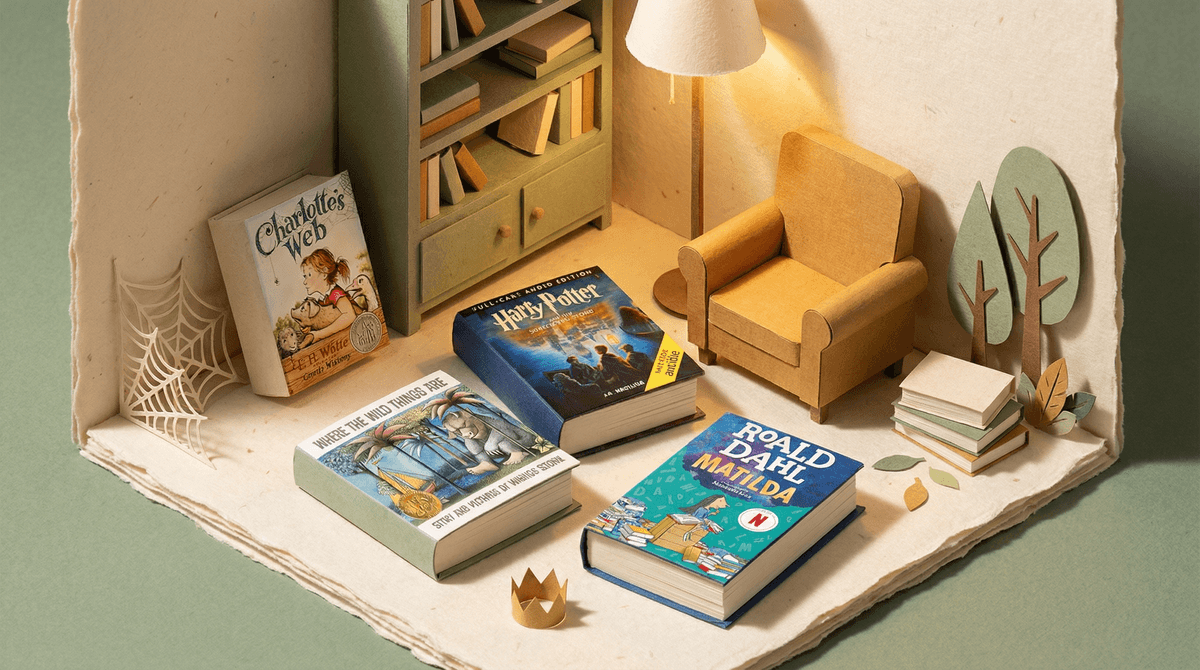
Look, we're talking about the books that have survived multiple generations for a reason. Charlotte's Web, Matilda, The Secret Garden, Where the Wild Things Are, Bridge to Terabithia — these aren't just books your parents read. They're books that kids still actually want to read, which in 2026 when competing with YouTube and Roblox is saying something.
Classic books are the analog antidote to algorithmic content. They have beginnings, middles, and ends. They require sustained attention. They don't have autoplay. And here's the thing that matters most: they create shared cultural touchstones that transcend screens.
Yes, reading builds vocabulary and empathy and all that. But classic books do something specific that's increasingly rare in digital spaces: they give kids a shared language that isn't tied to a platform or trend.
When your kid reads Harry Potter, they're joining a conversation that spans decades and doesn't require WiFi. When they finish The Giver, they can talk about it with their teacher, their cousin, and yes, even you — without needing to explain what a Skibidi Toilet is.
Classic books also model something kids desperately need to see: stories that were worth preserving. Not everything needs to be consumed and discarded in 60 seconds. Some things are worth returning to. Some stories get better with rereading.
And let's be real: classic books give you an easy conversation starter that isn't about screen time. "What chapter are you on?" beats "How many hours have you been on that?" every single time.
Ages 4-7:
- Where the Wild Things Are — Still perfect for processing big emotions
- The Giving Tree — Yes, it's kind of depressing, but kids love it
- Corduroy — A bear in overalls never gets old
- Frog and Toad — Friendship goals before that was even a thing
Ages 8-10:
- Charlotte's Web — Death, friendship, and a spider who can spell. It hits different.
- Matilda — For every kid who's ever felt smarter than the adults around them
- The Lion, the Witch and the Wardrobe — Fantasy that predates every video game your kid plays
- Holes — Somehow makes digging holes compelling
Ages 11-14:
- The Giver — Dystopia before every YA novel was dystopian
- A Wrinkle in Time — Sci-fi that's actually about family
- Bridge to Terabithia — Fair warning: this one will wreck you both
- The Outsiders — Written by a teenager, still resonates with teenagers
These books aren't all sunshine: Many classics deal with heavy themes — death, loss, injustice, war. Charlotte's Web literally opens with a kid trying to stop her dad from killing a pig. Bridge to Terabithia has one of the most devastating plot twists in children's literature. This isn't a bug, it's a feature. Kids need to process difficult emotions in safe contexts, and classic books provide that.
Some classics have aged poorly: Be prepared for outdated language and attitudes in older books. The Secret Garden has some colonial nonsense. Many classics lack diversity. This doesn't mean you skip them — it means you talk about them. "This book was written in 1911. What's different about how people talked then?" is a perfectly good conversation.
Physical books hit different: Yes, Kindle is convenient. But there's something about a physical book that makes it feel more real to kids. They can see their progress. They can leave it on their nightstand. They can lend it to a friend. Consider building an actual bookshelf, not just a digital library.
Read-alouds still work for older kids: Don't assume your 10-year-old is too old to be read to. Many families successfully do chapter books together well into middle school. It's 20 minutes of guaranteed screen-free connection, and you can tackle books slightly above their reading level.
Make it visible: Keep books in common spaces, not just bedrooms. A basket of books near the couch beats a bookshelf in a bedroom they barely use.
Model it: Kids who see adults reading read more. Full stop. Put your phone down and pick up a book where they can see you.
Don't make it homework: The fastest way to kill reading is to require a book report. Let them read for pleasure. Let them abandon books they don't like. Let them reread favorites 47 times.
Connect books to their interests: Kid obsessed with Minecraft? Try Hatchet for survival vibes. Into fantasy games? Percy Jackson is the gateway drug.
Use audiobooks strategically: Some kids process stories better by ear. Audiobooks during car rides or before bed count as reading. Purists can fight me.
Classic books aren't magic, and they won't single-handedly fix your family's screen habits. But they offer something increasingly rare: stories that require patience, reward attention, and create connections that outlast the latest app.
Your kid might not thank you now for putting Anne of Green Gables on their nightstand instead of letting them doomscroll TikTok. But ten years from now, when they reference Charlotte's "Some Pig" in a conversation or realize they've been thinking about The Giver's ending for years, they'll get it.
Plus, when your kid inevitably asks "Why is everything so weird?" you can hand them Alice in Wonderland and say "People have been asking that for 160 years."
Start with one book. Put it somewhere visible. Read it yourself if you haven't in years (you'll be surprised what you notice as an adult). Then leave it out and see what happens.
Need more recommendations? Check out our guide to building a family reading habit or explore alternatives to endless scrolling.