

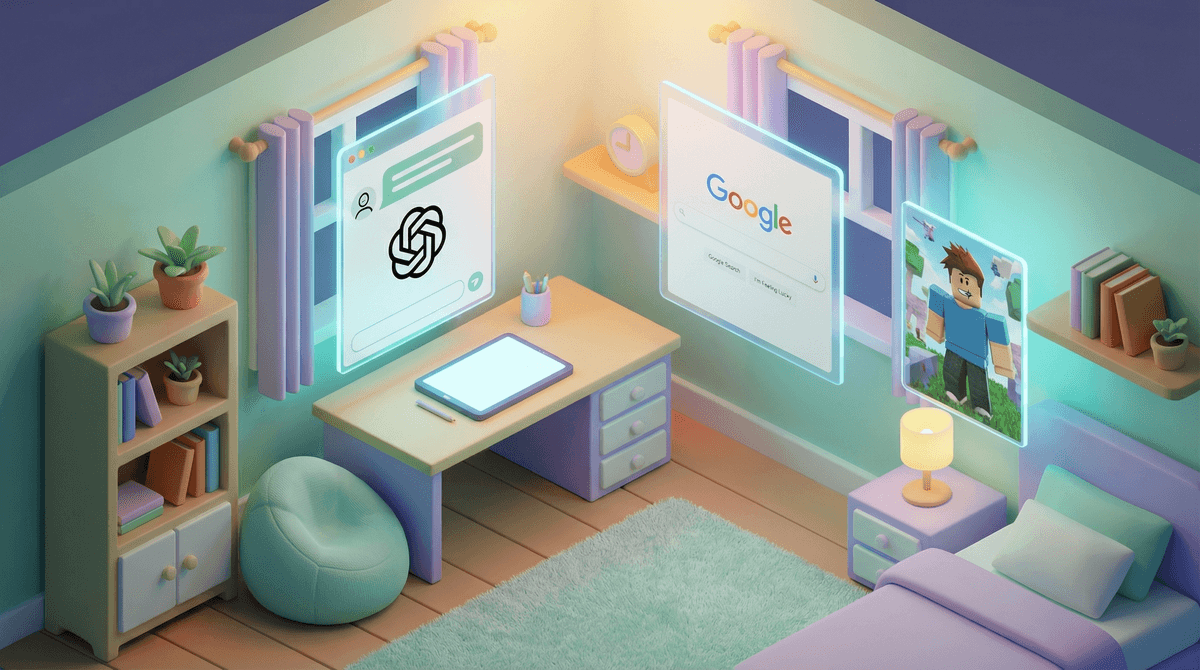
ChatGPT for Tweens: What Parents Need to Know About AI in Your Kid's Life
Look, I get it. You're still trying to figure out if your kid's Roblox obsession is a problem, and now they're asking about ChatGPT like it's the most natural thing in the world. Welcome to 2025, where your 10-year-old wants access to artificial intelligence the same way you wanted a calculator for math homework.
But here's the thing: ChatGPT isn't just another app. It's fundamentally different from social media or games, and honestly? That's both exciting and a little terrifying.
ChatGPT is an AI chatbot created by OpenAI that can have conversations, answer questions, write essays, help with homework, generate creative stories, explain complex topics, and basically act like an incredibly knowledgeable (if sometimes confidently wrong) digital assistant.
Think of it as Google search had a baby with a tutor who never gets tired of answering "why?" over and over again. Kids can type in questions or prompts and get detailed, conversational responses. They can ask it to explain photosynthesis, write a story about a dragon who's afraid of fire, or help brainstorm ideas for their science fair project.
The free version (ChatGPT 3.5) is available to anyone 13+, though let's be real – plenty of tweens are using it with or without accounts. ChatGPT Plus ($20/month) offers the more advanced GPT-4 model with better reasoning and fewer mistakes.
Your tween isn't asking about ChatGPT because they suddenly became passionate about artificial intelligence ethics. They love it because:
It never judges them. Ask a "dumb" question? ChatGPT won't roll its eyes like their older sibling. Need something explained five different ways? It's got infinite patience.
It feels like having a superpower. Seriously, imagine being 11 and having access to something that can help you understand literally any topic, write in any style, or answer questions your parents might not know. That's pretty cool.
Everyone's talking about it. Just like Roblox or whatever the latest viral game is, kids hear about ChatGPT from friends, YouTubers, and older siblings. FOMO is real, even with AI tools.
It actually helps with homework. And before you panic – that's not automatically a bad thing. We'll get into the nuances below.
Let's address what you're really worried about: Is my kid going to use this to cheat?
Short answer: Maybe. Probably. At least once.
Longer answer: The line between "helpful tool" and "doing the work for them" is blurry as hell, and we're all figuring this out in real-time. Teachers are struggling with this too. Some schools have banned it entirely. Others are teaching kids how to use it responsibly. Most are somewhere in the confused middle.
Here's what I've learned talking to parents and educators:
The "cheating" conversation is more nuanced than we think. If your kid asks ChatGPT to "write my essay about The Giver," that's cheating. If they ask it to "explain the main themes in The Giver so I can understand them better," that's... studying? If they write a draft and ask ChatGPT for feedback, that's... editing help?
Your family needs to define these lines together. What feels right will depend on your kid's age, their school's policies, and your own values around learning and effort.
Ages 8-10: Honestly, most kids this age don't need independent ChatGPT access. If they're curious, explore it together. Use it for fun stuff – having it write silly stories, explain how volcanoes work, or answer their endless questions about space. Think of it as a digital encyclopedia that talks back, and keep it supervised.
Ages 11-13: This is peak curiosity age, and they're probably already using it at a friend's house or school. Now's the time to teach responsible use before they develop bad habits. Have them show you what they're using it for. Talk about when it's helpful (brainstorming, understanding concepts, learning new things) versus when it's crossing a line (copying answers, letting it do their thinking).
Ages 13+: They can technically have their own account now. Set clear expectations about homework use based on their school's policies. Talk about academic integrity the same way you'd talk about copying from a friend's paper.
The good news: ChatGPT isn't social media. There's no comment section, no DMs from strangers, no addictive algorithm trying to keep them scrolling. It's a tool, not a platform.
The concerns:
It's not always accurate. ChatGPT can be confidently wrong. Like, really confidently wrong. Your kid needs to understand that it's not infallible. Cross-checking information matters.
Privacy matters. Anything typed into ChatGPT becomes part of its training data (unless you turn off chat history in settings). Teach kids not to share personal information – full names, addresses, school names, etc.
It can generate inappropriate content. While OpenAI has guardrails, they're not perfect. A determined kid can sometimes get around them. This is less about ChatGPT being dangerous and more about the general internet reality that filters aren't foolproof.
The cheating temptation is real. Especially when they're tired, overwhelmed, or just don't want to do the work. Having access to something that can instantly complete assignments requires serious self-regulation.
Your kid's school probably has a policy. Ask about it. Some schools require disclosure when AI tools are used. Some ban them entirely. Some are actively teaching kids how to use them. You need to know where your school stands.
AI literacy is becoming as important as digital literacy. Just like we taught kids to evaluate websites and not believe everything on social media, we now need to teach them to use AI tools critically. This skill will matter for their entire lives.
It's not going away. Even if you ban ChatGPT specifically, AI is being built into everything – Google, Microsoft Office, educational apps. Teaching responsible use is more realistic than prohibition.
It can actually be educational. Used well, ChatGPT can be an incredible learning tool. It can explain concepts in different ways, provide examples, help with brainstorming, and support learning differences. Some kids who struggle with traditional learning methods genuinely benefit from having an endlessly patient AI tutor.
Skip the lecture. Start with curiosity: "I keep hearing about ChatGPT. Have you used it? Show me."
Then share your thinking: "I can see how this would be helpful for understanding tough concepts, but I'm wondering where the line is between help and doing the work for you. What do you think?"
Set clear boundaries together:
- What's okay to use it for?
- What counts as cheating?
- When do they need to tell teachers they used AI?
- How do we make sure they're actually learning?
Make it an ongoing conversation, not a one-time talk. As they use it more, check in about what's working and what feels like it's crossing lines.
ChatGPT isn't inherently good or bad – it's a powerful tool that can be used well or poorly. Kind of like how YouTube can be educational content or hours of brain-melting nonsense, depending on how it's used.
The goal isn't to prevent your tween from ever using AI. That ship has sailed. The goal is to teach them to use it thoughtfully, ethically, and in ways that actually support their learning rather than replace it.
Will they sometimes use it to take shortcuts? Probably. Did we sometimes copy homework from friends or use SparkNotes? Also probably. The difference is we need to help them understand that over-relying on AI doesn't just risk getting caught – it risks not developing their own thinking skills.
-
Ask your kid if they've used ChatGPT and actually listen to their answer without immediately panicking.
-
Check your school's AI policy so you know what the official rules are.
-
Explore it together for something fun or educational. See how it works, where it's helpful, and where it falls short.
-
Set family guidelines about when AI tools are okay to use and when they're not.
-
Keep talking about it. This isn't a "set it and forget it" conversation. AI is evolving fast, and so is your kid's relationship with it.
And hey, if you're feeling overwhelmed by all of this, you're not alone. We're all figuring out how to parent in the age of AI together. No one has this perfectly figured out, and that's okay.
The fact that you're reading this and thinking critically about it? That already puts you ahead of the curve.