

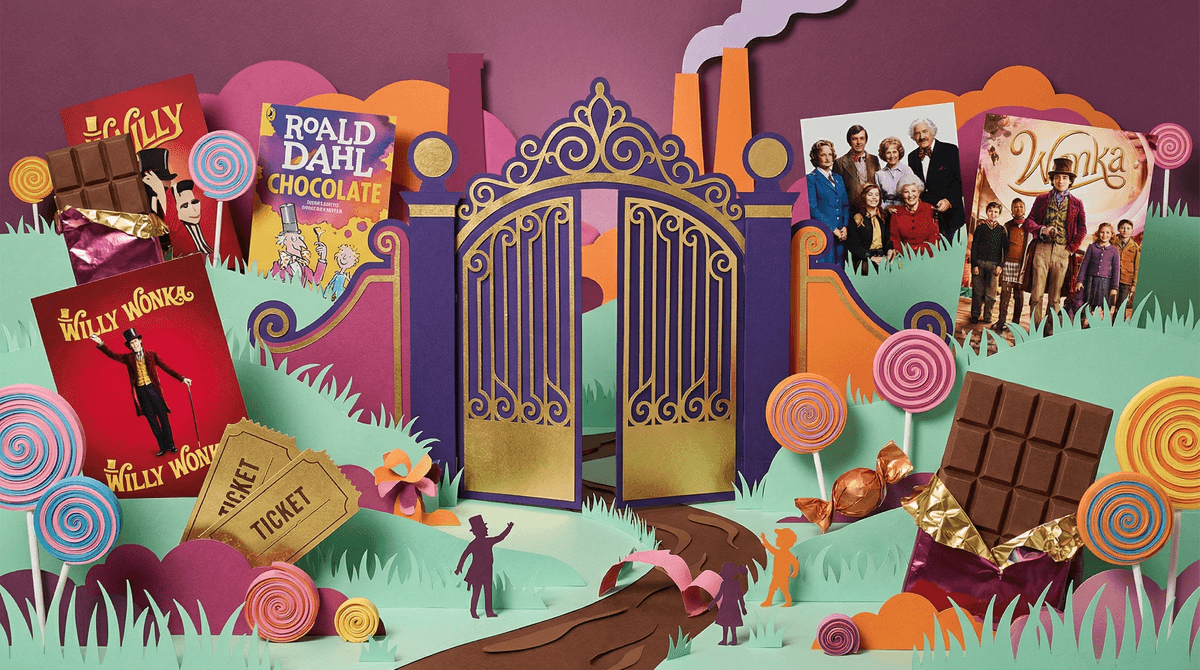
Charlie and the Chocolate Factory is Roald Dahl's 1964 novel about a poor boy who wins a golden ticket to tour the mysterious factory of eccentric chocolatier Willy Wonka. Along with four other children—each representing a different childhood vice—Charlie witnesses his fellow winners getting picked off one by one as their character flaws lead to increasingly bizarre consequences.
The story has been adapted multiple times, most notably in the 1971 film Willy Wonka & the Chocolate Factory and Tim Burton's 2005 Charlie and the Chocolate Factory, plus a recent musical adaptation on Netflix. And yes, there's a prequel called Wonka that came out in 2023.
Here's what makes this 60-year-old story weirdly relevant for today's parents: it's basically a morality tale about entitlement, instant gratification, and what happens when kids don't hear "no."
The four kids who lose out aren't villains—they're just spoiled, screen-addicted, gum-chewing, or gluttonous. Sound familiar? Augustus Glotz literally cannot stop consuming. Veruca Salt's parents buy her everything she demands. Mike Teavee is obsessed with screens (television in the book, but the metaphor translates perfectly to today's YouTube and TikTok binges). Violet Beauregarde is hyper-competitive and achievement-obsessed.
Meanwhile, Charlie—who has nothing—practices patience, gratitude, and self-control. And he's the one who wins everything.
The story taps into every parent's anxiety about raising kids in a world of abundance and instant everything. Are we creating little Augustus Glotzs every time we hand over the iPad to stop a tantrum? Are we Veruca Salt's parents when we cave on Roblox purchases? You can explore more about the psychology of digital rewards and entitlement .
.
Ages 5-7: The original book can be a bit dark (kids literally disappear into machinery), but many families start here. The 1971 film is gentler than the 2005 version. Be prepared for questions about why the Oompa-Loompas sing mean songs about the kids.
Ages 8-10: Prime age for both book and films. Kids can understand the morality tale aspects and will definitely have opinions about which kid is the worst. Great for discussing consequences and choices.
Ages 11+: Older kids can appreciate the satire and social commentary. They might also notice some problematic elements (the original depiction of Oompa-Loompas, the fat-shaming of Augustus) that are worth discussing. This is actually a great entry point for media literacy conversations.
The uncomfortable parts: Roald Dahl was brilliant but also wrote in a different era. The original Oompa-Loompas were African pygmies (changed to fictional Loompaland in later editions). Augustus Glotz is fat-shamed relentlessly. Violet's transformation is body horror for kids. The whole premise involves children being physically harmed as punishment.
These aren't reasons to avoid the story—they're opportunities for conversation about how stories reflect their time period and how we can enjoy classic literature while thinking critically about it.
The scarcity vs. abundance tension: Charlie's poverty is romanticized in ways that might feel uncomfortable. He's rewarded for being grateful for his meager circumstances, while the wealthy kids are punished for wanting more. In real life, poverty isn't noble and kids shouldn't have to earn basic dignity through perfect behavior. But the core message about gratitude and self-control still lands.
The "good kid" pressure: Some parents worry the story puts too much pressure on kids to be perfectly behaved. Charlie is almost unrealistically good. It's worth emphasizing that the other kids aren't bad—they just made bad choices in that moment. Learn more about helping kids understand mistakes vs. character.
Here's where Charlie and the Chocolate Factory becomes genuinely useful for modern digital parenting:
When discussing screen time limits: "Remember Mike Teavee? He was so obsessed with TV he couldn't see anything else. That's why we have limits—not to punish you, but to help you experience other stuff."
When talking about in-app purchases: "Veruca wanted everything immediately and couldn't handle not getting it. In Fortnite or Roblox, companies are actually designed to make you feel like Veruca—like you NEED that skin right now."
When addressing entitlement: The story creates shared language. "That's some Veruca Salt energy right now" lands differently than "you're being spoiled."
When teaching delayed gratification: Charlie waited, saved, hoped, and ultimately got something better than he imagined. That's a powerful counter-narrative to the instant-everything culture of Amazon, same-day delivery, and on-demand streaming.
Charlie and the Chocolate Factory isn't perfect, but it's a genuinely useful tool for talking about some of the hardest parts of modern parenting. The kids who fail aren't monsters—they're just kids whose worst impulses were never checked. And in a world where YouTube algorithms reward binge-watching, Roblox encourages constant purchasing, and TikTok delivers infinite content, that feels pretty relevant.
Read it with your kids. Watch one of the adaptations. Talk about which kid you'd be in that factory (spoiler: we're all a little bit Veruca sometimes). And maybe use it as a jumping-off point for bigger conversations about what we consume, what we deserve, and what actually makes us happy.
- Read or watch together and pause for conversations about each child's downfall
- Ask open-ended questions: "Why do you think Violet couldn't stop chewing that gum?" instead of "Wasn't she bad?"
- Connect to real life: "When do you feel like Veruca? When do you feel like Charlie?"
- Use it as a reference point for future discussions about wants vs. needs, screen time, and self-control
Want to explore how other classic stories can help with digital parenting conversations? Check out The Lion, the Witch and the Wardrobe for discussions about escapism, or Matilda for conversations about finding your people online and off.