

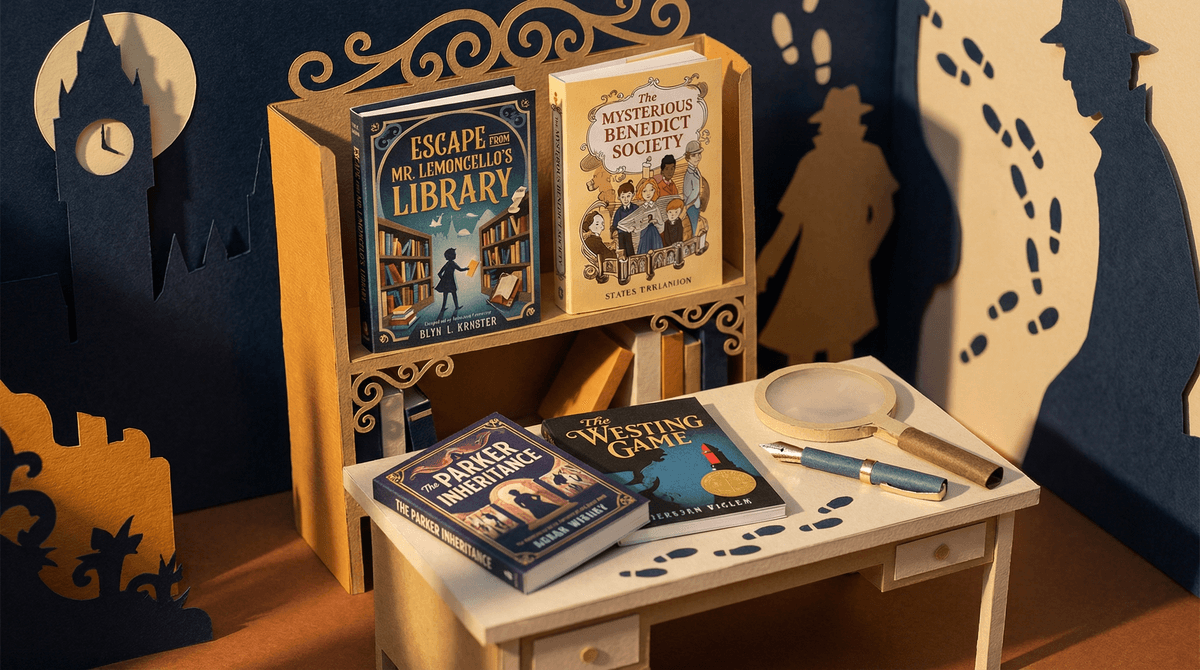
Mystery chapter books are exactly what they sound like—longer-form stories broken into chapters where characters solve puzzles, uncover secrets, or investigate crimes. But the best ones? They're so much more than just whodunits. We're talking about books like Nancy Drew, Encyclopedia Brown, The Mysterious Benedict Society, and newer series like The Parker Inheritance that weave together compelling mysteries with characters who actually grow, struggle, and change.
These aren't the quick-hit dopamine spikes of a YouTube video or a Roblox game. They're the slow burn—the kind of engagement that builds patience, critical thinking, and genuine emotional investment.
Here's what's happening when a kid gets hooked on a good mystery series:
The puzzle factor is addictive in the best way. Kids love feeling smart. When they're trying to solve the mystery alongside the characters, they're actively engaged—making predictions, remembering details, connecting clues. It's the same satisfaction they get from solving a tricky level in a game, but it's building reading comprehension and analytical skills.
Characters become friends. Series like The One and Only Ivan or From the Mixed-Up Files of Mrs. Basil E. Frankweiler aren't just about the mystery—they're about characters dealing with real stuff. Friendship drama, family complications, identity questions. Kids get attached. They care what happens. That emotional investment is what transforms reluctant readers into kids who beg for "just five more minutes" at bedtime.
They're naturally bingeable. Let's be honest—we're competing with streaming services and infinite scroll. Mystery series have built-in momentum. Each chapter ends with a hook. Each book in a series leaves you wanting more. It's the same mechanism that makes Stranger Things so watchable, but it's building literacy instead of passive consumption.
This isn't just about "getting kids to read" (though that alone would be worth it). Mystery chapter books with strong character development are doing some serious developmental heavy lifting:
Critical thinking and deductive reasoning. Kids learn to evaluate evidence, consider multiple perspectives, and test theories. The Westing Game is basically a masterclass in logical thinking disguised as entertainment.
Empathy and emotional intelligence. When characters are well-developed, kids practice understanding different motivations, backgrounds, and emotional responses. Books like Wonder (which has mystery elements woven through its character study) or Ghost help kids see the world through others' eyes.
Sustained attention and delayed gratification. In a world of TikTok and instant everything, following a complex plot over 200+ pages is actually a countercultural act. It teaches patience and the satisfaction of long-form engagement.
Vocabulary and writing skills. This one's obvious but worth stating—reading complex sentences, varied vocabulary, and well-crafted dialogue improves kids' own language skills in ways that Minecraft chat just doesn't.
Ages 6-8: Beginning Chapter Books
- Nate the Great series - Short, illustrated, perfect first mysteries
- Ivy and Bean series - More character-focused with mystery elements
- The Boxcar Children - Classic series with straightforward mysteries
Ages 8-10: Building Complexity
- The Mysterious Benedict Society - Puzzles, codes, and found family
- Chasing Vermeer - Art mystery with visual puzzles
- Escape from Mr. Lemoncello's Library - Game-like structure that appeals to Fortnite fans
Ages 10-13: Sophisticated Plots and Themes
- One of Us Is Lying - YA thriller with social media themes
- The Parker Inheritance - Historical mystery with real depth
- A Good Girl's Guide to Murder series - True crime podcast vibes in book form
Reading levels vs. interest levels matter. Your 8-year-old might be reading at a 5th-grade level but isn't ready for the mature themes in some YA mysteries. Check content warnings if you're unsure.
Series can be expensive. Libraries are your friend. Also, many kids will reread favorites multiple times—the cost-per-read actually beats most Nintendo Switch games.
Audiobooks count as reading. If your kid struggles with decoding but loves stories, Audible or library audiobook apps can be game-changers. They're still building comprehension, vocabulary, and narrative understanding.
Not all mysteries are created equal. Some series are basically junk food—formulaic plots with cardboard characters. Look for books that win awards (Newbery, Edgar Awards) or get recommended by actual librarians, not just Amazon algorithms.
Mystery chapter books with strong character development are one of the best investments you can make in your kid's cognitive and emotional development. They're building skills that matter—critical thinking, empathy, sustained attention—while providing genuine entertainment.
In a digital landscape where so much content is designed to be addictive but empty, these books offer something different: engagement that actually enriches rather than depletes.
Start where your kid is. If they're obsessed with Among Us, try a mystery with similar "figure out the suspect" vibes. If they love Percy Jackson, look for mysteries with mythological elements.
Make it social. Some families do book clubs, others just talk about theories at dinner. The conversation extends the learning and shows that reading is valued.
Create reading-friendly environments. This might mean limiting screen time before bed, having physical books visible around the house, or modeling your own reading habits.
And if you're wondering how your family's reading habits compare to others in your community, or want personalized book recommendations based on your kid's specific interests and maturity level, that's exactly what Screenwise helps with. Because every kid is different, and cookie-cutter advice only goes so far.