

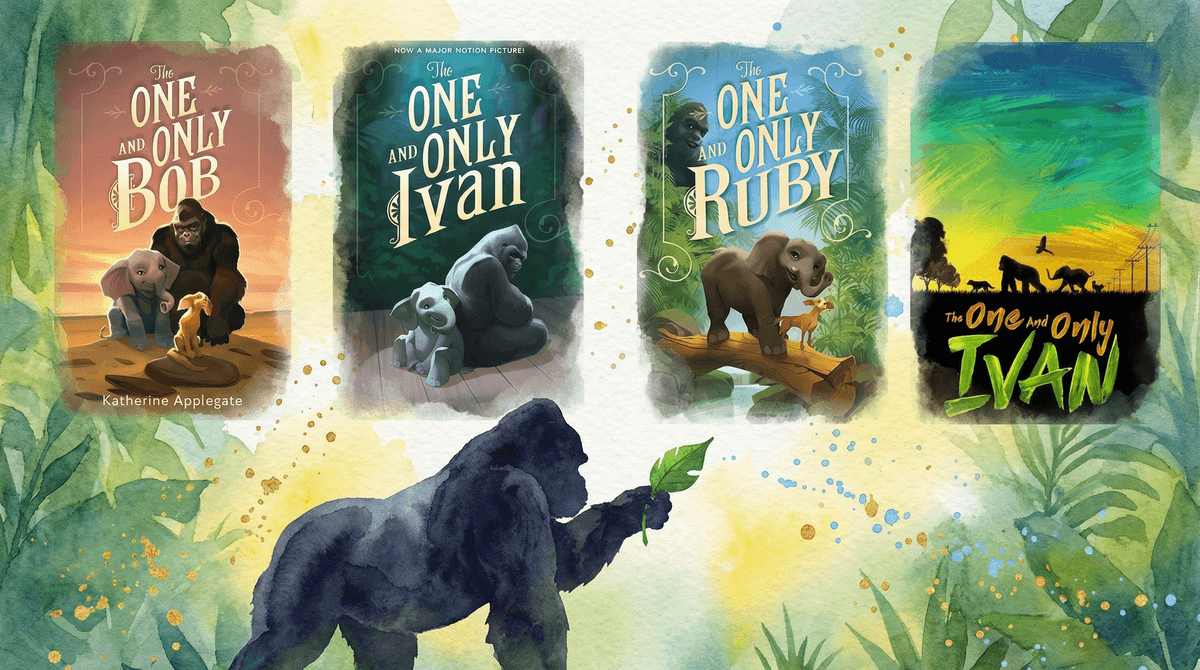
The One and Only Ivan by Katherine Applegate is a 2012 Newbery Medal-winning middle-grade novel told from the perspective of Ivan, a silverback gorilla who lives in a glass enclosure at a mall-based circus. Based on a true story, the book follows Ivan's life in captivity, his friendship with an elderly elephant named Stella and a stray dog named Bob, and his growing awareness that his situation—and that of a newly arrived baby elephant named Ruby—isn't right.
The book is written in spare, poetic prose that makes it accessible for younger readers (around ages 8-10) while still packing an emotional punch for older kids and adults. It's about 300 pages but reads quickly, with short chapters and plenty of white space. There's also a 2020 Disney+ movie adaptation starring the voices of Sam Rockwell, Angelina Jolie, and Bryan Cranston.
This book hits differently than a lot of animal stories because Ivan isn't in the wild. He's not on some adventure through the jungle—he's in a shopping mall in a suburb, watching humans walk by with their Orange Julius drinks. That mundane setting makes the injustice feel more immediate and real.
Kids connect with Ivan's voice. He's matter-of-fact, occasionally funny, and deeply observant. He doesn't understand everything about human behavior, which creates these moments of both humor and heartbreak. When he talks about his art (he paints to entertain mall visitors), or describes his memories of the jungle as fragmented and dreamlike, it's genuinely moving without being manipulative.
The friendship between Ivan, Stella, and Bob gives the story warmth. These aren't just animals in cages—they're individuals with personalities, histories, and the capacity to care for each other. When Stella makes Ivan promise to give Ruby a better life, the stakes become crystal clear.
This book deals with captivity, loss, and animal welfare, so be prepared for some tears and big questions. Stella dies partway through the book (not graphically, but it's sad), and there are references to Ivan's capture as a baby and the death of his sister. The overall tone isn't dark—there's hope and humor throughout—but younger or more sensitive kids might need some processing time.
The reading level is accessible but the themes are sophisticated. The book is often assigned in 4th-5th grade classrooms, but it works well as a read-aloud for younger kids (ages 7-8) if you're there to help with context. Older middle schoolers (ages 11-13) will pick up on the more nuanced commentary about entertainment, consumerism, and what we owe to other living beings.
It's based on a true story, which makes it a great gateway to conversations about real-world issues. The actual Ivan lived at a mall in Tacoma, Washington from 1978 to 1994 before being moved to Zoo Atlanta, where he lived until 2012. You can explore the real Ivan's story together and talk about how our understanding of animal welfare has evolved.
Ages 7-9: Great as a family read-aloud. You'll want to be available to answer questions about why Ivan was taken from his family, what it means to live in captivity, and whether the humans in the story are "bad people." These are good conversations to have! Just be ready for them.
Ages 10-12: Perfect for independent reading. Kids this age can handle the emotional weight and will likely want to talk about what they would do in Ivan's situation, or how they feel about zoos and circuses. This is also a great age to introduce the idea that well-meaning people can still participate in systems that cause harm.
Ages 13+: While technically below their reading level, the book still resonates with teens, especially if they're interested in animal rights, activism, or creative writing. The sparse, poetic style can also be a nice palate cleanser between denser books.
The beauty of The One and Only Ivan is that it opens up so many discussion points without being preachy:
About empathy and perspective: Ivan's narration helps kids practice seeing the world through someone else's eyes—literally. Ask your kid what they think Ivan misses most about his old life, or what they'd want if they were Ruby.
About entertainment and ethics: The circus in the book is clearly struggling, but it's also someone's livelihood. This creates space to talk about how we balance human needs with animal welfare, and how our entertainment choices have real consequences.
About promises and responsibility: When Ivan makes a promise to Stella, he has to figure out how to keep it despite having very limited power. This resonates with kids who often feel powerless in their own lives.
About art and expression: Ivan's paintings become the key to his freedom. You can talk about how we communicate when we don't have words, or how creativity can be a tool for change.
You might be wondering why a book guide is showing up on Screenwise. Here's the thing: the best defense against low-quality digital content is high-quality everything else. When kids have access to stories like The One and Only Ivan—stories that make them feel deeply and think critically—they develop stronger taste and discernment.
This book also pairs beautifully with documentaries and age-appropriate content about animal conservation. After reading, you might watch Disneynature documentaries together, or explore National Geographic Kids content about gorillas and elephants. These kinds of intentional screen choices can extend and deepen the reading experience.
The One and Only Ivan is one of those rare books that works on multiple levels—it's accessible enough for elementary schoolers but rich enough for middle schoolers and adults. It will probably make your kid cry (in a good way), and it will definitely spark conversations about how we treat animals, what freedom means, and how even small acts of courage can create change.
If your kid loves it, there are two sequels: The One and Only Bob (2020) and The One and Only Ruby (2023). Katherine Applegate also wrote Wishtree, another beautiful story told from a non-human perspective (this time a tree), and the Animorphs series if your kid wants something with more action.
If you're reading this with your kid: Take your time. Let them sit with the sad parts. Ask them what they're thinking rather than immediately trying to make them feel better.
If they've already finished it: Ask them what they think happened to Ivan after the book ends. Would they want to visit him at the zoo? Why or why not?
If they want to do something: Research local animal sanctuaries together, or learn about organizations working to end animal captivity. Sometimes the best follow-up to a powerful book is helping kids channel their feelings into action.