

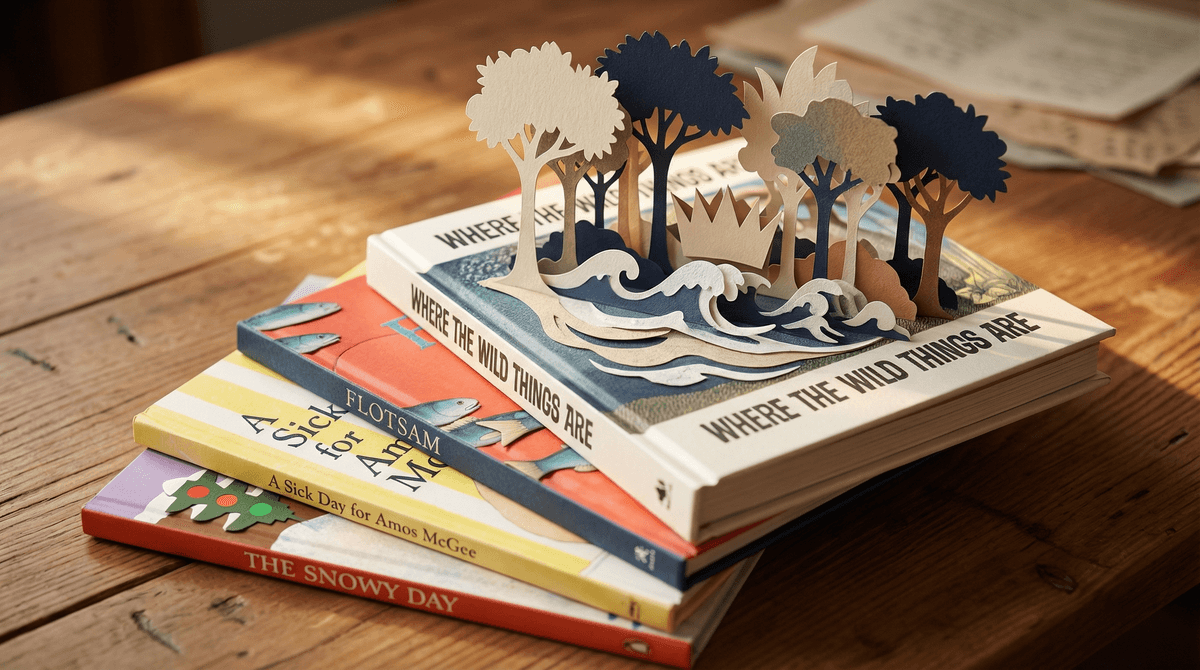
The Caldecott Medal is basically the Oscar for picture books. Every year since 1938, the American Library Association hands it to the illustrator who created the most distinguished picture book published in the U.S. that year. And honestly? These books slap.
Here's the thing about Caldecott winners that makes them different from the random board books accumulating under your couch: they're chosen by actual children's librarians who spend their entire careers evaluating what makes a picture book work. Not marketing teams. Not influencers. Librarians who've seen it all and know what holds up.
And in 2026, when we're all trying to figure out how to balance screens with literally everything else, these books are secret weapons. They're not just "screen-free activities" (ugh, that phrase). They're genuinely captivating stories that can compete with the dopamine hit of YouTube Kids.
Look, I'm not here to tell you screens are evil or that reading a picture book will magically undo three hours of Roblox. But here's what Caldecott winners do really well:
They create shared experiences. When you read a picture book together, you're both looking at the same thing, pointing at details, laughing at the same moments. Compare that to a kid watching Bluey on an iPad while you scroll your phone nearby. Both activities are fine! But only one involves actual connection.
They slow things down. Picture books have pacing. You turn pages together. You linger on illustrations. There's no autoplay, no algorithm deciding what comes next. Your kid controls the speed, which is basically the opposite of how digital content works.
They build visual literacy. Caldecott winners are chosen specifically for their illustrations, which means kids are learning to "read" images—noticing details, understanding visual storytelling, interpreting emotions through art. This stuff matters when they're eventually navigating a world full of digital imagery and trying to figure out what's real and what's AI-generated.
They're conversation starters. A good picture book leaves space for questions, predictions, and tangents. "Why do you think she did that?" "What would you do?" "Have you ever felt that way?" You can't really pause and discuss when the next episode is already loading.
Ages 2-4: The Gateway Books
The Snowy Day (1963) - Still perfect. A kid plays in snow. That's it. That's the book. And it's magical.
Where the Wild Things Are (1964) - Your toddler will want to be Max. They'll roar. They'll demand a wolf suit. This is normal.
The Hello, Goodbye Window (2006) - About grandparents' house and the specific magic that happens there. Hits different if your kid has that relationship.
Ages 4-7: The Sweet Spot
Last Stop on Market Street (2016) - A kid and his grandmother take the bus across town. It's about finding beauty in everyday life and noticing people. Honestly, we could all use this lesson.
The Girl Who Loved Wild Horses (1979) - Gorgeous illustrations, a kid who feels more at home with horses than people. Great for your animal-obsessed child.
Owl Moon (1988) - A quiet winter walk to find owls. The whole book is basically a meditation on patience and paying attention. Good luck explaining that concept to a kid who's used to YouTube Kids serving up new content every 3 minutes.
The Polar Express (1986) - Yes, the movie exists. The book is better. Fight me.
Ages 6-9: Getting Sophisticated
Flotsam (2007) - Wordless book about a camera that washes up on the beach. The illustrations tell an incredible story about connection across time. Your kid will spend 20 minutes studying each page, which is exactly the point.
The Invention of Hugo Cabret (2008) - This one's longer (like, 500+ pages) but it's heavily illustrated and reads like a movie. Great bridge between picture books and chapter books.
A Sick Day for Amos McGee (2011) - A zookeeper gets sick and the animals visit him. Gentle, sweet, and the illustrations are absolutely worth studying.
These books aren't cheap. Caldecott winners in hardcover can run $15-20 each. But here's the thing: they hold up. You'll read them 47 times and still notice new details. And they have actual resale value, unlike that $30 Paw Patrol toy that broke in three days.
Your library has all of these. Seriously. Librarians LOVE Caldecott winners. Many libraries have dedicated displays. This is literally free entertainment that doesn't require WiFi.
Not every Caldecott winner will land with your kid. Some are quiet and contemplative. Some are weird. Some are funny. Some deal with heavier themes. You know your kid—choose accordingly. Check out our guide to age-appropriate picture books if you want more specific recommendations.
These make great "special occasion" books. Birthday? New Caldecott winner. First day of school? Caldecott winner. Tuesday? Also fine. Building a tradition around getting a new special book creates anticipation that's different from the instant gratification of app downloads.
The older winners can feel dated. Gender roles, cultural representation, family structures—some books from the 1940s-1970s reflect their time period. This isn't necessarily bad! It can be an opportunity to talk about how things have changed. But heads up.
Create a routine. Bedtime is obvious, but also consider: after school, during breakfast, Sunday mornings. The key is consistency, not perfection.
Let them see you reading. If your kid only sees you on screens, they'll internalize that screens are what adults do. If they see you reading—anything, doesn't have to be Tolstoy—they learn that reading is an adult activity worth doing.
Don't make it a punishment. "No iPad until you read" positions reading as the thing you have to do to get to the good stuff. Instead: "It's reading time!" is just what happens now, like dinner or brushing teeth.
Read it more than once. Kids love repetition. It's how they learn. Yes, you'll get sick of it. Read it anyway. They're noticing new things each time, even if you're not.
Talk about the pictures. "What do you see?" "How do you think he's feeling?" "Why do you think the illustrator made everything blue on this page?" This is where the magic happens.
Caldecott winners aren't going to "fix" your family's screen time situation. They're not meant to. But they are high-quality, thoughtfully crafted books that can hold their own against digital entertainment—which is saying something in 2026.
Think of them as one tool in your toolkit. Not the only tool, not a magic solution, just a really solid option for creating moments of connection that don't involve a charging cable.
And honestly? When your kid is 25 and remembers sitting with you reading Where the Wild Things Are, they're not going to remember it as "that time we did a screen-free activity." They're going to remember it as time with you.
- Hit your library this week. Ask for Caldecott winners. Librarians will literally light up.
- Start with one. Don't buy 15 books. Get one, read it together, see what happens.
- Check out our guide to building a family reading routine if you want more structure around this.
- Explore other screen-free activities that actually work because variety matters.
You've got this.