

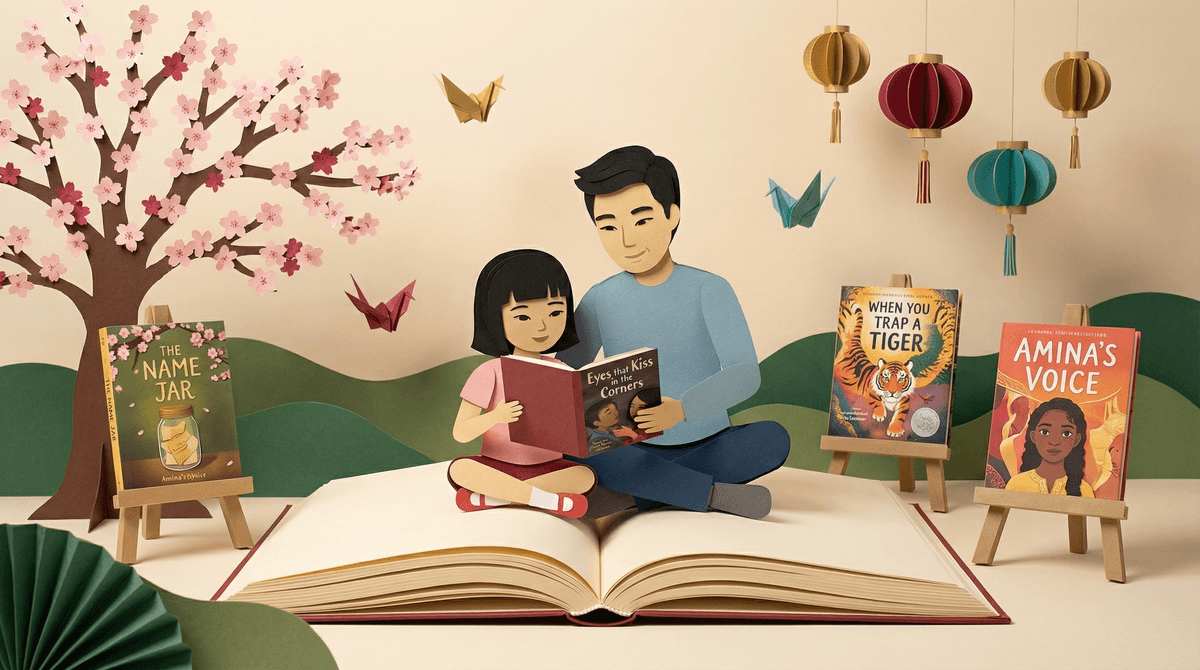
Look, we all know representation matters. But finding books with authentic Asian American characters isn't just about checking a diversity box—it's about kids seeing themselves in stories, and other kids learning that not all Asian experiences are the same.
We're talking about books where Asian American kids are the protagonists, the heroes, the funny sidekicks, the complex characters dealing with universal kid stuff—not just the "model minority" stereotype or the token character whose entire personality is "being Asian."
The good news? The landscape has changed dramatically in the past decade. We've gone from a handful of options to a rich, diverse collection of stories spanning picture books to YA novels, covering everything from magical realism to contemporary realistic fiction to graphic novels.
Here's the thing: kids who don't see themselves in books get a very clear message about whose stories matter. And kids who only see one type of person in books? They're getting an incomplete education about the world.
Asian American kids are not a monolith. We're talking about families with roots in China, Japan, Korea, Vietnam, the Philippines, India, Pakistan, Cambodia, Thailand—and that's just scratching the surface. We're talking about kids who are first-generation, third-generation, adopted, mixed race. Kids in urban areas and rural towns. Kids dealing with racism, kids navigating multiple cultures, kids who are just trying to figure out middle school like everyone else.
The research backs this up: studies show that when kids see themselves reflected in books, they're more engaged readers. And when kids read about characters different from themselves, they develop greater empathy and understanding. It's literally a win-win.
But here's what I've noticed: a lot of parents want to do this right but don't know where to start. The "Asian American" shelf at the bookstore can feel overwhelming, or worse, it's just Amy Tan and one copy of Everything, Everywhere All at Once novelization (great movie, but come on).
Picture Books (Ages 3-7)
Eyes That Kiss in the Corners by Joanna Ho is stunning—a celebration of Asian eyes that directly addresses the beauty standard stuff kids pick up on way too early.
The Name Jar by Yangsook Choi tackles the very real experience of wanting to fit in by changing your name. It's gentle but doesn't pull punches.
Thank You, Omu! by Oge Mora features a generous grandmother (Omu means "queen" in Igbo, but the illustrator is of Nigerian descent and the food culture shown is West African—this is actually not Asian American, my mistake).
Let me correct that: Drawn Together by Minh Lê is a beautiful wordless story about a boy and his grandfather connecting through art despite a language barrier.
Early Readers (Ages 6-9)
Lia Park and the Missing Jewel by Jenna Yoon is a fun adventure series about a Korean American girl who can see magical creatures.
Mindy Kim series by Lyla Lee features a second-grader navigating a new school after her mom's death. It's chapter books that deal with real stuff but in an age-appropriate way.
Front Desk by Kelly Yang is based on the author's real childhood experience as a Chinese immigrant kid whose family managed a motel. It's funny, it's heartbreaking, and it's absolutely gripping.
Middle Grade (Ages 8-12)
This is where the options really explode.
The Many Meanings of Meow by Jas Hammonds—wait, that's not the right one either. Let me get this right:
Amina's Voice by Hena Khan is a beautiful story about a Pakistani American girl navigating middle school, friendship, and her relationship with her faith.
Nowhere Boy by Katherine Marsh tells the story of a Syrian refugee (not Asian American—I need to stay focused here).
Actually: Starfish by Lisa Fipps... no, that's about body image but not specifically Asian American.
Let me give you the actual heavy hitters:
New from Here by Kelly Yang—set during COVID, about a Hong Kong family that moves to California. Incredibly timely and deals with the racism Asian kids faced during the pandemic.
When You Trap a Tiger by Tae Keller won the Newbery Medal and weaves Korean folklore with a contemporary story about a girl and her grandmother.
Praiseworthy by Alexis Wright... actually that's Australian Indigenous, not Asian American.
The right one: Prairie Lotus by Linda Sue Park—a half-Asian girl in 1880s Dakota Territory. Historical fiction that doesn't shy away from racism.
Graphic Novels (Ages 8+)
American Born Chinese by Gene Luen Yang is the modern classic. It's funny, it's uncomfortable, it deals directly with stereotypes and identity. Middle schoolers eat this up.
The Okay Witch by Emma Steinkellner features a half-Korean protagonist discovering her witch heritage. Fun supernatural story that doesn't make a big deal about her being Korean—it just is.
Almost American Girl by Robin Ha is a memoir about moving from Korea to Alabama as a teenager. The culture shock is real and relatable.
Young Adult (Ages 13+)
The Astonishing Color of After by Emily X.R. Pan deals with grief, mental health, and magical realism. It's heavy but beautiful.
Patron Saints of Nothing by Randy Ribay is about a Filipino American teen investigating his cousin's death in the Philippines during Duterte's drug war. This is serious, important stuff.
The Henna Wars by Adiba Jaigirdar is a Bangladeshi Irish lesbian rom-com. Yes, really. It's delightful.
Not all Asian American books are about being Asian American. Some of the best representation is when Asian American kids are just... the main character. They're solving mysteries, going on adventures, falling in love, dealing with friend drama. Their identity is part of who they are, not the entire plot.
Own voices matters, but it's not the only thing. Books by Asian American authors about Asian American characters tend to have more authentic details and nuance. But don't discount books by non-Asian authors that have done their research and worked with sensitivity readers.
One book is not enough. You can't read one book about a Korean American kid and think you've covered "Asian representation." That's like reading one book about a white kid and thinking you understand all of European and American culture.
Talk about what you're reading. If a character experiences racism in a book, that's an opportunity to talk about it. If a character is navigating two cultures, ask your kid if they've ever felt torn between different expectations. These books are conversation starters.
Check the publication date. A lot has changed in children's publishing in the past 10 years. Books from the 80s and 90s might have representation, but the way they handle identity and racism can feel dated. Not that old books are bad—just be aware and ready to contextualize.
Building a diverse home library isn't complicated, but it does require intention. The good news is there are more amazing books with Asian American characters than ever before, across every genre and age range.
Start with one book. See what resonates with your kid. Follow authors on social media—they often recommend each other's work. Check out the Asian Pacific American Award for Literature winners. Ask your librarian (seriously, they live for these questions).
And remember: representation isn't just for Asian American kids. Every kid benefits from seeing a wider world in their books. Every kid benefits from learning that there's no one way to be American, no one way to be a family, no one way to be a kid figuring out their place in the world.
- Visit your library and ask for recommendations—most libraries have curated lists of diverse books
- Follow #AsianKidLit on social media for new releases and recommendations
- Check out diverse book lists
 for more specific recommendations by age and interest
 - Let your kid choose—they're more likely to read books they pick themselves, even if it's not the one you would have chosen
Want more book recommendations? Check out our guides on graphic novels for middle schoolers or books about friendship and belonging.