

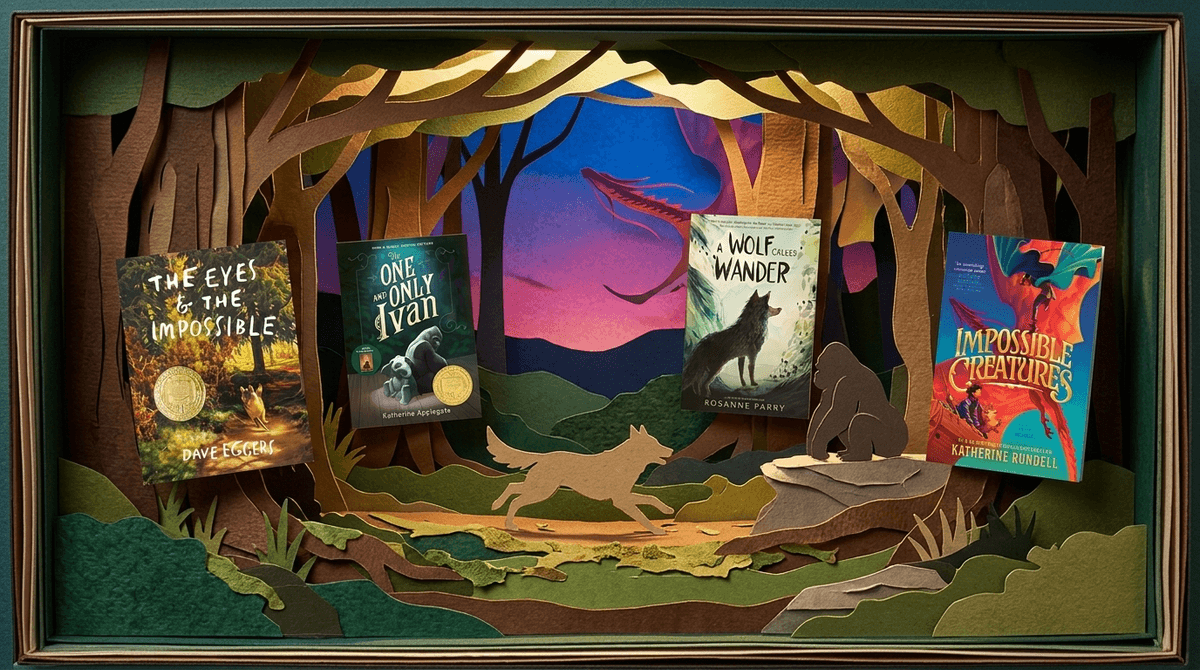

Dave Eggers pulled off something rare with The Eyes and the Impossible: he wrote a wild animal protagonist who thinks in high poetry, runs like lightning, and treats freedom like a sacred duty without sounding like a standard talking-critter cartoon. When that book clicks with a reader, finding the next title is tricky because typical animal adventures often trade philosophical wonder for slapstick or generic quest tropes.
TL;DR
If your reader fell in love with Johannes in The Eyes and the Impossible, hand them Katherine Applegate's Newbery winner The One and Only Ivan or Rosanne Parry's gripping wilderness survival tale A Wolf Called Wander. Both carry that specific blend of fierce animal dignity, lyrical first-person voice, and big emotional questions.
For younger readers who still want that gentle philosophical weight, Kate DiCamillo's Orris and Timble: The Beginning hits the exact same emotional frequency at a third of the page count.
The Philosophical Animal Narrators
These picks mirror Johannes the dog-like hero most directly: creature narrators who view humanity sideways and think deeply about loyalty, captivity, and purpose.
The One and Only Ivan
Ivan is a silverback gorilla living in an exit-mall circus enclosure who paints with finger paints and ponders the nature of his glass box. Katherine Applegate wrote this in sparse, poetic vignettes that give Ivan a distinct, contemplative voice. It shares the meditative pacing and artistic soul of Eggers' work.
Heads up on the emotional weight: Ivan's past includes the loss of his family to poachers, and an aging elephant friend dies during the story. It earns its tears, but sensitive readers will want a reading partner nearby. Best for ages 8 to 12.
The One and Only Bob
If Ivan is the philosopher, Bob is the cynic who discovers he has a spine. Bob, the scruffy stray dog from Ivan, gets his own standalone survival story when a hurricane hits the sanctuary. He talks tough, distrusts human sentimentality, and constantly questions his own capacity for heroism.
The pacing is faster and more comedic than Ivan, making it a great transitional book for readers who loved the wry, fast-talking observations in The Eyes and the Impossible. Best for ages 9 to 13.
A Wolf Called Wander
Based on the real journey of OR-7, a lone wolf who traveled a thousand miles across Oregon and California, this novel strips away human sentimentality entirely. Parry writes from wolf senses: scent ribbons, territory marks, and starvation. Like Johannes racing the bison in Eggers' park, Swift the wolf lives to run, and the prose pulses with speed.
The opening pages feature an intense pack battle that scatters Swift's family, and the hunger and highway crossings are visceral. For kids who want nature raw and beautiful rather than cuddly, this is the pick. Best for ages 9 to 13.
Wild Worlds and Big Imaginations
Eggers gives his park an almost mythic, legendary feel. These books widen the scope from local habitats to strange, expansive ecosystems.
Impossible Creatures
Katherine Rundell shares Dave Eggers' high-literary pedigree and refusal to talk down to younger audiences. Set in the Archipelago, a secret chain of islands where mythical beings still thrive, this adventure follows two kids trying to discover why the world's magic is failing. It features griffins, sphinxes, and sea beasts alongside lavish interior illustrations.
Rundell's writing has the same tactile love for fur, flight, and wild landscapes that Eggers brings to his stories. At nearly 400 pages, it demands stamina, making it ideal for confident chapter-book readers ages 9 to 14.
For Younger Readers: Big Ideas in Small Formats
If an older sibling or parent read The Eyes and the Impossible aloud and a younger kid wants a similar vibe they can read on their own, start here.
Orris and Timble: The Beginning Kate DiCamillo
Kate DiCamillo does not water down language for early chapter readers. Orris is an old, misanthropic rat who hoards pretty junk in a barn; Timble is an earnest young owl who gets caught in a trap. Owls eat rats, yet Orris has to choose whether to follow the noble example of a velvet slipper in his collection and do the brave thing.
It explores the tension between self-preservation and friendship in simple, rhythmic sentences. Perfect for ages 5 to 8 as an early independent read or bedtime story.
Toys Go Out
Emily Jenkins gives an eccentric cast of inanimate objects—a plush buffalo named Lumphy, a proud plastic stingray, and a bouncy rubber ball—the same existential curiosity that Johannes has about the world beyond his park. The humor comes from the toys trying to interpret human rituals, like the terror of the washing machine or the meaning of the beach.
It gives off quiet, clever energy with zero condescension. Works brilliantly as a read-aloud starting around age 5, or solo for ages 7 to 9.
How to Deepen the Reading Experience
When a kid finishes a book told from an animal perspective, the best prompt is sensory observation. Johannes spends chapters describing the exact feeling of running at top speed, the sight of the ocean from a cliff, and the distinct smells of the park's inhabitants.
Take a walk through a local park or neighborhood and challenge your reader to describe the surroundings using animal senses. What would a dog notice first about this street corner? How would a hawk describe that soccer field? Books like this work because they re-enchant everyday spaces, showing young readers that the familiar world is full of wild, hidden perspectives.
For families building out their library, take a spin through our best books for kids list or browse our digital guide for elementary school for stage-by-stage reading picks.
Frequently Asked Questions
Q: What reading level is The Eyes and the Impossible?
It sits around a 5th-grade independent reading level (ages 9 to 12), but the fast-moving plot and short chapters make it accessible for strong 3rd and 4th graders. It also works as a family read-aloud for kids as young as 7 because of the rhythmic, theatrical narrator voice.
Q: Are these books too sad for sensitive animal lovers?
The One and Only Ivan and A Wolf Called Wander both feature animal death, loss of family, and realistic survival threats, though neither is gratuitous. If your reader gets easily distressed by animal harm, start with Toys Go Out or Orris and Timble, which focus on humor and friendship without life-or-death grief.
Q: What should my kid read after Katherine Applegate?
Move to Rosanne Parry's animal survival books, or dive into classic nature-led fiction like Kenneth Grahame's The Wind in the Willows or Robert O'Brien's Mrs. Frisby and the Rats of NIMH, which balance high vocabulary with animal perspectives.
Next Steps
Start by picking the emotional weight that matches your reader right now: grab A Wolf Called Wander for outdoor wilderness grit, or The One and Only Ivan for poetic reflection. If you are shopping for an older tween ready for bigger fantasy worlds, explore our digital guide for middle school.