

Look, we all know that kid who groans at the mere mention of fractions or acts like science class is a personal attack. But here's the thing: kids aren't naturally bad at math and science. They're just often introduced to these subjects in ways that feel like eating cardboard when they could be having cake.
The right books can completely change the game. Not textbooks (obviously), but stories and non-fiction that make STEM subjects feel like discovery instead of drudgery. Books that show math as the language of patterns, not punishment. Books that present science as "how does literally everything work?" instead of memorizing the periodic table.
And honestly? These books work for ALL kids, not just the ones who are already raising their hands in math class. Sometimes the kid who "hates math" just hasn't met math in the right context yet.
There's this critical window—usually between ages 6-12—where kids decide whether they're "good at" math and science or not. And that decision often has nothing to do with actual ability and everything to do with whether these subjects feel accessible and interesting.
The stats are rough: by middle school, many kids (especially girls) have already mentally checked out of STEM. But kids who develop genuine curiosity about these subjects early? They're more likely to stick with challenging concepts, see mistakes as part of learning, and not freak out when things get hard.
Plus, let's be real: we're raising kids in a world where understanding data, algorithms, and scientific thinking isn't optional. You don't need to raise a future engineer (though cool if you do), but you do want to raise someone who can think critically about statistics they see online and understand how their world actually works.
For the Story-Lovers (Ages 6-10)
Some kids need math and science wrapped in narrative. They're not going to pick up a book about prime numbers, but they'll devour a mystery that happens to involve prime numbers.
The Wild Robot by Peter Brown is phenomenal for this. It's about a robot learning to survive in nature, and it sneaks in SO much about adaptation, ecosystems, and problem-solving without feeling educational. Kids just think it's a great story (because it is).
The Mysterious Benedict Society series is perfect for ages 8-12. The whole premise involves solving puzzles and using logic, and the characters are genuinely smart kids who use observation and critical thinking. It makes being clever feel cool.
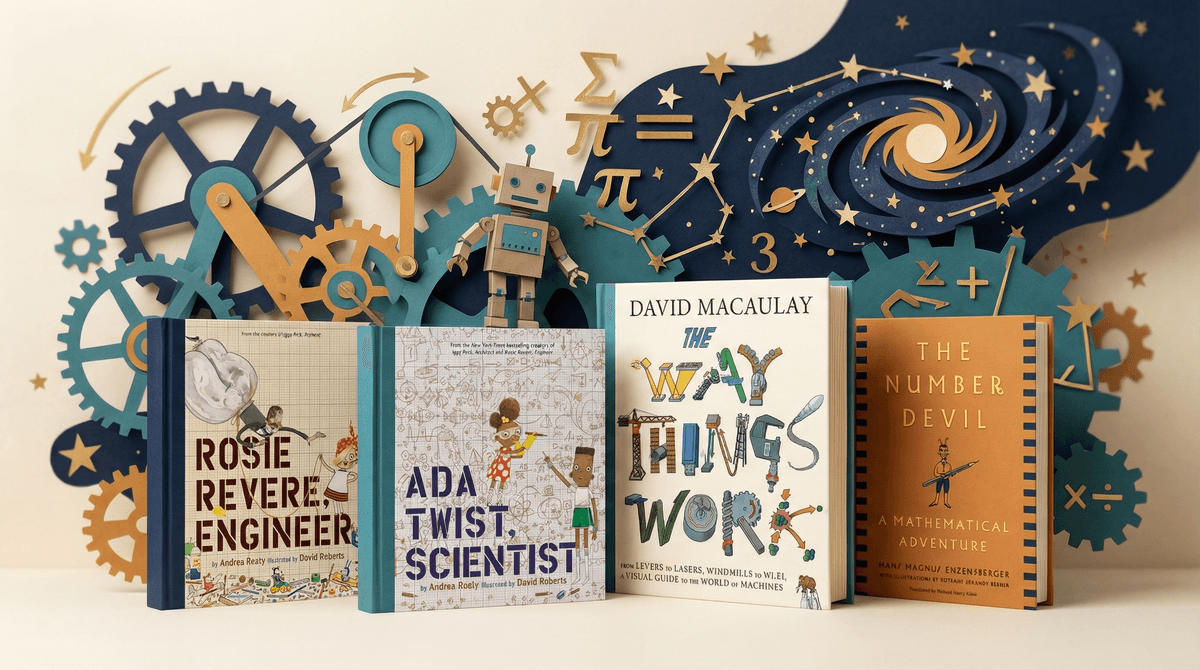
For younger kids (ages 6-8), Ada Twist, Scientist by Andrea Beaty is delightful. Ada asks questions about EVERYTHING and actually uses the scientific method to figure things out. There's also Iggy Peck (architecture) and Rosie Revere (engineering) in the same series.
For the Visual Learners (Ages 8-14)
The Way Things Work Now by David Macaulay is the gold standard. It's essentially "how does literally every machine work?" with incredible illustrations. Kids will just flip through looking at pictures and accidentally learn about physics and engineering.
What If? by Randall Munroe (the xkcd guy) takes absurd questions seriously using real science. "What would happen if you tried to hit a baseball pitched at 90% the speed of light?" The answers involve actual physics but are genuinely hilarious. Better for ages 10+.
The Basher Science series makes chemistry, physics, and biology into characters with personalities. It sounds weird but it WORKS. Elements become memorable because they're illustrated as little cartoon characters with attitude.
For the Fact-Hungry Kids (Ages 7-12)
Some kids just want information, straight up. They're the ones who will read an encyclopedia for fun.
The Book of Perfectly Perilous Math by Sean Connolly presents math through 24 "dangerous" experiments and activities. It's hands-on and makes math feel relevant to actual survival (sort of).
Women in Science by Rachel Ignotofsky is beautifully illustrated and profiles 50 women scientists. It's representation that matters, especially for girls who need to see that scientists don't all look like Einstein.
National Geographic Kids books are consistently excellent. They cover everything from space to the human body with great photos and digestible facts. Not groundbreaking, but reliably engaging.
For the Puzzle-Solvers (Ages 8-14)
Bedtime Math books by Laura Overdeck are brilliant for making math a daily, casual thing. Each page has a fun fact and then math problems at different levels. It's designed to be done together, which takes the pressure off.
The Number Devil by Hans Magnus Enzensberger is a story about a kid who hates math meeting a "number devil" in his dreams who shows him that math is actually fascinating. It covers real mathematical concepts through fantasy.
Start with their existing interests. If your kid loves animals, get them books about biology and ecosystems. If they're into building, look for books about engineering and architecture. If they're obsessed with space, lean into astronomy and physics.
Don't force it. Just having these books around, accessible and visible, is half the battle. Put them in the bathroom, on the coffee table, wherever they might get picked up casually.
Read them together when they're younger. For ages 6-9, these books work best as shared experiences. You can pause and talk about the concepts, try the experiments, or just enjoy the story together.
Let them abandon books. Not every book will hit. If something doesn't click, move on. The goal is to find what DOES work for your specific kid.
You're not trying to create a junior scientist or mathematician (unless that's genuinely their thing). You're trying to keep doors open. You're showing them that these subjects can be creative, narrative, visual, hands-on—whatever speaks to how their brain works.
The best STEM books don't feel like learning. They feel like discovering something cool. And that's exactly the point.
Want more recommendations? Check out our guide to educational podcasts or explore alternatives to screen time that build similar skills.