

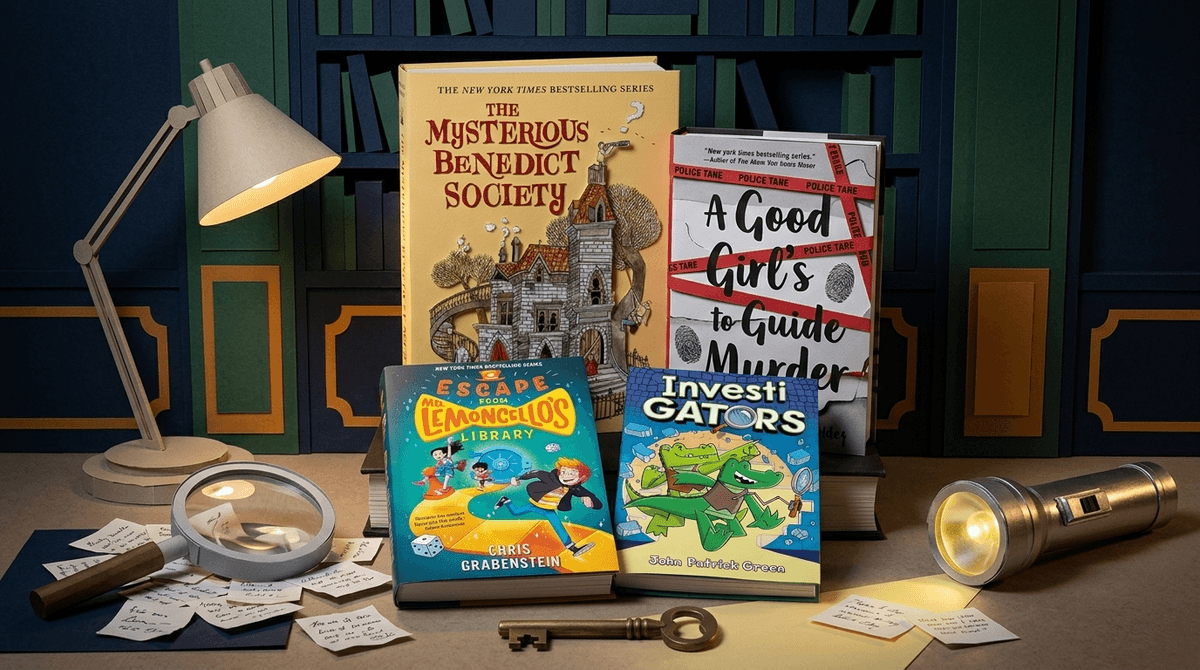
TL;DR: The Mystery Shortlist
If your kid is currently obsessed with Murder Mystery 2 on Roblox or spends their time watching "Who is the Traitor?" videos on YouTube, they are primed for a mystery book phase. Here are the top picks to pivot that digital sleuthing into some high-level reading:
- For the Gamer (Ages 8-12): Escape from Mr. Lemoncello's Library — It’s basically a Nintendo game in book form.
- For the Logic Genius (Ages 9-13): The Mysterious Benedict Society — Riddles, secret missions, and zero "brain rot."
- For the Graphic Novel Fan (Ages 7-10): InvestiGators — High energy, pun-heavy, and very accessible.
- For the Atmospheric Vibe (Ages 10-14): Greenglass House — A snowy inn, smugglers, and a slow-burn mystery.
- For the True Crime Teen (Ages 13+): A Good Girl's Guide to Murder — Fast-paced, modern, and very bingeable.
Get more book recommendations based on your child's favorite games
We’ve all been there: you look over your kid’s shoulder and they’re watching a 20-minute video of a neon-colored avatar running away from a "seeker" in a virtual map. Or maybe they’re using "Ohio" to describe anything slightly weird and you’re wondering if their attention span has been permanently reduced to 15-second intervals.
But here’s the secret: the same impulse that makes kids love Among Us or Murder Mystery 2 is the exact same impulse that makes a great mystery reader. They want to be the smartest person in the room. They want to solve the puzzle before the protagonist does.
Encyclopedia Brown was great for us, but let’s be real—today’s kids might find a kid solving mysteries out of a garage a little "mid." They want higher stakes, more complex puzzles, and characters that feel like they belong in 2026.
Why Mystery Books Are the Ultimate Screen-Time Pivot
Mystery and puzzle books aren't just stories; they’re interactive experiences. When a kid reads The Westing Game, they aren't just consuming content; they’re processing clues, eliminating suspects, and practicing deductive reasoning.
It’s the "escape room" effect. It gives them the same dopamine hit as winning a round of Among Us, but it requires the kind of sustained focus that helps counteract the "TikTok brain" we're all worried about.
InvestiGators by John Patrick Green (Ages 7-10)
If your kid is still in the Dog Man phase but needs a bit more plot, this is the winner. It’s about two alligators who travel through sewers to solve crimes. It’s heavy on the puns (which kids this age think is peak comedy) and the art is vibrant. It’s "low floor, high ceiling"—easy to read, but the mysteries actually have moving parts.
This is the gold standard for kids who love Roblox or Minecraft. A world-famous game maker builds a high-tech library and traps a group of kids inside. They have to solve puzzles, find hidden clues, and work as a team to get out. It’s basically a written version of an immersive video game.
This one is for the thinkers. Four gifted orphans are recruited to go undercover at a school called "The Learning Institute for the Very Enlightened" to stop a global brainwashing plot. The puzzles in this book are legit—they require the reader to think outside the box alongside the characters. If your kid liked the Disney+ show, the books are significantly deeper and more rewarding.
Friday Barnes, Girl Detective by R.A. Spratt (Ages 8-12)
Friday Barnes is a girl who lives in her head and solves crimes at a posh boarding school. She’s cynical, brilliant, and doesn’t care about being popular. It’s funny, a bit snarky, and perfect for the kid who thinks most "kid books" are too babyish.
This is a newer release (2023) and it’s fantastic. It’s got a very Knives Out vibe. The Swift family is full of people named after words in the dictionary, and when an arch-aunt is shoved down the stairs at a family reunion, Shenanigan Swift has to find the killer. It’s quirky, inclusive, and very well-written.
Greenglass House by Kate Milford (Ages 10-14)
This is for the kid who likes a "vibe." It’s a snowy, atmospheric mystery set in a house for smugglers. It’s a bit slower than Lemoncello, but the payoff is huge. It deals with themes of identity and adoption while keeping the "who-is-this-mysterious-guest" tension high.
Truly Devious by Maureen Johnson (Ages 13+)
For the teens who are into true crime podcasts or shows like Wednesday. This takes place at Ellingham Academy, a private school for "eccentric" geniuses. There’s a cold case from the 1930s and a modern-day murder happening at the same time. It’s smart, the protagonist has realistic anxiety, and the mystery is genuinely difficult to solve.
This is a massive hit on "BookTok" for a reason. It uses mixed media—interviews, logs, maps, and texts—to tell the story of a girl investigating a closed murder case in her town for a school project. It feels very "digital native." Warning: it deals with more mature themes (drugs, death), so it’s definitely for the older crowd.
The mystery genre has a wide range. On one end, you have "someone stole the cookies" (Ages 6-8), and on the other, you have "there is a serial killer in this high school" (Ages 14+).
- Middle Grade (8-12): Usually involves "bloodless" crimes. Think theft, kidnapping (where everyone turns out okay), or historical secrets. Characters like Nancy Drew or the kids in The 39 Clues are safe bets.
- Young Adult (13+): This is where murder becomes a central plot point. If your child is sensitive to violence or "thriller" elements, you’ll want to check the WISE scores on Screenwise first.
Check the WISE score for A Good Girl's Guide to Murder
The "Interactive" Element
If you have a kid who struggles to sit still and read, look for "interactive" mysteries. Books like Journal 29 or the Choose Your Own Adventure series (there are modern mystery versions now!) require the reader to solve a puzzle to know which page to turn to next.
Bridging the Gap from Gaming
If they are obsessed with Roblox, don't fight it—use it. "Hey, I saw you playing that mystery game. This book Lemoncello’s Library is actually about a guy who makes games like that. Want to see if you can solve the puzzles before the kids in the book do?"
Logic Over Luck
The best part of this genre is that it rewards critical thinking. In a world of mindless scrolling, mysteries require kids to hold multiple pieces of information in their heads at once. It’s a workout for their working memory.
Mystery books are the perfect "bridge" media. They bridge the gap between the high-octane stimulation of a video game and the deep focus of a novel. They allow kids to be the "main character" of the logic puzzle.
If your kid is currently deep in a "brain rot" phase, don't panic. Just swap the iPad for a copy of The Mysterious Benedict Society. They might find that solving a 300-page puzzle is actually more satisfying than winning a 3-minute round of Among Us.
Next Steps
- Identify the "Hook": Does your kid like humor (try InvestiGators), high-tech games (try Lemoncello), or dark vibes (try Truly Devious)?
- Read Together: Mystery books make great read-alouds or "co-reading" books because you can pause and guess the suspect together.
- Check the Stats: Use Screenwise to see what other kids in your child's grade are reading. If everyone is talking about A Good Girl's Guide to Murder, it might be time to have a conversation about what's in it.