

Books About Bullying: Stories That Help Kids Navigate Hard Social Situations
Look, we all know bullying happens. It's happening in your kid's school right now—maybe to them, maybe near them, maybe (and this is the hard one) by them. And while we'd love to bubble-wrap our kids from every mean comment and social landmine, what we can do is give them the language, empathy, and strategies to navigate these situations when they inevitably come up.
That's where books come in. Not as a cure-all, but as conversation starters. As mirrors that help kids see themselves. As windows into what it feels like to be on different sides of a hard social situation. The right book at the right time can give a kid the words they didn't have before, or help them realize they're not alone in what they're experiencing.
Here's the thing about bullying: it's complicated. Kids who are being bullied often feel ashamed and don't want to talk about it. Kids who witness bullying feel conflicted about whether to get involved. And kids who engage in bullying behavior (because yes, sometimes our kids are the ones being mean) rarely have the self-awareness to recognize what they're doing or why.
Books create emotional distance that makes these conversations possible. Instead of "Why were you mean to Sarah today?" it becomes "What do you think about how that character treated their friend?" It's a side door into hard topics.
Plus, good books show kids that there are multiple ways to respond to bullying—not just the "tell an adult" script that, let's be real, doesn't always feel doable to a 10-year-old trying to navigate the social hierarchy of fifth grade.
Ages 4-7: Building Empathy Early
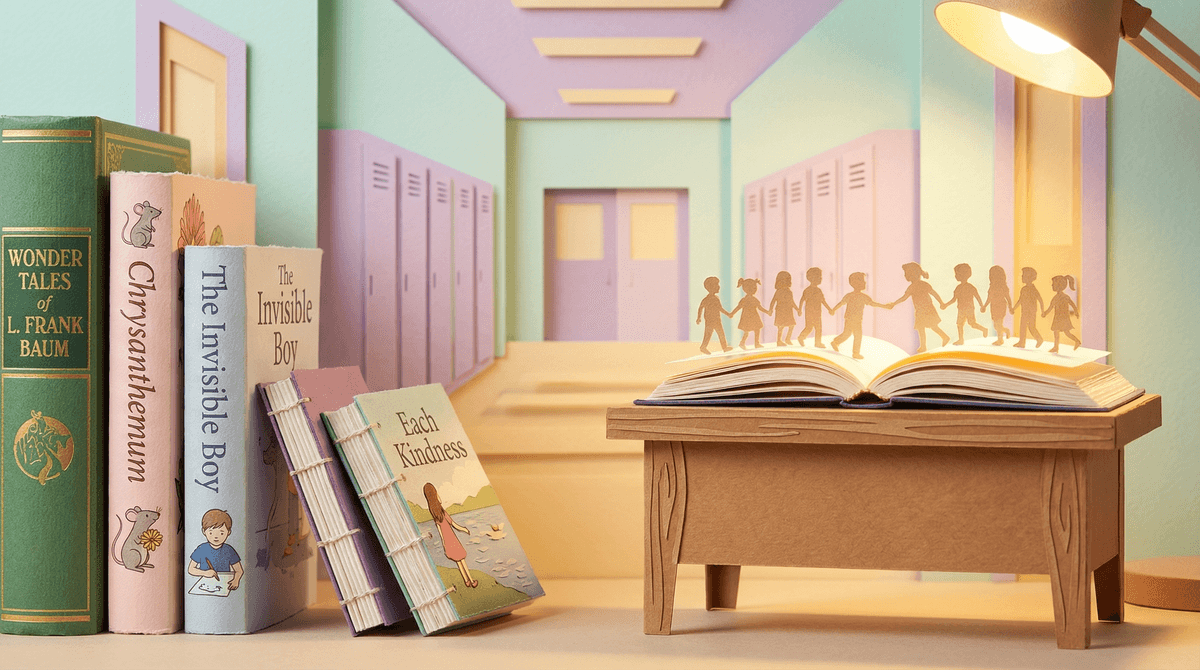
Chrysanthemum by Kevin Henkes - A mouse named Chrysanthemum loves her name until kids at school make fun of it. It's gentle, it's sweet, and it perfectly captures that first sting of being teased. Great for talking about how words can hurt.
The Invisible Boy by Trudy Ludwig - About a kid who gets overlooked and excluded until another student includes him. This one's excellent for teaching kids to notice who's being left out—and what it means to be an upstander.
Stand in My Shoes: Kids Learning About Empathy by Bob Sornson - Does exactly what it says on the tin. Helps little kids understand what it feels like to be someone else.
Ages 8-12: Getting Real About Social Dynamics
Wonder by R.J. Palacio - If you haven't read this yet, where have you been? It's about Auggie, a kid with facial differences starting mainstream school. But here's what makes it brilliant: it's told from multiple perspectives, including kids who were unkind to him. It shows how bullying happens, why kids go along with it, and how people can change.
The Revealers by Doug Wilhelm - Three middle school targets of bullying create an online newsletter to expose what's happening. It's realistic about how schools sometimes miss what's happening, and it gives kids agency—they don't just wait for adults to fix things.
Blubber by Judy Blume - This one's uncomfortable, and that's the point. The narrator isn't the victim—she's part of the group doing the bullying. Then the tables turn. It's a gut-punch about mob mentality and how quickly you can go from insider to target.
Each Kindness by Jacqueline Woodson - Fair warning: this one doesn't have a happy ending. A girl is excluded and bullied, then moves away before the narrator can make it right. It's about missed opportunities and regret, and it hits hard.
Ages 12+: Complex Social Situations
Speak by Laurie Halse Anderson - A high school freshman becomes an outcast after calling the police at a party. The reason why—she was assaulted—slowly unfolds. It's about isolation, trauma, and finding your voice. Heavy but important, especially for older middle schoolers and high schoolers.
The Misfits by James Howe - Four friends who don't fit in run for student council on a No-Name-Calling platform. It deals with homophobia, body-shaming, and class differences without being preachy.
Stargirl by Jerry Spinelli - About a girl who's unapologetically herself and the social consequences that follow. It's more about conformity and social pressure than traditional bullying, but those dynamics are closely related.
This is the conversation nobody wants to have, but sometimes our kid is the one being mean. These books can help:
Confessions of a Former Bully by Trudy Ludwig - A workbook-style book where a former bully reflects on her behavior. It's interactive and helps kids recognize their own actions.
My Secret Bully by Trudy Ludwig - About relational aggression (the "I'm not inviting you to my party" kind of bullying that flies under adult radar). Good for helping kids recognize subtle forms of meanness.
Don't make it homework. Read together if your kid's age-appropriate for that, or just have the book around. Forced conversations about bullying are about as effective as forced apologies.
Ask open-ended questions. "What did you think about that?" beats "See how that character felt bad?"
Share your own experiences. Kids need to know that adults have been through this too. Tell them about the time you were excluded or when you went along with the group and regretted it.
Watch for the right moment. If your kid mentions something happening at school, that's your opening. "You know, that reminds me of what happened in [book title]..."
Books aren't going to prevent bullying. But they can give kids the vocabulary to name what's happening, the empathy to understand different perspectives, and the courage to make different choices—whether they're being targeted, witnessing it, or (hard as it is to admit) participating in it.
The goal isn't to have all the answers. It's to keep the conversation open so your kid knows they can come to you when things get hard. And sometimes a book is the bridge that makes that possible.
Check out our full guide to handling bullying situations for more practical strategies beyond books.
Not sure which book is right for your kid's situation? Find the right bullying book for your child for personalized recommendations based on age and what's happening.
Want to understand the difference between normal conflict and bullying? That's a whole thing—learn more about recognizing the signs.