

TL;DR: The Top Picks
If you’re just looking for the heavy hitters to add to your library cart or Amazon wish list, here are the absolute best books to get your elementary-aged kid thinking about AI and robotics:
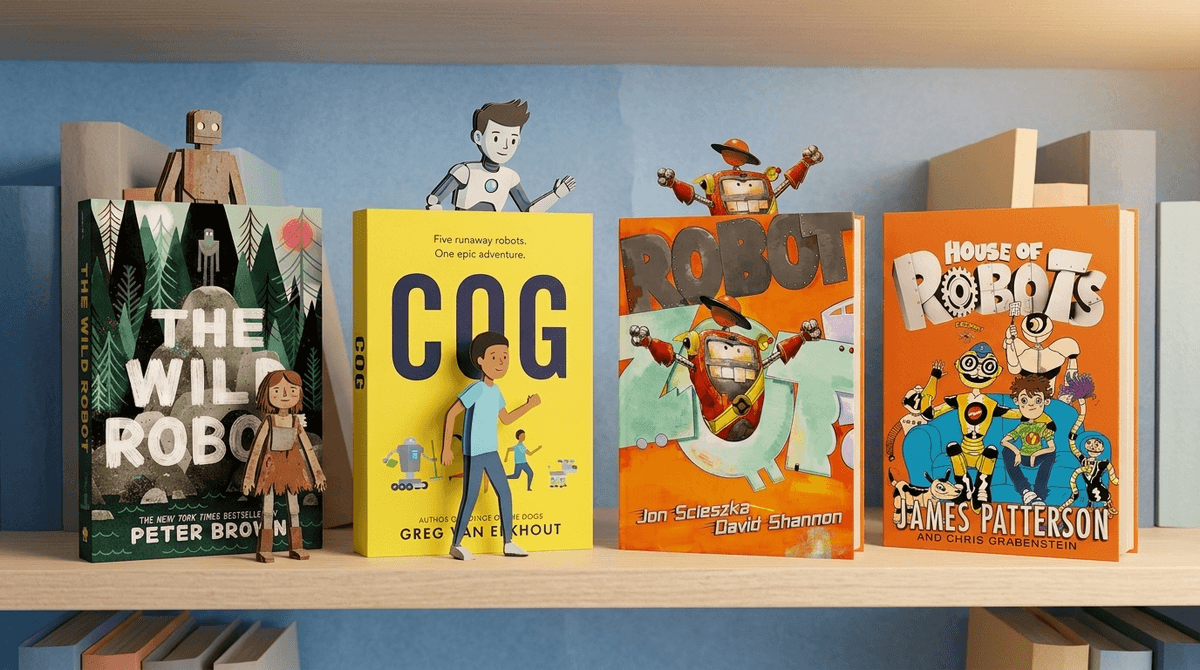
- Best Overall Story: The Wild Robot by Peter Brown – A modern classic about nature vs. technology.
- Best for Budding Engineers: How to Train Your Robot – Breaks down actual logic without being a dry manual.
- Best for Younger Kids (K-2): Robot Zot! by Jon Scieszka – Pure, chaotic fun that introduces "robot logic."
- Best for AI Ethics: Cog by Greg van Eekhout – A "Brave Little Toaster" vibe but for the AI generation.
- Best Non-Fiction: National Geographic Kids: Robots – Great visuals for kids who prefer facts over fiction.
Ask our chatbot for more personalized book recommendations based on your child's age
Between the "Ohio" memes and the weirdly realistic AI-generated images popping up on their YouTube feeds, our kids are growing up in a world where the line between "human-made" and "machine-made" is getting blurry.
Most kids interact with AI every day without knowing it—whether it’s the Netflix algorithm suggesting their next show or the NPCs in Roblox acting suspiciously smart. But there’s a massive gap between using technology and understanding it. These books help bridge that gap, moving kids from passive consumers to informed critics.
We often push STEM because we want our kids to get good jobs, but the real reason to read about AI and robots in 2026 is digital literacy.
By the time kids hit 4th or 5th grade, about 45% of them are already experimenting with some form of AI chatbot or image generator, often through apps like Snapchat or Discord. If they don't understand that an AI is just a series of "if/then" statements and probabilistic guesses, they’re more likely to trust it blindly.
Books allow us to explore the "what if" scenarios. Can a robot feel? Can AI be "mean"? Who is responsible when a machine makes a mistake? These are the conversations that turn a kid who just plays Minecraft into a kid who understands the architecture of the digital world.
Ages 7-12 If you haven't read this yet, stop everything. It’s the gold standard. When Roz the robot wakes up on a remote island, she has to learn to survive by observing the animals. It’s essentially a story about machine learning through the lens of nature. It tackles the big question: Can a programmed being develop a "soul" or a sense of community? It’s emotional, beautifully illustrated, and doesn't talk down to kids. Parent Tip: The movie is also fantastic, but the book allows for much better discussions about Roz's internal processing.
Ages 8-12 Cog is a robot built to look like a twelve-year-old boy, but his "brain" is designed to learn through experience. When he gets separated from his creator, he goes on a road trip with other robots to find her. This book is brilliant for explaining AI ethics and the concept of "purpose." It’s funny, a little bit heartbreaking, and perfect for kids who like The Iron Giant.
Ages 8-11 Look, James Patterson is a factory, and some of his kids' books feel a bit "produced," but House of Robots actually hits the mark for this age group. It’s about a kid whose mom is a world-class roboticist who sends a "robot brother" to school with him. It’s more of a middle-school drama with robots, but it’s a great entry point for kids who aren't usually "readers" but love the humor in Diary of a Wimpy Kid.
Ages 4-8 For the younger set, this is a riot. Zot is a tiny, aggressive robot from another planet who "attacks" common household appliances (like the toaster). It’s a great way to talk about how robots "see" the world differently than humans do. It’s visual, loud, and very funny.
Check out our guide on the best coding toys for elementary kids
Ages 6-9 National Geographic knows their audience. This book is filled with high-res photos of real-world robots—from Mars rovers to surgical arms. It’s the best way to show kids that robots aren't just sci-fi characters; they’re tools that help humans solve problems. It’s a great "coffee table book" for a 2nd grader's bedroom.
Ages 7-11 This book is a sleeper hit. It uses the metaphor of "training" to explain how programming works. It’s less about the hardware and more about the logic. If your kid is starting to use Scratch or Code.org, this book will help them understand the "why" behind the blocks they’re dragging and dropping.
Ages 5-9 The "A Kids Book About" series is known for being direct and minimalist. This one explains AI in the simplest terms possible: it’s a tool made by humans that uses data to make decisions. It’s a great conversation starter if your kid has started asking why Alexa knows their favorite song.
When picking these books, keep in mind where your kid is at developmentally:
- Grades K-2: Focus on physical robots. At this age, the concept of "invisible AI" (like an algorithm) is too abstract. Stick to books where the robot is a character they can see and touch.
- Grades 3-5: This is the sweet spot for logic and ethics. They can handle stories where the robot has a conflict or where the AI makes a mistake. This is also the age where they should start learning that AI isn't "alive," even if it acts like it is.
You don't need a PhD in Computer Science to have these talks. Use the books as a springboard for these questions:
- "Is the robot in this book 'thinking' or just following a list of rules?" (This helps them understand programming vs. consciousness).
- "If a robot breaks something, whose fault is it? The robot, or the person who wrote the code?" (This is a huge topic in AI ethics right now).
- "What is one thing you can do that a robot will never be able to do?" (Focuses on empathy, creativity, and human connection).
Learn more about how to talk to your kids about ChatGPT and AI
AI isn't going anywhere, and the "brain rot" concerns are real if kids just let the algorithms wash over them. But if we give them the vocabulary to understand what's happening under the hood, we're giving them an advantage.
Start with The Wild Robot. It’s the easiest way to start a deep conversation without it feeling like a "lesson." From there, let their curiosity lead. Whether they want to build a battle bot or just understand why their YouTube Kids recommendations are so weird, these books are the perfect starting point.
- Audit your library: Grab two fiction and one non-fiction book from this list.
- Connect it to play: After reading, let them try a basic coding site like Scratch to see if they can "program" their own character.
- Watch together: If you read The Wild Robot or The Iron Giant, make a movie night out of it and compare the two versions.
Ask our chatbot for a list of movies about robots for a family movie night