

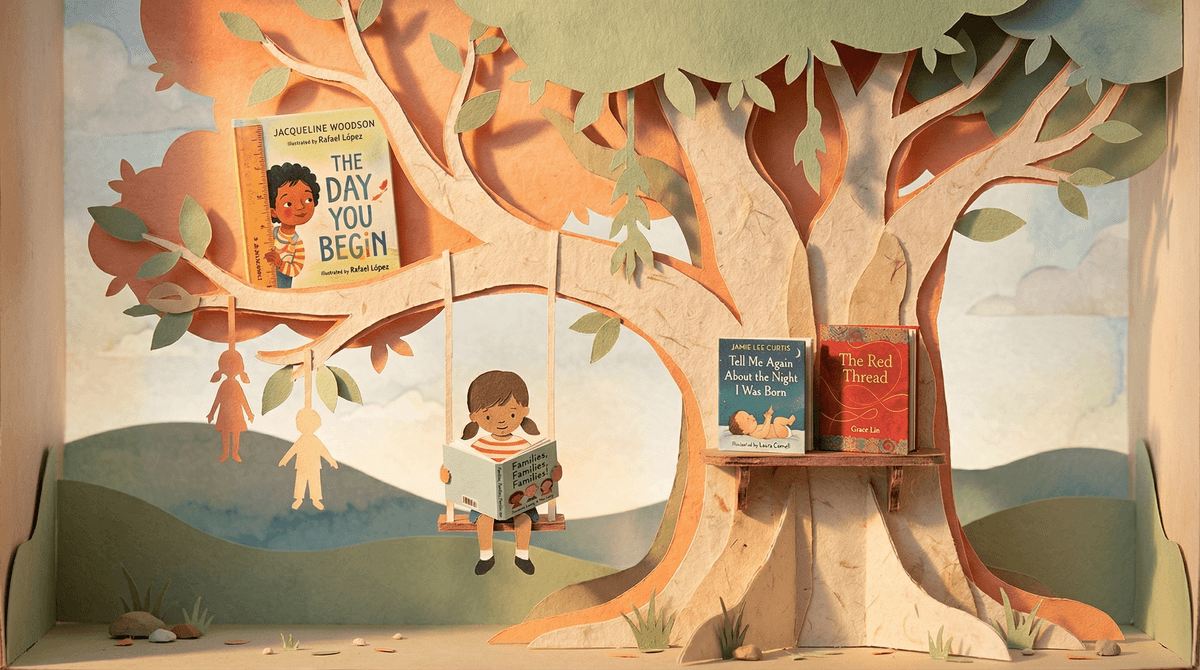
Look, adoption stories aren't just "special books for adopted kids." They're windows into different family structures, conversations about identity and belonging, and honestly? They're for all kids. Whether your family was formed through adoption, you have friends who were adopted, or you're just raising humans who need to understand that families come in all configurations—these books matter.
The best adoption books don't treat adoption as a problem to solve or a sad backstory. They treat it as one of many ways families are made, with all the complexity, joy, questions, and realness that comes with it. Some are picture books for littles, some are middle-grade novels wrestling with identity, and some are YA books that don't pull punches about the hard stuff.
Here's the thing: adopted kids will have questions. "Why didn't my birth parents keep me?" "Do I look like them?" "Can I love two families?" These aren't questions you want them Googling at 2am (trust me, the internet is not the place for nuanced family conversations). Books give kids a safe way to explore these feelings with characters who get it.
But also? Non-adopted kids need these stories too. They need to understand that their classmate's two-mom family or their friend who came from foster care or their cousin who was adopted from another country—these are just different origin stories, not lesser ones.
The research is pretty clear: kids who see diverse family structures in books develop more empathy and less "othering" behavior. And for adopted kids specifically, seeing themselves reflected in stories helps with identity formation and self-esteem. It's the whole "you can't be what you can't see" thing.
Ages 2-5: Building the Foundation
Little kids need simple, affirming messages: "You were chosen," "Families are made in different ways," "You are loved." Picture books at this age should be warm, not heavy.
- A Mother for Choco by Keiko Kasza - A little bird looks for a mother who looks like him, but finds family in unexpected places. Sweet without being saccharine.
- Tell Me Again About the Night I Was Born by Jamie Lee Curtis - Adoption as a celebration story. Kids love the repetition and the joy.
- The Day You Begin by Jacqueline Woodson - Not explicitly about adoption, but about feeling different and finding your people. Gorgeous.
Ages 6-9: Getting More Complex
Early elementary kids can handle more nuance. They're starting to understand that adoption involves loss and gain, that it's okay to have big feelings about both.
- Maybe Days by Jennifer Wilgocki - About foster care and the uncertainty of "maybe you'll stay, maybe you won't." Honest and tender.
- The Red Thread by Grace Lin - Based on the Chinese legend that an invisible red thread connects people destined to be together. Beautiful for international adoption stories.
- Families, Families, Families! by Suzanne Lang - Not adoption-specific, but celebrates ALL family types. Good for classroom libraries.
Ages 10-14: Wrestling with Identity
Middle grade is when adopted kids often start asking harder questions about their birth families, their cultural identity, and where they fit. These books don't shy away from the messy parts.
- One for the Murphys by Lynda Mullaly Hunt - Foster care, found family, and a kid learning she deserves good things. Will make you cry.
- Counting by 7s by Holly Goldberg Sloan - About a gifted kid who loses her adoptive parents and has to build a new family. Quirky and heartbreaking.
- Inside Out and Back Again by Thanhha Lai - A refugee story that resonates with international adoptees navigating two cultures.
Ages 14+: The Unvarnished Truth
Teen books can tackle the hard stuff: birth parent searches, transracial adoption complexities, the trauma that often precedes adoption.
- The Language of Flowers by Vanessa Diffenbaugh - About aging out of foster care and learning to trust. Not a happy-clappy adoption story, but powerful.
- Everything Sad Is Untrue by Daniel Nayeri - A refugee/adoption memoir that's funny and devastating and so, so good.
- American Panda by Gloria Chao - Not about adoption, but about cultural identity and family expectations—themes many transracial adoptees relate to.
Don't wait for "the talk": Adoption shouldn't be a one-time Big Reveal. It should be woven into your family story from the beginning. Books make this easier—they normalize the conversation.
Match the book to your family's story: Not all adoption books will fit your situation. International adoption is different from domestic. Foster-to-adopt is different from infant adoption. Transracial adoption has unique considerations. Choose books that reflect your reality, but also expose your kids to other adoption experiences.
It's okay if books bring up hard questions: If your kid finishes a book and asks "Why didn't my birth mom keep me?" that's not the book's fault—that's the book doing its job. These conversations are supposed to happen. Have resources ready for when they do.
Representation matters, but so does quality: Don't just grab any book with adoption in it. Some are outdated, some are savior-y, some are just badly written. Look for books where adoption is part of the story, not the whole story. Where adopted characters are full humans, not just their trauma.
These books aren't just for adopted kids: Put them on the shelf for all your kids. Have them in classroom libraries. Normalize diverse family structures for everyone.
Books about adoption aren't a niche category for a "special" subset of families. They're essential reading for building empathy, understanding different family structures, and giving adopted kids the language to process their experiences.
The best adoption books treat adoption as one of many ways families are formed—complex, beautiful, sometimes hard, always valid. They don't sugarcoat, but they also don't catastrophize. They just tell the truth: families are made in lots of ways, and all of them count.
Start with books that match your kid's age and your family's story. Read them together. Let the questions come. And remember: the goal isn't to have all the answers—it's to create a space where the questions are always welcome.
Want more recommendations? Check out our guide to books about diverse families or books that build empathy.
Need help talking about adoption with your kids? Get advice on talking to kids about adoption based on your kid's age and your family situation.
Looking for more family conversation starters? Books are great, but sometimes you need other tools. Check out our guides on conversation card games or podcasts for families that tackle big topics.