

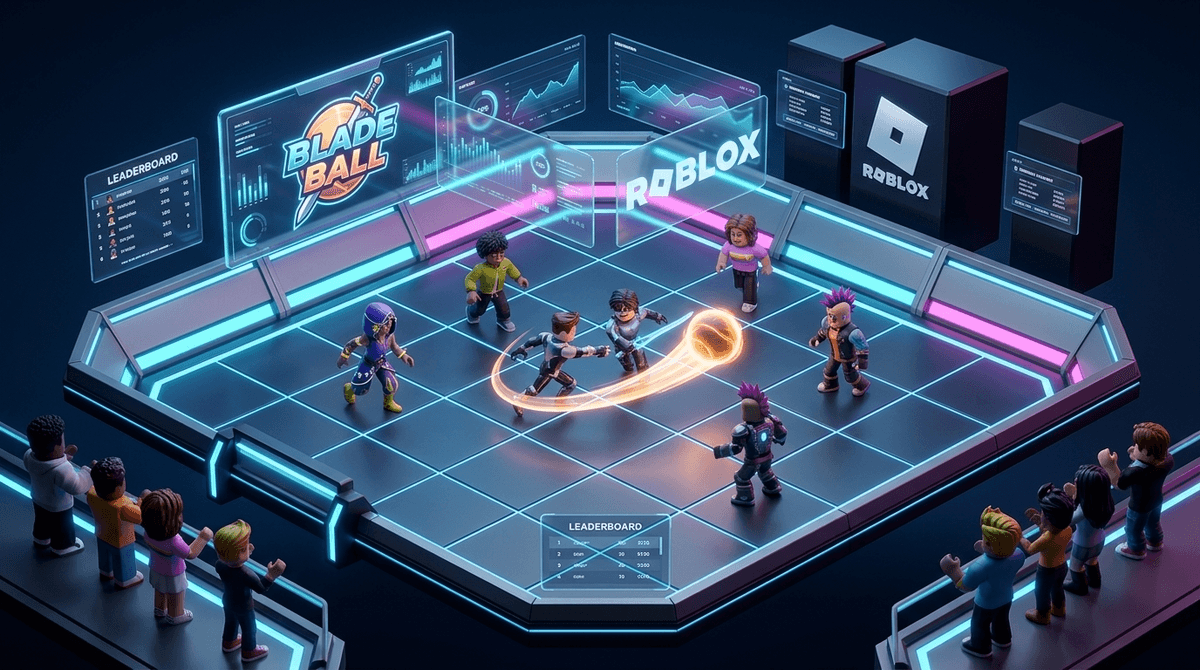
TL;DR: Blade Ball is a high-octane "deflect-em-up" inside Roblox that has completely taken over middle school lunchroom conversations. It’s essentially a digital version of "hot potato" where the potato is a homing missile and everyone has a sword. It’s great for reflexes but can be a major drain on the wallet due to "crate" gambling for rare skins.
Quick Links for Context:

If you’ve walked past your kid’s screen lately and seen a neon-colored ball zipping around a small arena while characters in capes do backflips, you’ve seen Blade Ball.
The premise is deceptively simple: players stand in an arena, and a homing ball (the "Blade Ball") targets one player at a time. That player has to hit the "block" or "parry" button at the exact right millisecond to deflect the ball toward someone else. Every time the ball is deflected, it gets faster. Eventually, it’s moving at a speed that requires near-superhuman reflexes. If you miss the timing, you’re eliminated. Last person standing wins.
It’s part of the broader "Battle Royale" genre, similar to Fortnite, but distilled into rounds that last about 60 seconds. It’s fast, it’s loud, and it’s incredibly addictive because the "just one more game" loop is so short.
The appeal here is the "clutch" factor. In gaming culture, a "clutch" is when you win under extreme pressure. Blade Ball is 100% pressure.
You’ll also notice a lot of cultural crossover. Because it’s on Roblox, the game is a melting pot of current internet memes. You’ll see "Skibidi" themed explosions or kids calling a missed hit "so Ohio" (which, in middle-school speak, basically means weird, cringey, or low-quality).
The game also taps into the status economy. Having a default sword is "noob" behavior. Kids want the limited-edition lightsabers, the fire-trail effects, and the unique "kill explosions" that trigger when they eliminate an opponent. In the world of Roblox, your "fit" (outfit/equipment) is your social standing.
Here is where we need to be real: Blade Ball is a monetization machine. While the game is free to play, the path to looking "cool" or getting better abilities is paved with Robux.
The Crate System
The game uses a "gacha" or loot box mechanic. You spend Robux to open a crate, and you have a 0.1% chance of getting a "Legendary" or "Godly" sword skin. This is effectively gambling-lite. Kids can easily sink $20, $50, or $100 trying to "roll" for a specific sword that doesn't actually change the gameplay—it just looks cool.
Abilities
Unlike skins, Abilities actually change the game. You can buy the ability to teleport, freeze the ball, or go invisible. While you can earn these by playing, the shortcut is—you guessed it—paying. This creates a "pay-to-win" environment that can be incredibly frustrating for kids who are playing for free, leading to "rage-quitting" or more begging for Robux.
Recommended Age: 8+
The ESRB rating for Roblox is E10+, but Blade Ball itself is relatively mild in terms of content. There is no blood, no realistic violence, and the "combat" is purely mechanical. However, there are two things parents should watch:
- The Stress Factor: This game is high-intensity. If your child struggles with emotional regulation or gets "tilted" (gaming speak for angry/frustrated) easily, Blade Ball will trigger that. The rounds are fast, and losing feels personal because it’s usually due to a split-second mistake.
- The Chat: Like all Roblox games, the chat can be a wild west. While Roblox filters a lot, kids still find ways to be toxic, call each other "trash," or use bypasses for swear words.
If you haven't already, you should set up a Parent PIN on your child's Roblox account. This prevents them from changing the settings you’ve put in place. You can also restrict chat to "Friends Only," which I highly recommend for kids under 11.
If you’re looking to transition them away from the high-stress environment of Blade Ball or just want to offer some variety, here are a few recommendations:
Rocket League (Ages 6+)
If they love the physics and the "hit the ball at the right time" mechanic, Rocket League is the gold standard. It’s soccer with rocket-powered cars. It’s skill-based, high-energy, and has a much more robust competitive scene without the "jankiness" of Roblox.
Super Smash Bros. Ultimate (Ages 7+)
For kids who like the "arena battle" feel, Smash Bros offers that same "last man standing" thrill but with iconic characters and much better local multiplayer options (so they can actually play with friends in the same room).
Adopt Me! (Ages 6+)
If the stress of Blade Ball is getting to them, Adopt Me! is the "cozy" side of Roblox. It’s about collecting pets and building houses. It still has a trading economy (which has its own issues), but the "vibe" is much lower stakes.
Minecraft (Ages 7+)
Specifically, suggest they play on "Bed Wars" or "Sky Wars" servers. It provides that competitive edge and tactical gameplay but within the familiar, creative world of Minecraft.
Sometimes we tell ourselves that Roblox is teaching kids about the economy because they are "trading" items. In Blade Ball, this is mostly a myth. The "trading" in these games is often predatory, with older kids trying to "scam" younger kids out of rare skins.
Unless your kid is actually coding a game in Roblox Studio, they aren't learning entrepreneurship—they’re learning how to be a consumer in a very aggressive digital marketplace.
Learn about the difference between playing Roblox and making games
Instead of "Why are you playing that loud game again?", try these conversation starters:
- "What ability are you saving up for right now?" (This helps you understand if they are eyeing a $20 purchase or working toward a goal).
- "I saw a 'Godly' sword in the lobby—how rare is that actually?" (This opens the door to talking about the odds of those crates/loot boxes).
- "That ball gets incredibly fast. Do you find it hard to keep your cool when you lose a 'clutch' moment?" (A great way to talk about emotional regulation without being preachy).
Blade Ball isn't "brain rot," but it is "brain candy." It’s fast, sugary, and provides a quick hit of dopamine. It’s a great way for kids to blow off steam and practice hand-eye coordination, but it requires a watchful eye on the spending and the stress levels.
If your kid is playing it, they are part of a massive global trend. It’s the "it" game of the moment. Enjoy the fact that the rounds are short—it makes "five more minutes" a lot easier to enforce than a 30-minute Fortnite match.
- Check the transaction history on their Roblox account to see if they've been "rolling" for crates.
- Watch them play one round. Ask them to explain what "parrying" is.
- Set a "no-spend" rule for cosmetic items (skins) while allowing them to earn abilities through gameplay.