

TL;DR: The Quick List
If you’re just trying to get through the afternoon and want to put on something that isn't brain rot, here are the top picks for different ages:
- Best for Preschoolers: Canticos or Rosie's Rules
- Best for Elementary Kids: Alma's Way or Santiago of the Seas
- Best for Older Kids (Immersion): Legend Quest
- Best Spanglish/Culture Mix: The Casagrandes
- Best Interactive App: Duolingo ABC
Get Spanish-language media recommendations
We’ve all been there. You want your kid to pick up a second language—or maybe just stay connected to their heritage—but if you have to hear the "Map Song" from Dora the Explorer one more time, you might actually lose it.
The good news? We are living in a golden age of bilingual content. We’ve moved way beyond the "repeat after me" style of the early 2000s. Today’s shows actually have plots, character development, and cultural nuances that don't feel like a cardboard cutout of Latin American life.
Whether your kid is saying everything is "Ohio" (don't ask, it just means "weird" or "bad" in Gen Alpha speak) or they're obsessed with Skibidi Toilet, you can pivot that screen time into something that actually builds a skill.
Language learning isn't just about the vocabulary. It’s about the "cultural agility." Research consistently shows that kids who engage with bilingual media have better executive function and problem-solving skills. But more importantly, it helps normalize a world where English isn't the only default.
If you're raising a bilingual kid, seeing their world reflected on screen is huge for their identity. If you're an English-speaking family trying to introduce Spanish, these shows provide a low-pressure way to get those sounds into their ears before their "language window" starts to close (usually around age 7 or 8).
At this age, it’s all about repetition and music. You want shows that use "code-switching"—mixing English and Spanish naturally—so they don't get frustrated by not understanding the plot.
This is the gold standard for nursery rhymes. It’s beautifully animated and features classic Latino "pollitos" and "elefantes" songs. It’s gentle, short, and won’t overstimulate them. Check out our guide to Canticos and early language learning
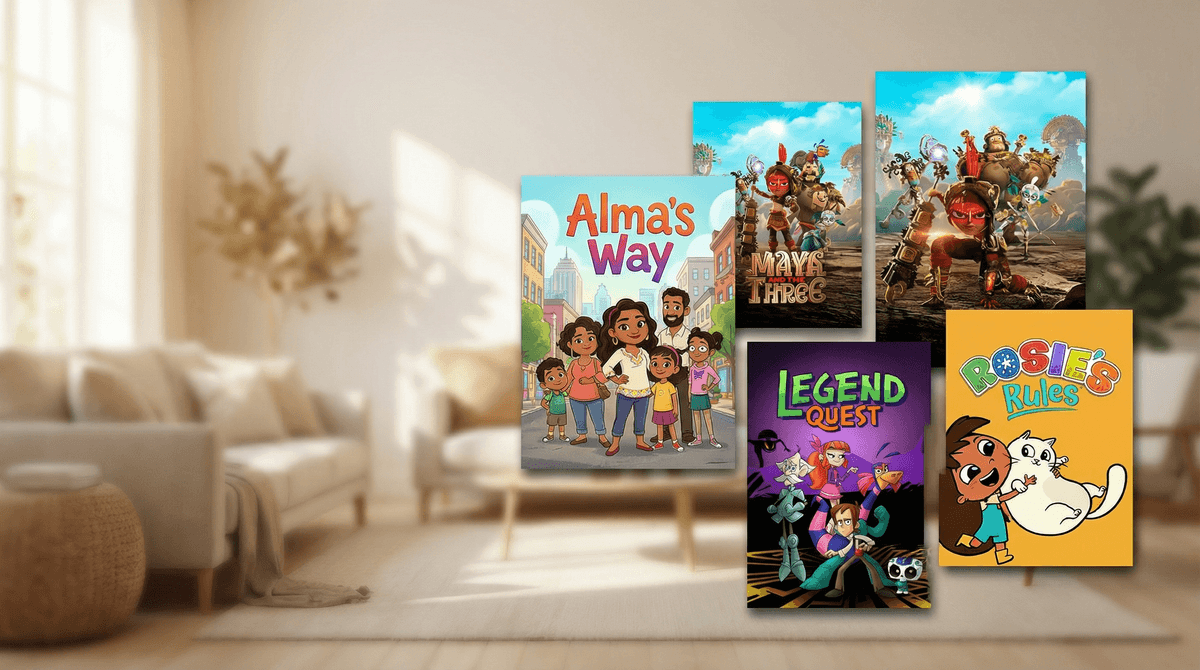
Rosie is a Mexican-American girl living in Texas. The show is great because it explains "how the world works" (like how the mail system works or how to be a good neighbor) while weaving in Spanish phrases that actually make sense in context. It’s not a vocabulary lesson; it’s just her life.
While Pocoyo is available in English, it was originally created in Spain. Switching the audio track to Spanish is a pro-move here because the narrator speaks very clearly and the vocabulary is simple. It’s the ultimate "starter" immersion show.
Once they hit school age, they want action. If a show feels too "educational," they’ll smell it a mile away and ask for MrBeast instead.
Created by Sonia Manzano (Maria from Sesame Street), this show is set in the Bronx. It’s fantastic for teaching "thinking through" problems. The bilingual element is seamless—Alma and her family speak Spanglish the way real families do. It’s authentic, urban, and high-quality.
If your kid likes Paw Patrol, they’ll like this. It’s an action-adventure pirate show that incorporates Spanish culture and language as "magic" elements. It’s fast-paced and high-energy.
A spinoff of The Loud House, this follows Ronnie Anne living in a multi-generational Mexican-American household. It’s funny, a bit chaotic, and deals with things like tamale-making and Quinceañeras without being cheesy.
For older kids, you can move away from "bilingual" shows and into actual Spanish-language content produced in Latin America or Spain.
This is a Mexican animated series (originally Las Leyendas). It’s about a boy who can see ghosts and travels the world to stop a supernatural threat. It’s spooky, cool, and perfect for the kid who thinks they’re "too old" for PBS. Watch it in the original Spanish with English subtitles.
This is a visual masterpiece based on Mesoamerican mythology. While the voice cast is star-studded in English (Zoe Saldaña, etc.), the Spanish dub is incredible. It’s an epic fantasy that rivals anything Disney has put out recently.
Here is a secret: Almost every major show on Netflix, Disney+, and Max has a Spanish audio track.
If your kid is obsessed with Bluey or Minecraft videos, try switching the audio to Spanish. Because they already know the plot of their favorite episodes, their brains can map the new Spanish words onto the actions they’re seeing. This is actually more effective for language retention than watching a "teaching" show because they are emotionally invested in the characters.
Read our guide on how to change language settings on every streaming platform
If you want to move from passive watching to active participation:
- Duolingo ABC: Great for early literacy.
- Lingokids: A solid "play-learning" app that has a lot of bilingual content.
- Roblox: Believe it or not, if you find Spanish-speaking servers (with supervision), it’s a crash course in "street Spanish" and slang. Just be careful—Roblox is a wild west.
When looking for Spanish content on YouTube, be extra careful. The Spanish-speaking "kids' content" world on YouTube is massive, but it's also full of low-quality, AI-generated "Elsagate" style videos. Stick to official channels like PBS Kids or Nick Jr to avoid the weird side of the algorithm.
Also, be aware that "Spanish" isn't a monolith. A show from Spain (Pocoyo) will use different slang and accents than a show from Mexico (Legend Quest). It’s a great talking point with your kids about how languages change depending on where people live.
You don't need to be fluent in Spanish to support your kid. In fact, it's better if you learn with them. Ask them, "Hey, what did Alma mean when she said 'piénsalo'?" It gives them a sense of mastery and makes the screen time feel like a shared family goal rather than just a babysitter.
Don't settle for the same three "bilingual" shows that have been on loop since 2010. Use the tech you already have to find high-quality, culturally rich content. Whether it’s switching Bluey to Spanish or diving into the folklore of Legend Quest, you can turn a standard Saturday morning into a language lab—without the "Ohio" vibes.
- Pick one show from the list above based on your kid's age.
- Commit to one "Spanish Saturday" where all cartoons are watched with Spanish audio.
- Check out our guide on how to balance screen time and language learning.
- Get a 7-day bilingual media plan