

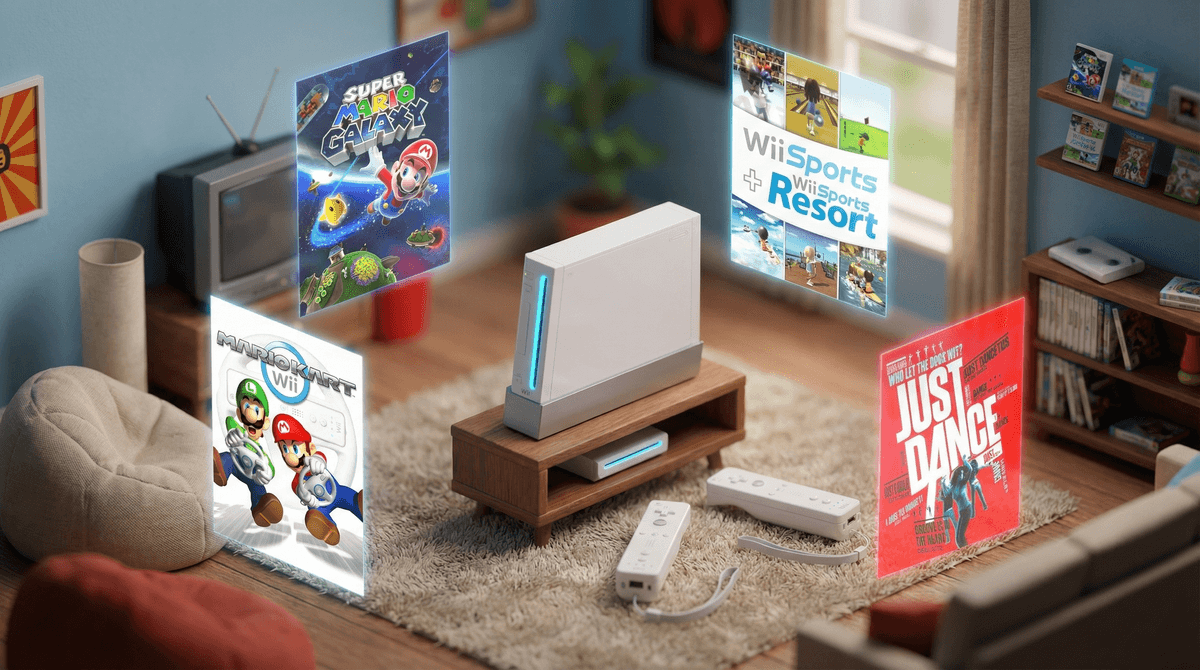
Okay, real talk: the Nintendo Wii came out in 2006, which means it's now officially retro. Like, your 10-year-old playing Wii Sports is the equivalent of you playing Atari as a kid. Wild.
But here's the thing—the Wii is having a moment. Maybe you've got one collecting dust in the basement, or you picked one up at a garage sale for $30, or your kid discovered it at their cousin's house and suddenly it's all they want to play. And honestly? The Wii is kind of perfect for the 8-12 age range.
The motion controls mean kids are actually moving (even if "bowling" mostly involves aggressive wrist flicks from the couch). The games are genuinely family-friendly without being babyish. There's no online chat to worry about, no microtransactions draining your credit card, and the graphics are charmingly blocky in a way that feels nostalgic rather than outdated.
Plus, Wii games are dirt cheap now. We're talking $5-15 for most titles. Compare that to $60-70 for a new Switch game, and suddenly that dusty console looks pretty appealing.
The Wii hits a sweet spot for elementary and middle schoolers because:
It's physically engaging. Kids this age have energy to burn, and games like Wii Sports or Just Dance actually get them moving. It's not a workout, but it's not vegetating either.
It's genuinely multiplayer. Not online multiplayer with strangers screaming slurs—actual same-room, same-couch multiplayer. Your kid and their friends can play together without you worrying about who they're talking to online.
The difficulty curve is gentle. Most Wii games are designed to be accessible. An 8-year-old can pick up the controls in minutes, but there's enough depth to keep a 12-year-old engaged.
It feels retro-cool. There's something about playing "old" games that makes kids feel like they've discovered a secret. It's the same appeal as listening to your Spotify playlists or wearing your old band t-shirt.
Wii Sports / Wii Sports Resort
Ages: 6+
This is the gateway drug. Wii Sports came bundled with most Wiis, so you probably already have it. Tennis, bowling, baseball, golf, boxing—all with simple motion controls that actually work pretty well.
Wii Sports Resort is the upgraded version with better graphics and more variety (swordplay, basketball, frisbee, wakeboarding). Both are perfect for family game nights or when your kid has friends over.
Parent note: The boxing can get a little intense—mostly because kids will absolutely whale on each other with the controllers. Set boundaries about personal space.
Mario Kart Wii
Ages: 6+
Mario Kart Wii is peak Mario Kart. The steering wheel accessory makes it feel special, the courses are creative and varied, and the difficulty settings mean everyone from your 8-year-old to your teenager can race together without it being a blowout.
The game supports up to 4 players locally, and the chaos of a red shell hitting you right before the finish line is a rite of passage. Expect some salt, some trash talk, and a lot of "ONE MORE RACE."
Parent note: This is where you'll hear "THAT'S NOT FAIR" approximately 47 times per session. It's part of the charm.
Super Mario Galaxy / Super Mario Galaxy 2
Ages: 7+
These are legitimately some of the best platformers ever made. Super Mario Galaxy and its sequel have creative level design, gorgeous music, and just enough challenge to keep kids engaged without being frustrating.
The second player can help by collecting star bits and stunning enemies—perfect for a younger sibling who wants to "play" but isn't quite ready for the full game.
Parent note: These games require some problem-solving and spatial reasoning. Great for developing those skills, but younger kids might need help with some of the trickier levels.
The Legend of Zelda: Twilight Princess
Ages: 10+
This is the big one for older tweens. Twilight Princess is a full-fledged adventure game with puzzles, combat, and exploration. It's darker and more mature than most Wii games (think Lord of the Rings vibes), but still appropriate for this age range.
The motion controls for sword fighting and aiming are satisfying, and the game is meaty—expect 30-40 hours of gameplay. Perfect for a kid who's ready for something more substantial than mini-games.
Parent note: There's some fantasy violence (sword fighting, monsters), but it's all very cartoony. The wolf transformation mechanic is cool but might be intense for sensitive kids.
Just Dance (any version)
Ages: 6+
Just Dance is exactly what it sounds like: you dance along to pop songs while the Wii remote tracks your movements. There are like 15 different Just Dance games for the Wii, and honestly, they're all pretty similar.
This is a party game through and through. Great for birthday parties, rainy afternoons, or burning off energy before bedtime. The songs are catchy (sometimes annoyingly so), and kids will absolutely want to show you their moves.
Parent note: Some versions have songs with lyrics you might want to preview first. The newer versions tend to have cleaner song selections, but it's worth checking.
Wii Fit Plus
Ages: 8+
Wii Fit Plus requires the Balance Board accessory, but if you've got one, this is a surprisingly engaging way to introduce kids to yoga, strength training, and balance exercises.
The mini-games are fun (ski jumping, hula hooping, tightrope walking), and the fitness tracking actually motivates some kids to keep coming back. It's not a substitute for real exercise, but it's a nice supplement.
Parent note: The BMI feature is controversial and can be problematic for body image. You can skip that part entirely and just focus on the games.
LEGO Games (Star Wars, Indiana Jones, Batman, Harry Potter)
Ages: 7+
The LEGO Star Wars, LEGO Indiana Jones, LEGO Batman, and LEGO Harry Potter games are all excellent co-op experiences. They're funny, forgiving (you can't really "die"), and packed with puzzles and collectibles.
The two-player co-op is drop-in/drop-out, so you can play together or let your kid explore solo. Plus, the LEGO humor is genuinely charming—lots of sight gags and slapstick that works for kids and adults.
Parent note: These games are long and can be repetitive, but the humor and variety keep most kids engaged. Great for siblings to play together.
Super Smash Bros. Brawl
Ages: 10+
Super Smash Bros. Brawl is the Wii version of the beloved fighting game franchise. It's chaotic, colorful, and endlessly replayable. Up to 4 players can battle it out as their favorite Nintendo characters (Mario, Link, Pikachu, etc.).
The learning curve is steeper than most Wii games, but once kids get the hang of it, they'll be hooked. There's a story mode, tons of unlockables, and enough depth to keep even competitive tweens engaged.
Parent note: It's a fighting game, but the violence is cartoonish (characters just get knocked off the stage). Expect some heated competition and possibly some controller-throwing if boundaries aren't set.
Kirby's Epic Yarn
Ages: 6+
Kirby's Epic Yarn is adorable, creative, and perfect for younger kids in this age range or kids who prefer gentler games. Everything is made of yarn and fabric, and the art style is just delightful.
It's a platformer with two-player co-op, and you literally can't die—you just lose beads (the collectible currency). This makes it perfect for less experienced gamers or kids who get frustrated easily.
Parent note: This is on the easier/younger end of the spectrum, so 11-12-year-olds might find it too simple. But it's great for younger siblings or as a chill, low-stakes game.
Animal Crossing: City Folk
Ages: 8+
Animal Crossing: City Folk is the Wii version of the life simulation series. You move to a new town, make friends with animal villagers, decorate your house, catch bugs, fish, and just... vibe.
There's no winning or losing, no time pressure, and no stress. It's open-ended and creative, which appeals to a lot of kids in this age range. The real-time clock means the game changes based on the actual time of day and season.
Parent note: This game is chill to the point of being slow. Some kids will love it; others will find it boring. It's also a bit dated compared to the newer Switch version, but still charming.
The Wii is offline-only. The Wii's online services shut down in 2014, which means no online multiplayer, no chat, no strangers. This is honestly a huge plus for this age range. Your kid can game without you worrying about who they're talking to.
Motion controls can be hit or miss. Some games (Wii Sports, Mario Kart) nail the motion controls. Others are clunky or require constant recalibration. If your kid gets frustrated easily, stick to games with traditional controller options.
It's a great "first console" experience. The Wii is forgiving, accessible, and doesn't require the same level of hand-eye coordination as modern consoles. It's a perfect stepping stone before moving to a Switch or PlayStation.
The library is huge and cheap. There are hundreds of Wii games, and most are under $20 used. You can build a solid collection for the price of two new Switch games.
Screen time feels different. Because so many Wii games require physical movement, it doesn't feel quite as sedentary as other gaming. That said, it's still screen time—just with more arm flailing.
The Wii is a hidden gem for the 8-12 age range. It's active, social, affordable, and blissfully free of the online chaos that comes with modern gaming. Whether you're dusting off an old console or picking one up secondhand, you've got access to a library of genuinely great games that hold up surprisingly well.
Start with Wii Sports or Mario Kart Wii to see if your kid vibes with the motion controls, then branch out based on their interests. Want adventure? Zelda. Want creativity? Animal Crossing. Want chaos? Smash Bros.
And honestly? The Wii is just fun. It's simple, it's silly, and it's a nice break from the overstimulating, hyper-competitive world of modern gaming. Sometimes retro is exactly what your family needs.
Want more game recommendations? Check out our guides on the best Nintendo Switch games for kids or alternatives to Fortnite.