

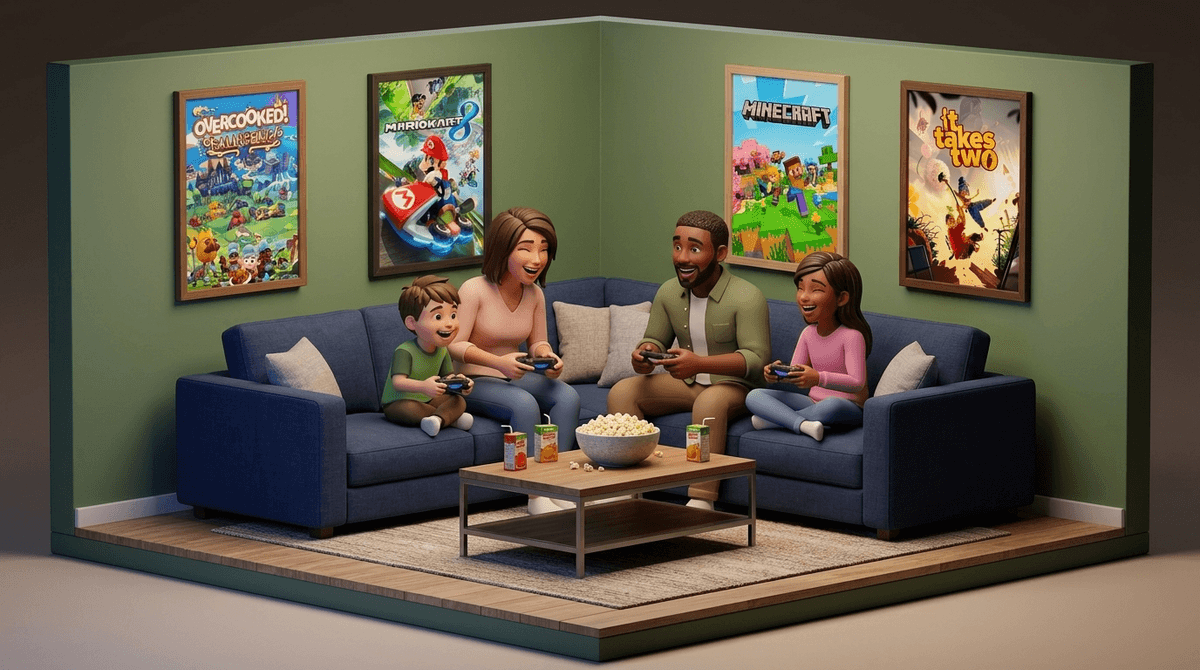
TL;DR: If you’re tired of your kids disappearing into the "online lobby" abyss with strangers, couch co-op is the antidote. These games require sitting on the same sofa, communicating in real-time, and—crucially—not screaming at a headset.
Our top picks for immediate family bonding:
- Best for Chaos & Communication: Overcooked! All You Can Eat
- Best for Pure Joy: Mario Kart 8 Deluxe
- Best for Problem Solving: Snipperclips
- Best for Narrative (Ages 10+): It Takes Two
- Best for Creativity: Minecraft
Let’s be real: most "multiplayer" gaming these days is a solitary experience. Your kid is wearing a headset, hunched over a glowing rectangle, arguing with a 12-year-old in another timezone about whether a skin is "mid" or "Ohio." It’s isolating, and frankly, it makes it hard to know what’s actually happening in their digital world.
"Local multiplayer" (or couch co-op) is the old-school solution to the modern "brain rot" problem. It’s about playing together in the same physical space. It turns screen time from a passive, isolating activity into a high-fiving, collaborative, and occasionally loud family event.
Whether you’re trying to understand why they’re obsessed with Roblox or you just want to beat them at a race, these games are the best way to bridge the gap.
When kids play Fortnite or Among Us online, the social dynamics are hidden. You can’t see the facial expressions of the people they’re playing with.
In a local multiplayer setting, they have to navigate the "physical" social cues of their siblings or parents. They learn how to lose gracefully (hopefully), how to give clear instructions without being a jerk, and how to work toward a common goal. It’s basically a stealth lesson in emotional intelligence, wrapped in a colorful digital package.
See the benefits of co-playing video games with your kids
This game is the ultimate litmus test for family harmony. You’re all chefs in a kitchen that is constantly trying to kill you—sometimes the floor disappears, sometimes you’re on a moving truck. You have to chop, cook, and wash dishes while shouting "I NEED A TOMATO!" at your spouse. It’s stressful, hilarious, and requires more teamwork than a corporate retreat.
- Ages: 7+ (requires quick reflexes and reading recipes)
- Parent Tip: Use the "Assist Mode" to slow down the timers if your younger kids are getting overwhelmed.
If Overcooked is about cooking, this is about the nightmare of moving furniture. You and up to three others are "Furniture Arrangement & Relocation Technicians." You have to haul couches and TVs out of houses, often throwing them through windows to save time. It’s silly, physics-based fun that rewards creative problem-solving.
- Ages: 6+
- Why it works: It’s less about "winning" and more about the absurdity of trying to fit a L-shaped sofa through a narrow door.
There is a reason this game is in almost every household with a Nintendo Switch. It is the gold standard of local multiplayer. It’s easy enough for a 4-year-old to play (with "Smart Steering" turned on) but competitive enough to keep adults engaged.
- Ages: 4 to 99
- Pro Tip: If your kid is constantly winning and getting "cocky," it might be time to introduce them to the history of the Blue Shell.
This is a fighting game, yes, but it’s "cartoon violence." Think Wile E. Coyote, not Mortal Kombat. It’s a great way for kids to blow off steam. It also features characters from almost every major franchise, making it a great "entry point" to talk about different games.
- Ages: 8+
- Note: This can get very competitive. If your kids struggle with "sore loser" syndrome, maybe stick to the co-op team modes rather than "free-for-all."
This is a hidden gem. Two players control paper characters who have to "snip" pieces out of each other to change their shapes and solve puzzles. It’s quiet, thoughtful, and requires genuine communication. You can’t "brute force" your way through it; you have to talk.
- Ages: 6+
- The Vibe: Calm, colorful, and highly rewarding.
While many kids play Minecraft on servers like Hypixel, the "split-screen" mode on consoles is fantastic. Building a house together or exploring a cave system in the same room is a totally different experience than playing separately.
- Ages: 7+
- Parent Tip: If you’re worried about monsters or the "stress" of survival, just play in Creative Mode. It turns the game into a digital LEGO set.
This is arguably the best co-op game ever made, but it’s for a specific audience. The story follows a husband and wife going through a divorce who are turned into dolls and must work together to return to normal.
- Ages: 10+ (due to some mature themes and one very traumatic scene involving a stuffed elephant—don't say I didn't warn you).
- Why it’s special: You literally cannot progress without your partner. Every level introduces a new mechanic that requires synchronization. It’s a beautiful, if occasionally dark, metaphor for relationships.
If your family wants something "cozy" and low-stress, building a farm together in Stardew is the way to go. You can divide the chores—one person fishes, one person mines, one person waters the crops. It’s slow-paced and incredibly charming.
- Ages: 8+
- Parent Tip: This is a great "wind-down" game for Sunday afternoons.
When picking a local multiplayer game, the ESRB rating is only half the story. You also need to consider:
- Motor Skills: Some games (like Cuphead) are brutally difficult. If your kid is still mastering the difference between the "A" and "B" buttons, they will get frustrated and quit. Start with Kirby’s Return to Dream Land Deluxe instead.
- Frustration Tolerance: Games like Overcooked are designed to be stressful. If your child is currently in a phase where they throw the controller when they lose a life in Super Mario Bros. Wonder, maybe wait a year.
- Reading Ability: Many indie games rely on text to explain objectives. If they aren't reading fluently yet, you'll be doing a lot of narrating.
Check out our guide on how to handle gaming tantrums
Let’s talk about the elephant in the room: The "Brain Rot" Factor.
Parents often worry that video games are just "wasted time." And look, if they’re spending six hours a day watching unboxing videos on YouTube, I’m with you—that’s not great.
But local multiplayer is different. It’s active. It’s social. It’s a shared language. When you play a game with your kid, you’re not just "watching them play"—you’re in the trenches with them. You’re learning the slang, you’re seeing how they handle pressure, and you’re showing them that you care about the things they care about.
Also, a quick warning: Avoid "Free-to-Play" console games that claim to be local multiplayer. Often, these are just vehicles for microtransactions. Stick to the "Buy Once, Play Forever" titles listed above. Your bank account will thank you.
Digital wellness isn't about "zero screens." It's about intentionality.
Replacing one hour of solitary iPad time with one hour of family Mario Kart is a massive win. You’re moving from "screen time as a babysitter" to "screen time as a campfire."
Pick a game, grab a second controller (yes, they are expensive, but they're worth it), and get on the floor. Even if you’re terrible at it, your kids will love seeing you try. And if they call your driving "Ohio"? Just hit them with a red shell. They’ll respect the hustle.
- Evaluate your hardware: Do you have enough controllers for the whole family?
- Set a "Family Game Night": Make it a recurring event so it becomes part of your family culture.
- Take the Screenwise Survey: Understand how your family's gaming habits compare to your community.
- Explore more: Check out our guide on the best board games for kids who love video games.