

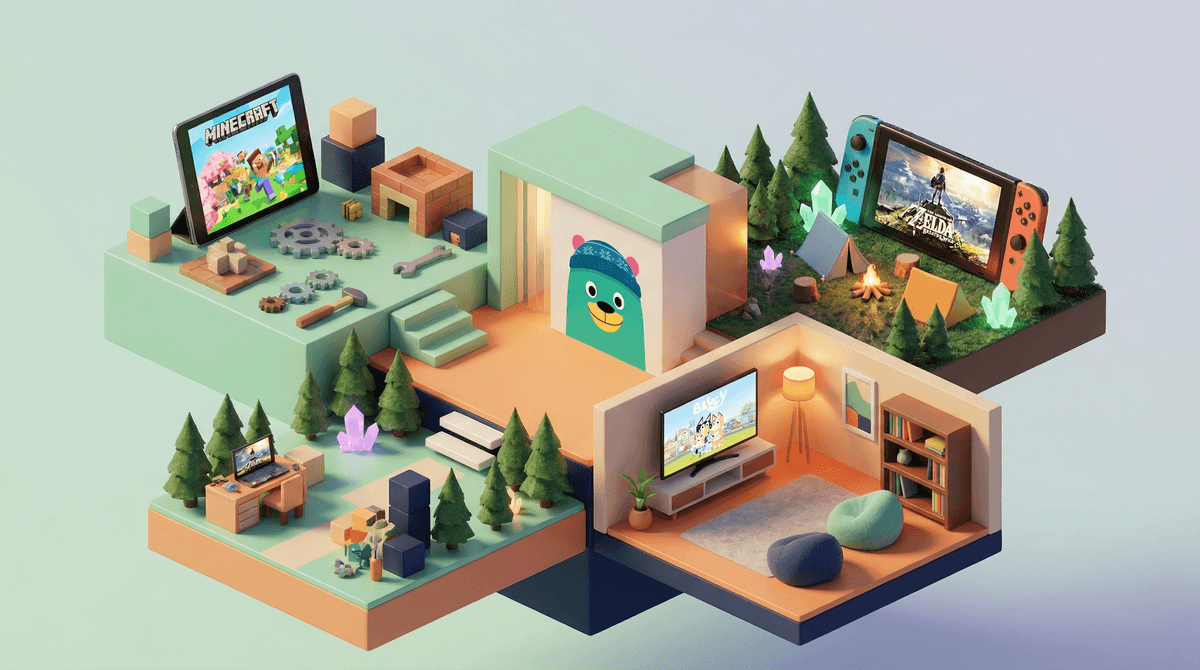
Let's start with the uncomfortable truth: the line between "educational" and "entertaining" media has basically dissolved. Your kid learning redstone circuits in Minecraft? That's engineering. Them watching Bluey and then working through their feelings about a friendship conflict? That's emotional intelligence. Even Roblox teaches basic economics when they're figuring out how to budget their Robux.
But here's the thing—not all screen time is created equal. There's a massive difference between a kid passively watching YouTube compilations of other kids opening toys versus actively problem-solving in Zelda: Breath of the Wild. Both are "screen time" but only one is actually engaging their brain.
So when we talk about educational media, we're really talking about content that does at least one of these things:
- Teaches specific skills or knowledge (math, reading, science, coding)
- Encourages critical thinking (problem-solving, strategy, analysis)
- Builds emotional intelligence (empathy, conflict resolution, self-awareness)
- Sparks curiosity (makes kids want to learn MORE about something)
The best educational media does multiple things at once. And honestly? It doesn't feel like homework.
Look, we all know the guilt spiral. Your kid watches two hours of TV and you're wondering if you've just sentenced them to community college. (You haven't. Relax.)
But here's what research actually shows: the content matters more than the screen time. A 2019 study found that kids who watched educational programming like Sesame Street had better vocabulary and school readiness than kids who watched the same amount of non-educational content. Quality over quantity isn't just a platitude—it's backed by data.
The other reason this matters? Kids are spending an average of 4-6 hours per day on screens (depending on age). If even half of that could be stuff that's actually enriching rather than just numbing? That's a meaningful difference in their development.
Ages 3-5: Building Blocks
Shows:
- Bluey - Emotional intelligence disguised as a cartoon about a dog family. Every episode is a masterclass in imaginative play and working through feelings.
- Daniel Tiger's Neighborhood - Those little songs actually work. "When you feel so mad that you want to roar..." will be stuck in your head, but at least your kid is learning emotional regulation.
- Octonauts - Marine biology for preschoolers. Surprisingly accurate science content.
Apps:
- Khan Academy Kids - Completely free, no ads, legitimately good. Math, reading, social-emotional learning. This is the gold standard.
- Endless Alphabet - Vocabulary building that doesn't feel like flashcards.
Podcasts:
- Wow in the World - Science stories that make kids say "WAIT, REALLY?" Great for car rides.
Ages 6-9: The Sweet Spot
Shows:
- The Magic School Bus Rides Again - The reboot is actually good. Science concepts explained through adventure.
- Avatar: The Last Airbender - Philosophy, ethics, and emotional complexity wrapped in an adventure story. This is the show that teaches kids about war, loss, and redemption without being heavy-handed.
- Mythbusters Jr. - Scientific method in action. Plus explosions.
Games:
- Minecraft - Yes, really. Spatial reasoning, planning, creativity, basic coding with redstone. Learn more about Minecraft's educational benefits.
- Osmo - Physical/digital hybrid games that teach math, spelling, and problem-solving.
- Prodigy Math - Math practice disguised as a fantasy RPG. Kids actually ASK to do more math problems.
Podcasts:
- Brains On! - Science podcast that treats kids like intelligent humans. Covers everything from black holes to why we hiccup.
Ages 10-13: Getting Real
Shows:
- Cosmos - Neil deGrasse Tyson making astrophysics accessible. Genuinely beautiful.
- The Great British Baking Show - Chemistry, following directions, handling failure gracefully. Plus it's wholesome AF.
- Bill Nye Saves the World - Climate science, engineering, current events. More mature than the original Bill Nye.
Games:
- Kerbal Space Program - Rocket science and orbital mechanics. NASA literally uses this for education.
- Civilization VI - World history, resource management, strategic thinking. Also teaches them that Gandhi will nuke you if you're not careful.
- Portal 2 - Physics puzzles that make your brain hurt in the best way.
YouTube Channels:
- Crash Course - High school level content on everything from chemistry to world history. John and Hank Green are national treasures.
- Kurzgesagt - Complex science explained with gorgeous animations. Warning: existential dread may occur.
- Mark Rober - Former NASA engineer doing wild science experiments. The glitter bomb videos are legendary.
Educational doesn't mean boring. If your kid is groaning before you even suggest it, it's probably not going to stick. The best educational content is stuff they'd choose themselves.
Active vs. passive matters. A kid playing Zelda is problem-solving, planning, learning from failure. A kid watching someone ELSE play Zelda on YouTube? That's just passive consumption. Both are fine in moderation, but they're not the same thing.
Beware the "educational" label. Lots of apps and shows slap "educational" on their marketing while being basically digital candy. Look for content that's actually been developed with educators or child development experts. Common Sense Media ratings are your friend here.
Follow their interests. A kid obsessed with dinosaurs will learn more from Prehistoric Planet than from a "well-rounded" show they don't care about. Lean into their obsessions—that's where deep learning happens.
Co-viewing is a multiplier. Watching or playing together and talking about what you're seeing makes everything more educational. Ask questions. Make connections. Point out cool stuff. Your engagement matters more than the content itself.
Educational media isn't about replacing school or turning every screen moment into a lesson. It's about making the screen time that's already happening count for something.
The best educational content doesn't announce itself. It sneaks learning in through the back door while your kid is having fun. They're not "studying marine biology"—they're just really into the Octonauts. They're not "practicing spatial reasoning"—they're building a castle in Minecraft.
And honestly? Sometimes the most educational thing is just a show that teaches empathy and emotional regulation. Bluey isn't teaching your kid algebra, but it's teaching them how to be a better human. That counts.
Start with one swap. Don't overhaul everything at once. Pick one show or game your kid currently loves and find an educational alternative in the same genre. Love adventure games? Try Zelda. Love silly cartoons? Try Bluey.
Use Screenwise to explore. Not sure if something is actually educational or just marketing? Check our ratings and parent reviews to see what other families think.
Ask your kid what they want to learn about. Then find media that matches. Curiosity is the best teacher—you're just the guide pointing them toward good resources.
And remember: perfect is the enemy of good. Your kid watching some educational content and some total brain rot? That's called balance. You're doing fine.