

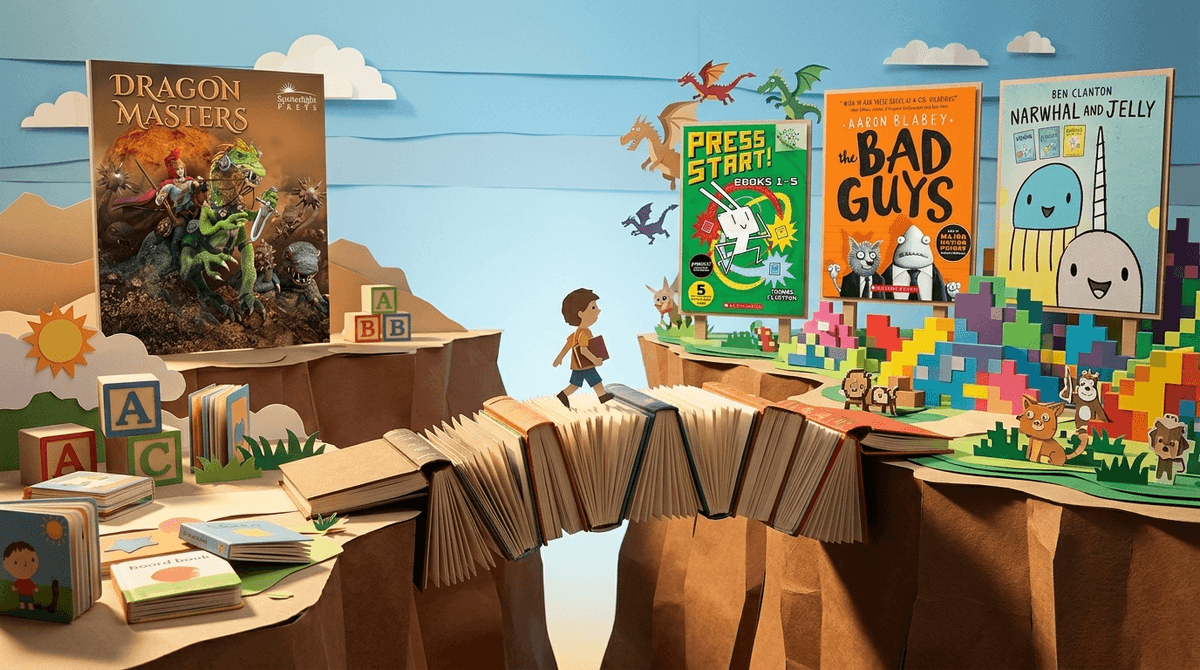
TL;DR: The Best "Bridge" Books for Early Readers
If you’re looking for a quick win to get your kid off the "reading cliff" and into a series they actually want to finish, start here:
- For the Gamer: Press Start! — High-octane, 8-bit aesthetic, very low barrier to entry.
- For the Fantasy Fan: Dragon Masters — The undisputed king of the "bridge" category.
- For the Graphic Novel Lover: The Bad Guys — Hilarious, fast-paced, and makes them feel like "big kids."
- For the Visual Learner: Narwhal and Jelly — Gentle, funny, and perfect for building confidence.
- For the Animal Lover: Mercy Watson — Short chapters, full-color art, and a pig who loves hot buttered toast.
Get a book list based on your kid's favorite Roblox game
We’ve all been there. Your kid is crushing picture books, they’ve memorized every word of their favorite Mo Willems story, and you think, "This is it. We’re moving to Harry Potter by Christmas."
Then you hand them a traditional chapter book—300 pages of dense black-and-white text—and the vibe immediately goes "Ohio." (That’s Gen Alpha for weird or bad, for those of us still catching up). They shut down. They ask for the iPad. They tell you reading is "boring."
The problem isn't your kid's brain; it's the "reading cliff." The jump from a 32-page picture book to a 150-page novel is massive. To bridge that gap, we need books that look and feel like a win. We need "bridge" books: series with short chapters, high-frequency illustrations, and plots that move as fast as a YouTube Short.
In the world of digital wellness, we talk a lot about "flow state" and "dopamine hits." Video games like Minecraft or Roblox provide constant feedback. If a book is too dense, the kid isn't getting that feedback. They feel like they're failing.
Bridge books provide "micro-wins." Every time they turn a page and see a cool illustration, or finish a three-page chapter, they get a hit of "I can do this." This builds reading stamina, which is the ultimate goal before they tackle something like The Wild Robot by Peter Brown.
If there is a "gateway drug" to independent reading, this is it. Scholastic’s Branches line was specifically designed for this transition, and Dragon Masters is the crown jewel.
- The Vibe: Pokemon meets Game of Thrones (but, you know, for 7-year-olds).
- Why it works: There are over 20 books in the series, so if they hook into it, you’re set for months. The sentences are simple, but the world-building is surprisingly deep.
For the kid who would rather be playing Super Mario Odyssey, this is your secret weapon.
- The Vibe: A literal video game in book form.
- Why it works: It uses speech bubbles and "level up" mechanics. It mimics the visual language of a screen, making the transition to paper feel less like a chore and more like a side quest.
You might have seen the The Bad Guys movie, but the books are where the real magic is.
- The Vibe: Heist movie energy with a lot of slapstick humor.
- Why it works: It’s technically a graphic novel/chapter book hybrid. There are very few words per page, which is great for kids who get overwhelmed by blocks of text. It’s also legitimately funny for parents to read along with.
This is the "low-stress" option.
- The Vibe: Spongebob Squarepants but wholesome and sweet.
- Why it works: It’s broken into short stories within each book. If your kid has a shorter attention span, they can finish one "story" in five minutes and feel a sense of accomplishment.
If your child prefers classic "once upon a time" stories over fart jokes and video games, go here.
- The Vibe: Traditional high fantasy with maps, dragons, and quests.
- Why it works: The vocabulary is a bit more elevated than Dragon Masters, but the beautiful, detailed illustrations on every page keep it from feeling intimidating.
I hear this at pickup all the time: "My kid only reads Dog Man. Is that actually reading?"
Let’s be real: Dog Man and InvestiGators are doing the heavy lifting for literacy in 2026. Reading a graphic novel requires multimodal literacy—the ability to synthesize text and image simultaneously. It’s a different brain muscle, and it’s a vital one.
If your kid is obsessed with Dog Man, let them be. They are learning pacing, dialogue, and narrative arc. They are building a positive association with books. That is a win. Don't pull the "real book" card yet. We're playing the long game here.
1. The "First Three Chapters" Rule
The hardest part of a chapter book is the setup. Offer to read the first three chapters aloud. Once the "inciting incident" happens and the kid is hooked on the plot, tell them you have to go make dinner and leave the book with them.
2. Use Digital Tools as a Supplement
Apps like Epic! are incredible for this phase. They have "Read-to-Me" versions of many bridge books. Your kid can follow along with the highlighted text while a narrator reads. It’s a great way to bridge the gap between listening and independent reading.
3. Audiobooks are "Real" Reading
If your kid is struggling with the mechanics of decoding words, their "ear reading" level is likely much higher than their "eye reading" level. Listening to The Wild Robot or Wings of Fire while playing with Legos still counts as consuming a story. It keeps their love for narrative alive while their eyes catch up.
- Kindergarten - 1st Grade: Focus on "Early Readers" (Level 1 and 2). Think Elephant & Piggie.
- 2nd Grade: This is the sweet spot for Dragon Masters and Owl Diaries.
- 3rd Grade: Transitioning into longer series like The Notebook of Doom or moving toward middle-grade fiction like Percy Jackson.
The "brain rot" era of content—think Skibidi Toilet or mindless Unboxing Videos—is designed for passive consumption. Chapter books, even the silly ones about bad guys or farting dogs, require active engagement.
When your kid moves from picture books to bridge books, they are moving from being a "consumer" to being a "participant" in a story. It’s a massive developmental leap. If they want to read the same The Bad Guys book six times, let them. Fluency comes from repetition.
Transitioning to chapter books isn't a race. There is no prize for the parent whose kid starts Harry Potter the earliest (trust me, if they read it too early, they miss 80% of the nuance anyway).
Focus on interest over "level." If they love Minecraft, get them the Minecraft: Woodsword Chronicles. If they love mystery, try A to Z Mysteries.
The goal isn't just to get them to read; it's to get them to see themselves as "a reader." Once that identity clicks, the rest is easy.
- Visit the Library: Let them pick out three "bridge" books based purely on the cover art.
- Model the Behavior: Put your phone in the charging basket and read your own book for 15 minutes while they read theirs.
- Check the Data: Use Screenwise to see which apps are competing for your kid’s attention and consider setting a "Book Before Roblox" rule.