

Beyond the Finale: A Parent's Guide to the Avatar: The Last Airbender Graphic Novels
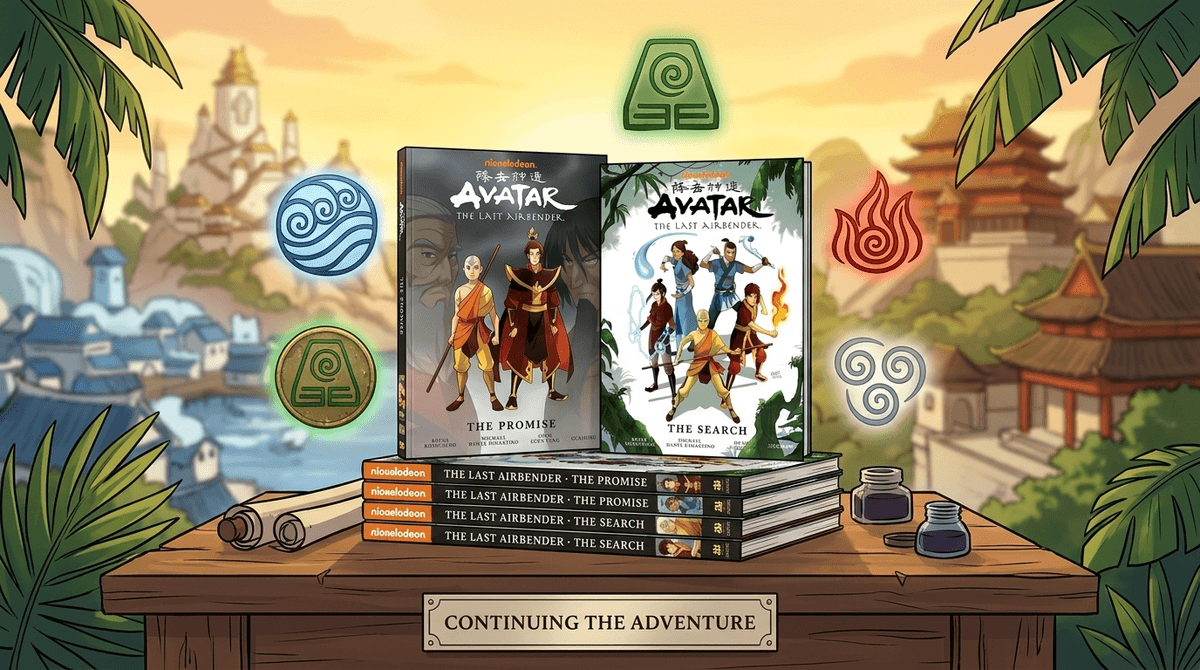
If your kid finished Avatar: The Last Airbender and is begging for more, the graphic novels are an excellent bridge from screen to page. These aren't just cash-grab tie-ins—they're canon continuations written by the show's creators that tackle genuinely complex themes like reconciliation after war, family secrets, and the messy reality of diplomacy. Start with The Promise trilogy for immediate post-finale satisfaction, move to The Search if they're obsessed with Zuko's mom, and save Imbalance for when they're ready for discussions about industrialization and labor rights. Ages 8+ can handle the content, though some colonial violence themes might need context for younger readers.
Quick recommendations:
- The Promise trilogy - Post-war reconciliation (start here)
- The Search trilogy - Zuko's mom mystery
- The Rift trilogy - Tradition vs. progress
- Smoke and Shadow trilogy - Fire Nation politics
- North and South trilogy - Water Tribe modernization
- Imbalance trilogy - Industrialization and class conflict
Here's what you need to know: these aren't adaptations of the show. They're official sequels co-written by Gene Luen Yang (who also wrote the excellent American Born Chinese) with input from original creators Michael Dante DiMartino and Bryan Konietzko. The art style mirrors the show closely enough that kids recognize their beloved characters immediately, but the stories tackle themes the TV series couldn't fully explore in 23-minute episodes.
Each trilogy (yes, they come in sets of three) runs about 200+ pages total and takes roughly 2-3 hours to read—perfect for a rainy afternoon or a long car ride. The format works brilliantly for kids who loved the show but haven't quite developed the stamina for 300-page novels yet.
About 40% of families in our community use Netflix regularly for kids' content, and YouTube usage is even higher—42% of kids have solo access. Getting kids to voluntarily put down screens and pick up books? That's the parenting equivalent of achieving world peace. The Avatar graphic novels are one of the few things that actually work.
The secret is that these don't feel like "reading" to reluctant readers—they feel like watching more episodes. The visual storytelling carries kids through complex vocabulary and dense dialogue they might skip in a traditional novel. I've seen kids who "hate reading" devour these in single sittings because they're so desperate to know what happens to Aang and Zuko.
Ages 8+ | Start here
Takes place immediately after the series finale. Zuko and Aang face their first major disagreement about how to handle Fire Nation colonies in Earth Kingdom territory. Some colonists have lived there for generations—do they get forcibly removed? What about mixed families?
This is where the graphic novels prove they're not messing around. The Promise tackles colonialism, cultural identity, and the reality that "good guys" can have fundamentally incompatible visions of justice. It's heavy stuff, but presented accessibly enough that an 8-year-old can grasp it while giving 12-year-olds (and parents) plenty to discuss.
Parent note: This introduces Yu Dao, the colony that becomes the foundation for Republic City in The Legend of Korra. If your kid plans to watch Korra next, this trilogy provides essential context.
Ages 9+
Finally answers the question every fan screamed at their TV: What happened to Zuko's mom? Team Avatar (plus Azula, in a fascinating and uncomfortable alliance) goes on a quest to find Ursa.
This trilogy gets darker than the show ever did. Azula's mental health struggles are front and center, and the revelations about Ursa's past involve some mature themes around forced marriage and identity erasure. Not inappropriate for kids, but definitely conversation-starters.
Why kids love it: Azula is simultaneously sympathetic and terrifying. The dynamic between her and Zuko is chef's kiss for character development.
Ages 8+
Aang faces conflict with Toph over a sacred Air Nomad site that's been turned into an industrial factory. This is basically "environmentalism vs. economic progress: the graphic novel," but way more nuanced than that sounds.
Toph's relationship with her father gets real development here, and we meet her metalbending students who become the police force in Korra. The story respects both sides of the tradition-versus-innovation debate without getting preachy.
Parent bonus: Excellent jumping-off point for discussions about climate change, industrial development, and indigenous land rights if your family is into that.
Ages 10+
Zuko's having a rough time as Fire Lord (shocker), and mysterious kidnappers are snatching Fire Nation children while dressed as the Kemurikage—dark spirits from Fire Nation folklore. Mai returns, there's legitimate horror-movie vibes, and Azula is... well, Azula.
This trilogy leans into psychological thriller territory more than previous ones. The kidnapping plot might be intense for sensitive younger readers, and Azula's manipulation tactics are disturbingly realistic.
Content consideration: Some scary imagery and themes around child endangerment. Not graphic, but atmospheric and tense.
Ages 9+
Katara and Sokka return to the Southern Water Tribe to find it rapidly modernizing with help from the Northern Water Tribe. Their father Hakoda is trying to balance tradition with progress, while a resistance movement thinks the South is selling out its culture.
This is probably the most politically sophisticated of all the trilogies. It's essentially about cultural imperialism, resource extraction, and who gets to decide a community's future. The fact that it's Water Tribe helping Water Tribe (not an outside colonizer) makes the moral questions even thornier.
Why it's great: Katara gets to be the main character again, and the story doesn't provide easy answers about "correct" development.
Ages 10+
Set in Cranefish Town (the future Republic City), this trilogy tackles industrialization, income inequality, and labor rights. Benders are using their powers in factories, non-benders are getting economically squeezed, and a populist movement is gaining traction.
This is the most "adult" in themes—it's basically about class warfare and economic justice. The villain (Liling) isn't wrong about systemic inequality, but her methods are... problematic. It's messy and uncomfortable in the best way.
Discussion gold: Perfect for families who want to talk about economic systems, fairness, and how good intentions can lead to harmful outcomes.
The publisher rates these 8+, which is generally accurate, but here's the real breakdown:
Ages 7-8: Can handle the action and plot but might miss the political nuance. The Promise and The Rift are the most accessible.
Ages 9-11: Sweet spot. Old enough to grasp the themes, young enough to still be fully immersed in the Avatar world.
Ages 12+: Will appreciate the complexity and might want to discuss the political parallels to real-world issues. These kids often reread the series and catch layers they missed before.
Content concerns across all trilogies:
- Cartoon violence consistent with the show (no blood/gore)
- Some scary imagery, especially in Smoke and Shadow
- Complex themes around war, colonialism, and political violence
- Azula's mental health struggles (portrayed with surprising sensitivity)
- Brief romantic content (mostly Aang/Katara, Sokka/Suki, Zuko/Mai—all very innocent)
Nothing here is worse than the show, and honestly, the show already dealt with genocide, child soldiers, and abusive families, so if your kid handled that, they'll be fine with these.
These are expensive. Each trilogy costs roughly $30-40 in paperback, $50-60 in hardcover. Libraries usually have them, or you can find used copies. The good news? Kids reread them obsessively, so the cost-per-hour of entertainment is actually reasonable.
They're gateway drugs to reading. I cannot overstate how many kids have gone from these graphic novels to Gene Luen Yang's other work, then to other graphic novels, and eventually to traditional novels. If your kid is a reluctant reader, this is a legitimate pathway.
The art quality varies slightly. Different artists worked on different trilogies. Some parents and kids have strong preferences—The Search and Smoke and Shadow are generally considered the most visually polished.
They're building toward Korra. If your kid hasn't watched The Legend of Korra yet, these graphic novels will make that series richer. If they have watched it, these provide satisfying context for how Republic City came to be.
There are also standalone stories. Beyond the trilogies, there are shorter graphic novels like Katara and the Pirate's Silver and Suki Alone that focus on individual characters. These are great for kids who want more but aren't ready to commit to another trilogy.
The Avatar graphic novels are that rare thing: official continuations that actually respect the source material and their audience's intelligence. They don't talk down to kids, they don't shy away from complexity, and they trust young readers to handle moral ambiguity.
If you're trying to reduce screen time without starting World War III, these books are your secret weapon. They satisfy the "I want more Avatar" craving while building reading skills and providing genuinely worthwhile content for family discussions.
Start with The Promise, see if it clicks, and go from there. Your library probably has them, or you can test the waters with a single volume before committing to full trilogies.
And if your kid tears through all of these and is still hungry for more? Check out our guide to books about Eastern philosophy and martial arts or other graphic novels for kids who loved Avatar.