

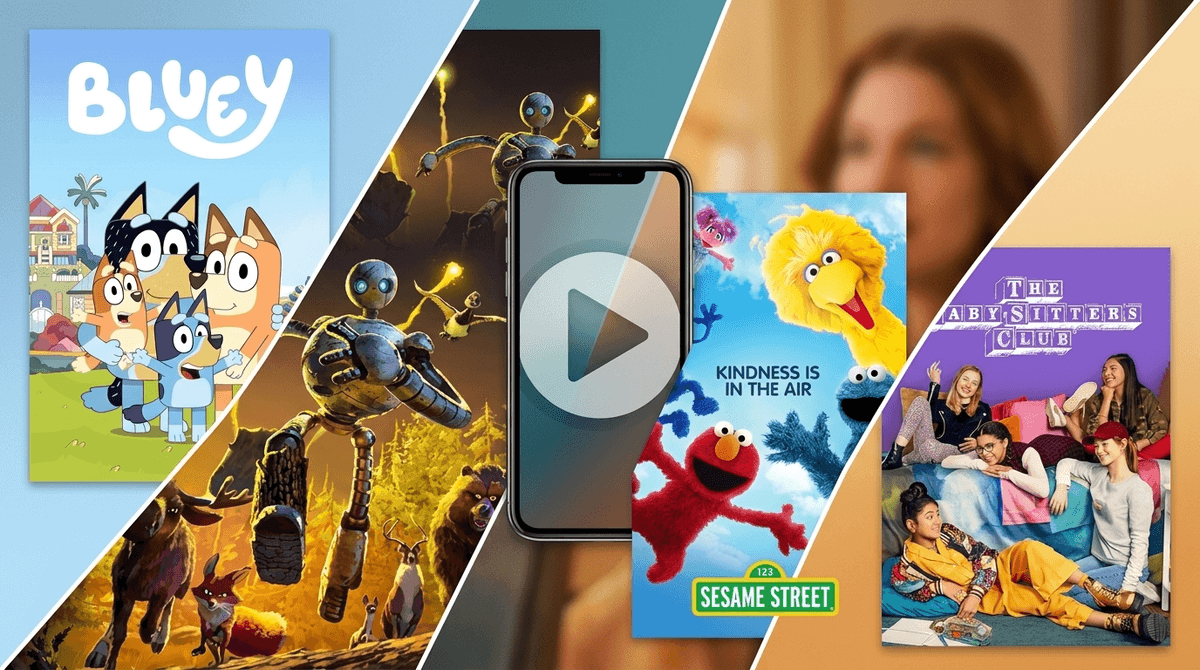
TL;DR: Animation is the "training wheels" of visual processing—great for toddlers who need simplified social cues, but it can easily turn into high-octane brain rot if the pacing is too fast. Live action is the gold standard for building empathy and "reading the room," but it requires a more mature brain to handle the visual complexity.
Quick Links to Top Recommendations:
- Best Low-Stim Animation: Bluey, Puffin Rock, Trash Truck
- Best "Starter" Live Action: Sesame Street, Waffles + Mochi
- Best Social-Emotional Live Action: The Baby-Sitters Club, Ghostwriter
We’ve all been there: you’re trying to cook dinner without a toddler clinging to your leg like a koala, so you put on a show. But then you catch a glimpse of what they’re watching—a neon-colored, high-pitched, hyper-animated fever dream where the camera cuts every 1.5 seconds—and you wonder, is this actually melting their brain?
Then you try to pivot to something "real," like a nature documentary or a live-action sitcom, and they lose interest in thirty seconds because the pacing feels "boring" compared to the dopamine-dripping pixels of a YouTube cartoon.
The debate between animation and live action isn't just about "cartoons vs. real people." It’s about how your child’s developing brain processes information, decodes emotions, and learns to pay attention in a world that is increasingly "Ohio" (that’s kid-speak for weird/cringe, for those of us still catching up).
For kids under five, the world is a chaotic mess of sensory input. Animation works because it simplifies.
In a cartoon, a character’s "sad face" is just two giant teardrops and a downward curve for a mouth. It’s an icon. A toddler’s brain can look at that and go, "Oh, he’s sad," without having to navigate the subtle micro-expressions of a real human actor. Animation distills complex human experiences into digestible, high-contrast chunks.
But there’s a dark side. Because animation isn't bound by the laws of physics or the cost of film crews, creators can make it fast. Shows like Cocomelon or some of the more chaotic YouTube Kids content use rapid-fire scene changes to "hook" the brain’s primitive orientation reflex. This is what parents call "zombie mode."

Once kids hit age 5 or 6, their brains start developing "Theory of Mind"—the ability to understand that other people have different thoughts and feelings than they do. This is where live action becomes a superpower.
When a kid watches The Baby-Sitters Club or even All Creatures Great and Small, they aren't just looking at icons. They are looking at real human eyes, subtle shifts in posture, and complex social dynamics.
Live action teaches kids to read the room. You can’t learn the nuance of a sarcastic "nice job" or a supportive "nice job" from a cartoon character with a fixed expression. You need to see the human behind it.
Ages 2-4: The Low-Stim Animation Era
At this age, live action can actually be a bit scary or confusing. The "Uncanny Valley" is real—real people doing strange things can feel threatening. Stick to animation, but keep it slow.
- The Goal: Narrative over noise.
- The Move: Puffin Rock or Frog and Toad. These shows have muted palettes and stories that move at the pace of actual life.
- The Warning: If the show feels like a Skibidi Toilet meme—random, loud, and nonsensical—it’s probably overstimulating them.
Ages 5-8: The Bridge Years
This is the sweet spot for introducing "gentle" live action. Kids are starting to navigate school friendships and need to see those modeled by real people.
- The Goal: Social-emotional literacy.
- The Move: Sesame Street is the classic bridge because it mixes puppets (simplified animation-adjacent) with real humans. Also, check out Waffles + Mochi on Netflix. It’s visually stunning but grounded in reality.
- The Animation Pivot: Move them toward Bluey. Yes, it’s a cartoon, but the emotional intelligence in Bluey is higher than most Oscar-winning dramas.
Ages 9-12: The Reality Check
By now, they might think cartoons are "for babies" (unless it’s Avatar: The Last Airbender, which is a masterpiece they should definitely watch). This is the time to lean heavily into live action to combat the "brain rot" of short-form content.
- The Goal: Critical thinking and empathy.
- The Move: Ghostwriter or The Wonder Years. These shows deal with real-world stakes—racism, friendship breakups, and growing pains—in a way that animation often glosses over.
- The Conversation: This is a great time to talk about "staged" reality. Is that YouTuber really that happy, or are they just acting?
We need to address the elephant in the room: the "brain rot" accusations. Not all animation is created equal.
There is a massive difference between The Wild Robot—which is a visual poem about motherhood and survival—and a 10-minute YouTube loop of a 3D character falling into a pit of slime.
Animation becomes "brain rot" when:
- Pacing is too fast: If there’s a scene change every 2 seconds, the brain never has to focus.
- No Narrative Arc: If things just happen without cause and effect, the kid isn't learning logic.
- High-Frequency Audio: That "YouTube Voice" (you know the one—loud, fast, slightly manic) is designed to keep kids in a state of high arousal.
Live action, by its nature, usually has to follow the laws of physics and human biology, which naturally slows the pacing down. That’s why we often see kids "calm down" more after an episode of a live-action show than a hyper-active cartoon.
One thing to watch out for: live-action "scary" is different from animated "scary."
A giant purple monster in a cartoon is clearly "make-believe." A slightly creepy neighbor in a live-action show can feel very real to a 6-year-old. Because live action looks like their actual life, the threats feel more immediate.
If your kid is sensitive, stick to high-quality animation like Hilda or Kiki's Delivery Service where the "magic" provides a safety buffer between the screen and reality.
The best way to figure out if a show is "better" for your kid isn't by checking a chart—it's by watching their face.
- The "Glaze": If they are staring at the screen with an open mouth and don't respond when you call their name, the show is likely too high-stimulation (common in "junk food" animation).
- The "Lean-In": If they are asking questions ("Why is she sad?" "Is that a real dog?"), they are actively processing. This happens more often with live action or slow-paced animation.
Check out our guide on how to co-view without losing your mind
It’s not a "one is good, one is bad" situation. It’s about balance.
Think of animation like a picture book—it’s a great way to learn the basics of storytelling and emotion through simplified visuals. Think of live action like a chapter book—it requires more focus, rewards empathy, and prepares them for the complexities of the real world.
If your kid's media diet is 100% cartoons, try swapping in one live-action show this week. You might find that the "post-screen time meltdown" is a lot less intense when they’ve been watching real people instead of vibrating pixels.
- Audit the "Pacing": Watch 3 minutes of your kid's favorite show. Count the camera cuts. If it's more than 10, it's high-stim.
- Introduce a "Human" Show: Try Waffles + Mochi or Sesame Street for the little ones.
- Talk about the "Real": Ask your older kids, "Do you think people actually act like that in real life?" after a live-action show. It’s the best media literacy training there is.