

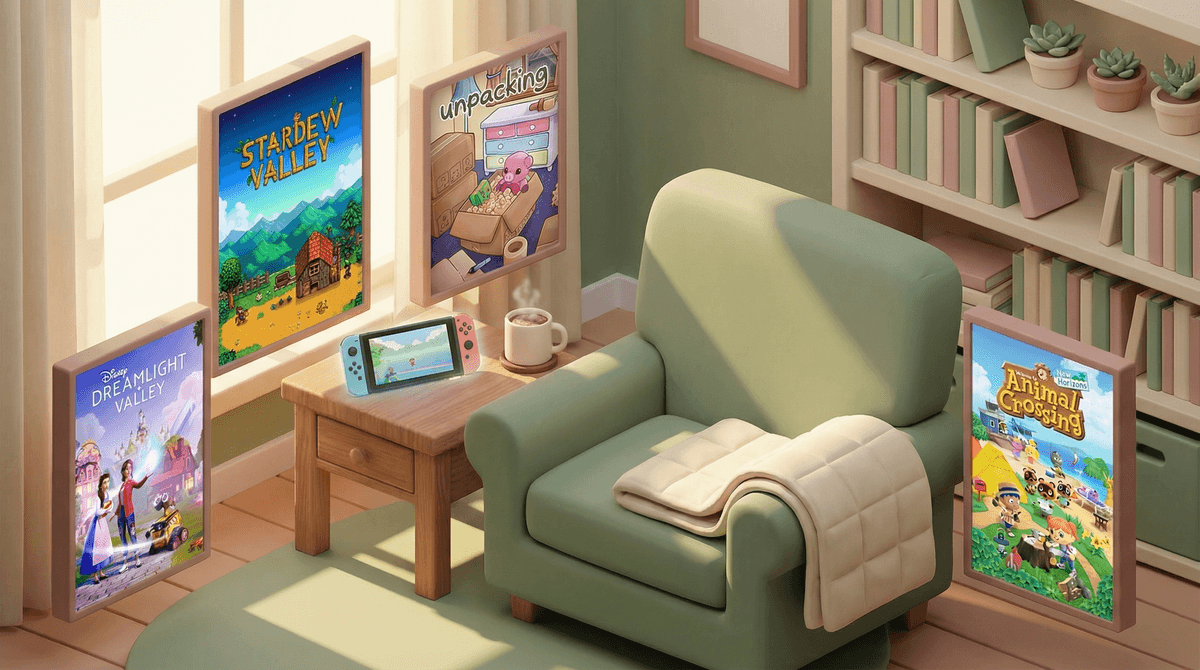
Animal Crossing and the World of Cozy Games
TL;DR
If your kid’s gaming diet has been a steady stream of high-octane "brain rot" or stressful battle royales, "cozy games" are the digital equivalent of a weighted blanket. They focus on creativity, organization, and relaxation rather than "winning."
Top Recommendations:
- The Gold Standard: Animal Crossing: New Horizons
- The Creative Powerhouse: Stardew Valley
- The Zen Puzzler: Unpacking
- The IP Favorite: Disney Dreamlight Valley
- The Bite-Sized Adventure: A Short Hike
Find cozy game recommendations by age
The "cozy" genre (sometimes called "wholesome games") is a massive trend that has exploded over the last few years. Unlike Fortnite or Roblox, where the goal is often competition, survival, or social status, cozy games are built around "low-stakes" activities. We’re talking about gardening, decorating a house, befriending talking animals, or organizing a digital room.
There is usually no "Game Over" screen. You can’t really lose. The music is lo-fi and chill. The art style is often soft or "kawaii." For a lot of kids (and let’s be honest, a lot of us parents), these games serve as a genuine tool for emotional regulation and mindfulness.
In a world where school is stressful and social media is a minefield, cozy games offer a sense of agency and order.
In Animal Crossing: New Horizons, a kid can design their entire island, decide where the trees go, and pick out their own furniture. It’s digital nesting. It’s also a way to "collect" things—bugs, fish, fossils—without the clutter taking over your actual living room.
If you have a Nintendo Switch, you’ve likely heard of this one. You move to a deserted island, pay off a mortgage to a tanuki named Tom Nook (who is either a benevolent mentor or a capitalist overlord, depending on who you ask), and build a community.
The Real-Time Catch
The most unique—and potentially frustrating—part of Animal Crossing is that it runs on a real-time clock. If it’s 3:00 PM in the real world, it’s 3:00 PM on the island. If it’s Christmas Day, the island is celebrating Toy Day.
This creates a specific kind of FOMO (Fear Of Missing Out). If your child wants to catch a specific fish that only appears in June after 9:00 PM, they might suddenly become very "intentional" about their screen time in a way that clashes with your house rules.
For the Junior Entrepreneur: Stardew Valley
This is a farming simulator where you inherit your grandfather's old farm. It’s incredibly deep. Kids learn about crop rotation, resource management, and building relationships with NPCs (non-player characters).
- Parent Note: While it's mostly wholesome, there are some "real world" themes in the character backstories, like a character dealing with alcoholism or another dealing with the aftermath of war. It’s handled gently, but it’s there.
- Ages: 10+ (due to complexity and some mature themes)
For the Perfectionist: Unpacking
This is a zen puzzle game where you simply unpack boxes and put items away in different rooms as a character grows up. There’s no dialogue, just a story told through objects. It is surprisingly emotional and incredibly satisfying for kids who love to organize.
- Ages: 6+
For the Disney Super-Fan: Disney Dreamlight Valley
Think Animal Crossing, but with Mickey, Moana, and Wall-E. You clear "Night Thorns" to restore a magical valley.
- The No-BS Take: This game is fun, but it is much more "grindy" than Animal Crossing. It also leans harder into micro-transactions (buying "Moonstones" for premium items). It’s basically a high-quality "freemium" game that you usually have to pay for upfront.
- Ages: 7+
For a Quick Reset: A Short Hike
This is a tiny, beautiful game about a bird going on a hike. It takes about two hours to finish. No combat, no stress, just exploration. It’s the perfect "palate cleanser" game.
- Ages: All ages
For the Creature Collector: Ooblets
Instead of Pokémon battles, you have dance-offs. You grow little creatures called Ooblets from seeds in your garden. It’s weird, quirky, and very funny.
- Ages: 8+
While these games are generally "safe," there are three things to keep an eye on:
1. The Time Sink
Cozy games are designed to be "sticky." Because there’s no natural stopping point (like the end of a match), kids can easily lose three hours "just finishing this one bridge" or "just watering the pumpkins." You’ll need to be the one to provide the "Game Over" screen.
2. FOMO and "Dailies"
Many of these games reward "daily logins." In Animal Crossing, if you don't play for a month, your island gets covered in weeds and your villagers might get sad and leave. For sensitive kids, this can feel like a chore or an emotional burden.
3. Online Visiting
In Animal Crossing and Stardew Valley, players can visit each other's farms/islands. This is usually done via "Dodo Codes" or invite links. It’s generally safe because there’s no open "lobby" of strangers, but if your kid is looking up codes on Discord or Reddit to visit "treasure islands," they are interacting with the broader internet.
- Ages 5-7: Stick to A Short Hike or Alba: A Wildlife Adventure. They are simple, have clear goals, and don't require much reading.
- Ages 8-12: Animal Crossing: New Horizons is the sweet spot. It encourages reading (lots of dialogue) and basic math/economics.
- Ages 13+: Stardew Valley or Spiritfarer. Spiritfarer is a "cozy game about dying"—it’s beautiful and profound, but it will absolutely make them (and you) cry.
If you want to connect with your kid over these games, don't ask "Are you winning?" They aren't. Instead, try these:
- "Which villager is your favorite right now? Why?"
- "Can you show me what you’ve done with your house decor?"
- "I noticed you're playing a lot of Animal Crossing lately. Does it help you feel more relaxed after school?"
- "Is there a specific event happening on your island this week that we should plan for?" (This helps manage the real-time clock issue).
Cozy games are a fantastic alternative to the high-stress, dopamine-loop games that dominate the market. They encourage creativity, patience, and a sense of "digital stewardship."
Yes, they can be a bit of a time-suck, and yes, Tom Nook is a bit of a shakedown artist, but compared to the toxic chat of a competitive shooter, a cozy village is a breath of fresh air.
- Check the Wise Scores: Look up Animal Crossing: New Horizons on Screenwise to see how other parents in your community are rating it.
- Set a "Harvest Timer": If your kid is playing a farming sim, set a timer for 30-45 minutes to help them transition out of the "one more day" loop.
- Try it yourself: Seriously. Grab a controller and help them pull some weeds. It’s surprisingly therapeutic.