

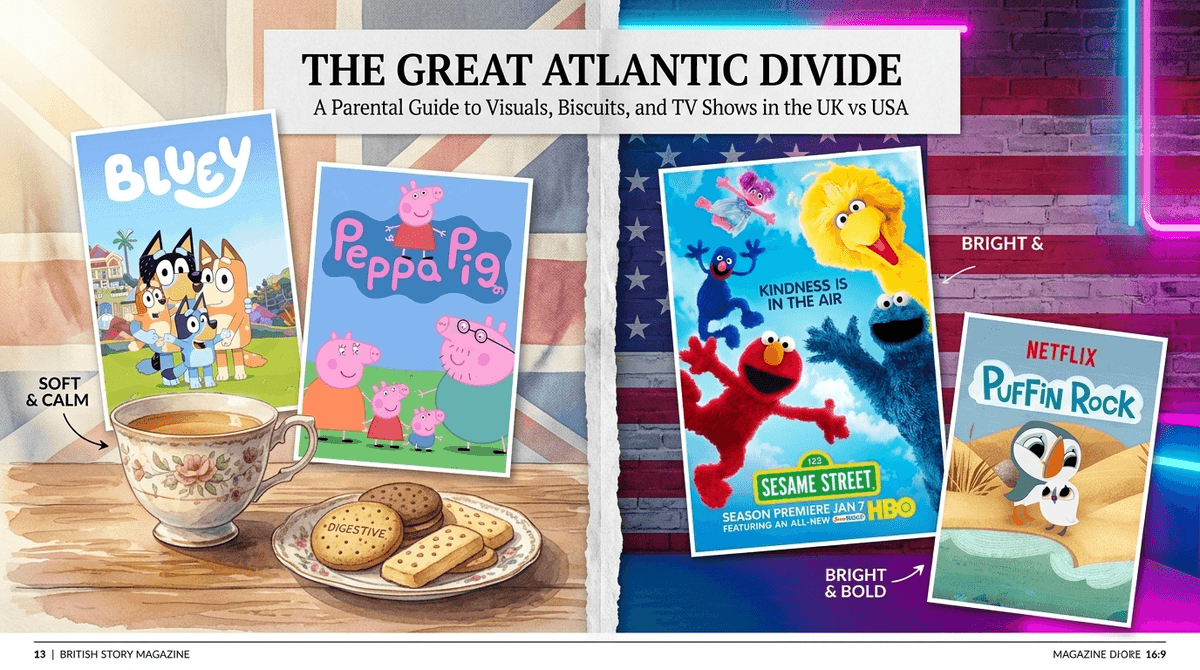
TL;DR: British (and Commonwealth) kids' TV often prioritizes slower pacing, dry humor, and "gentle" storytelling compared to the high-octane, commercial-driven energy of many American counterparts. While the "Peppa accent" is a funny quirk, the real difference lies in how these shows affect your child's attention span and emotional regulation.
Top Recommendations:
- The Gold Standard: Bluey (Technically Australian, but follows the UK-style public service model)
- Best for Calm: Puffin Rock
- Best for Humor: Hey Duggee
- Best for STEM: Octonauts
- US Classic that holds its own: Sesame Street
If you’ve ever walked into the kitchen to find your four-year-old asking for a "biscuit" instead of a cookie or calling the trash can a "bin," you’ve experienced the Peppa Effect. It’s a real phenomenon where American kids start adopting British inflections and vocabulary thanks to heavy doses of Peppa Pig.
But beyond the adorable accents, there is a fundamental divide between US and UK kids' media that most parents sense but can't quite put their finger on. It’s the difference between a show that feels like a warm hug and a show that feels like a neon-colored fever dream.
As we navigate the world of digital wellness for toddlers and preschoolers, understanding these cultural differences helps us choose content that doesn't leave our kids (and us) feeling completely fried by dinner time.
The biggest difference parents "miss" isn't the words—it's the frame rate and the "cut" speed.
Many American shows, particularly those born on YouTube like Cocomelon or Blippi, are designed using "retention editing." This means a camera cut happens every 2-3 seconds. The colors are hyper-saturated, the music is constant, and the characters are always shouting. This is essentially visual crack for a developing brain. It keeps them glued to the screen, but it also overstimulates their nervous system.
Contrast that with British "Public Service Broadcasting" (like CBeebies). Shows like Puffin Rock or Sarah & Duck use a much slower pace. The camera stays still. There is silence. The colors are muted and natural.
When a child watches a slower-paced show, they have the cognitive "breathing room" to actually process what they’re seeing. If you’ve noticed your kid is a "zombie" after watching certain shows or has a massive meltdown the second the TV turns off, you’re likely dealing with a pacing issue.

American kids' TV often feels like it’s trying really hard to be funny, usually through slapstick or high-pitched voices. British shows, however, often treat children like they’re "small adults" who can handle irony and dry wit.
Take Hey Duggee. It’s a show about a dog who runs a "Squirrel Club" (basically Scouts). It is arguably the funniest show on television for parents because it’s packed with cultural references—everything from Stranger Things parodies to 90s rave culture—without ever losing the kids.
Then there’s the "naughtiness" factor. American parents are often shocked by Peppa Pig because she can be a bit of a brat. She’s cheeky, she makes fun of her dad’s "big tummy," and she splashes in mud. In the US, we tend to prefer "aspirational" characters like Daniel Tiger's Neighborhood, who always says the right thing and handles his emotions perfectly.
The British approach is often more "observational." It shows life as it is—messy, slightly sarcastic, and full of puddles—rather than how it should be. Neither is inherently better, but if you want a show that actually makes you laugh along with your kid, the UK/Commonwealth exports usually win.
While we’re talking about the US/UK divide, we have to talk about Australia’s biggest export: Bluey.
Bluey is the "Unicorn" of kids' TV. It uses the British model of slow pacing and dry humor but adds a level of emotional depth that frankly makes most American shows look like cardboard. It’s not just "not brain rot"—it’s actually good art.
It’s also a great example of why we need to be careful with "educational" labels. Many US shows are "educational" in a "let’s count the apples" way. Bluey is educational in a "how to be a good friend and how to deal with disappointment" way.
Check out our deep dive on why Bluey is the best show for parents too
If you're looking to diversify your kid's media diet and move away from the "Ohio" energy of high-octane YouTube content, here are the top picks organized by "vibe."
Ages 2-5 This is the ultimate "gentle" show. Narrated by Chris O'Dowd, it follows a family of puffins on an Irish island. The animation is gorgeous (looks like a watercolor book), and the stakes are low. It’s perfect for winding down before bed or a "quiet time" screen session.
Ages 3-7 Imagine Star Trek but underwater with cute animals. This British show is legit STEM-heavy. Your kid will learn about hydrothermal vents and symbiotic relationships, but because it’s paced like a calm adventure, it doesn’t feel like a lecture.
Ages 3-6 If you want "traditional" education, this is the gold standard. It’s a BBC production that teaches math through visual grouping. It’s lightyears ahead of most American math shows in terms of pedagogical strategy, and the songs are surprisingly catchy (in a good way).
Ages 2-5 An American show that feels British. It’s slow, sweet, and focuses on the friendship between a boy and a literal trash truck. No shouting, no strobe lights, just vibes.
Ages 2-6 The GOAT. Even in 2026, Sesame Street manages to maintain its soul. It has adapted to modern pacing slightly, but it still prioritizes human (and Muppet) connection over flashy graphics.
We talk a lot about "brain rot" in digital wellness circles—that weird, nonsensical content like Skibidi Toilet that seems to suck the life out of kids' eyes.
The reason British-style TV is often recommended as an antidote is that it requires active listening. When a show is slower, the child has to follow the dialogue to understand the plot. When a show is hyper-fast (like many US commercial shows), the child is just reacting to visual stimuli. They aren't "watching" a story; they're being "hit" by images.
If you’re worried about your child’s attention span, the first step isn't necessarily "no screens"—it's switching the type of screen.
Learn more about the difference between active and passive screen time
- Ages 0-2: Ideally, no screens. If you must, go for the "gentlest" UK-style shows like In the Night Garden.
- Ages 3-5: This is the "Peppa" sweet spot. Focus on shows with clear narrative arcs and social-emotional lessons. Avoid anything with "unboxing" or YouTube-style influencers.
- Ages 6+: Kids start gravitating toward higher energy. This is when you can introduce US classics like SpongeBob SquarePants, but keep an eye on whether the "snark" is becoming their primary personality trait.
The American vs. British divide isn't about which country is "better" at TV—it's about the intent behind the content.
American media is often built on a commercial model: "How do we keep this kid's eyes on the screen long enough to sell a toy or show an ad?" This leads to high-energy, high-stimulation content.
British (and public-service style) media is often built on an educational model: "How do we provide value to this citizen-in-training?" This leads to slower pacing, nuanced humor, and better emotional regulation.
You don't have to ban Cocomelon entirely (unless you want to preserve your own sanity), but being "intentional" means recognizing when your kid needs a "biscuit and a bit of a laugh" with Bluey rather than a high-speed chase with a YouTube influencer.
- Audit the "After-TV" Mood: Pay attention to how your child acts after an episode of a US show vs. a UK show. The behavior will tell you everything you need to know about the pacing.
- Toggle the Settings: If you use Netflix or YouTube Kids, proactively search for "CBeebies" or "Gentle TV" to reset the algorithm.
- Embrace the Accent: If they start saying "mummy" and "telly," just lean into it. It’s a small price to pay for a kid who isn't overstimulated.