

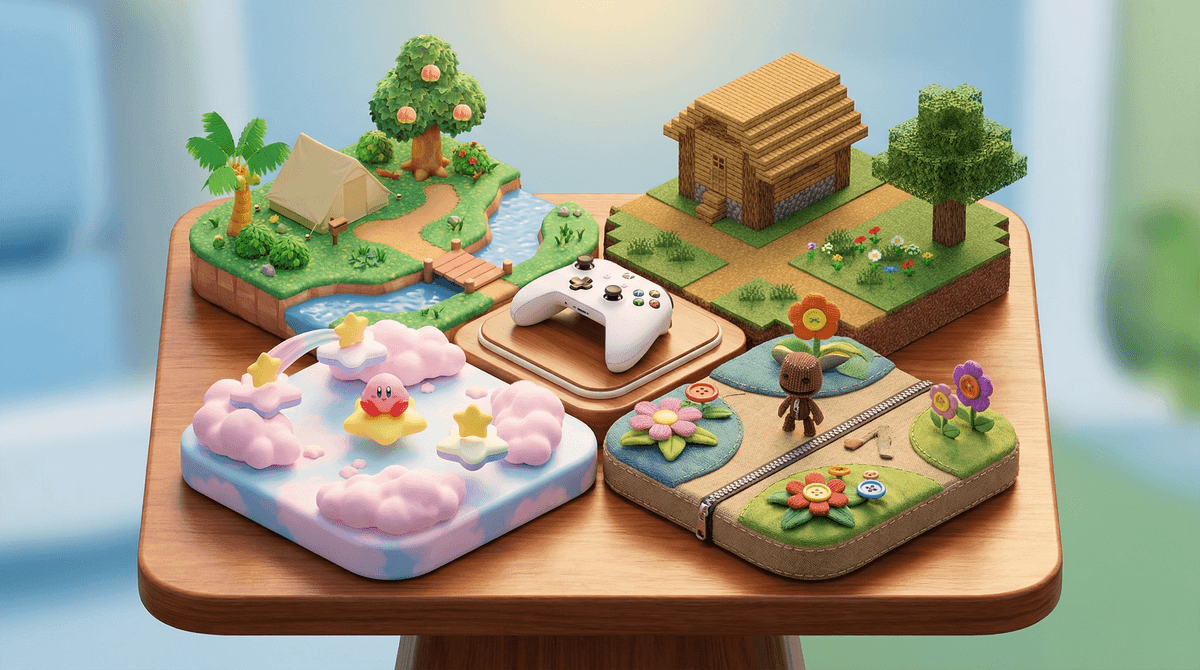
Age-Appropriate Video Games for 5-Year-Olds: A Parent's Guide
Five-year-olds can absolutely enjoy video games—the key is finding ones that match their developing motor skills, short attention spans, and need for positive reinforcement. Here are the standouts:
- Animal Crossing: New Horizons - Creative, open-ended island life
- LEGO video games - Cooperative play with familiar characters
- Pokémon Snap - Photography instead of battles
- Kirby and the Forgotten Land - Forgiving platformer with co-op mode
- Sackboy: A Big Adventure - Charming platformer perfect for beginners
Screenwise Parents
See allAt five, kids are still developing fine motor control and hand-eye coordination. They're learning to read but can't handle complex text-heavy interfaces. They get frustrated easily but also light up with encouragement and silly humor. The best games for this age:
- Have simple, intuitive controls (two or three buttons max)
- Can't really be "failed" or have forgiving consequences
- Provide frequent positive feedback (cheerful sounds, celebrations)
- Feature bright, appealing visuals without scary or intense imagery
- Allow for creative expression rather than just following objectives
- Work well in short 15-20 minute sessions
Violence is obviously a concern, but so is complexity. A game rated E for Everyone might still be frustrating if it requires reading quest logs or managing inventory systems. At this age, accessibility matters more than the ESRB rating alone.
Platform: Nintendo Switch | ESRB: E for Everyone
This is the gold standard for young kids' first real video game experience. You move to an island, decorate it however you want, catch bugs, fish, and chat with adorable animal neighbors. There's no time pressure, no failure state, no combat.
The reading requirement is real—there's a fair amount of text—but most five-year-olds can navigate with a parent nearby to help with dialogue. The game teaches resource management, delayed gratification (saving up bells for that perfect couch), and creative expression. Plus, the seasonal events and daily changes give kids a reason to check in without creating FOMO anxiety.
Parent tip: Set up a family island where everyone shares one Switch, or give each kid their own island if you have multiple Switches. The game autosaves constantly, so no tears over lost progress.
Platforms: Switch, PlayStation, Xbox, PC | ESRB: E to E10+
The LEGO games (LEGO Star Wars, LEGO Marvel, LEGO Harry Potter) are brilliant for this age because they're designed for cooperative play. You and your kid can play together, and when they inevitably fall off a cliff or get stuck, they respawn instantly as a pile of LEGO studs.
The humor is goofy and physical—characters bonk into things, make silly faces, and everything breaks apart into satisfying LEGO pieces. There's light combat (characters just fall apart), puzzle-solving that's manageable with help, and tons of unlockables that keep kids engaged.
Pick based on their interests: Love Star Wars? Get LEGO Star Wars: The Skywalker Saga. Into superheroes? LEGO Marvel Superheroes is perfect. The gameplay is essentially the same across all titles, just reskinned with different characters.
Platform: Nintendo Switch | ESRB: E for Everyone
Instead of battling Pokémon, you're photographing them in their natural habitats. You ride on a rail (no complex movement controls), point your camera, and snap pictures. It's essentially a safari tour where you throw apples to get creatures to pose.
The game rewards observation and patience rather than quick reflexes. Kids learn to look carefully at their environment, time their shots, and appreciate the different Pokémon behaviors. There's zero violence, and the worst thing that happens is you miss a good photo opportunity.
Bonus: If your kid loves Pokémon but you're not ready for the complexity of mainline games like Pokémon Scarlet and Violet, this is the perfect gateway.
Platform: Nintendo Switch | ESRB: E10+ (but totally fine for 5-year-olds)
Kirby games are famously forgiving. You play as a pink puffball who inhales enemies and copies their abilities. The controls are simple, the aesthetic is adorable, and there's a co-op mode where a second player can join as Bandana Waddle Dee.
What makes this perfect for five-year-olds: Kirby has a huge health bar, healing items are everywhere, and if you get stuck on a section, the game offers to make it easier. There's light combat, but it's so cartoonish (Kirby literally swallows bad guys and they disappear with a pop) that it doesn't register as violent.
The game also has a "mouthful mode" where Kirby swallows objects like cars and vending machines, which is objectively hilarious to this age group.
Platforms: PlayStation 4/5 | ESRB: E for Everyone
This is a 3D platformer starring the lovable sack-creature from LittleBigPlanet. You run, jump, and collect items through beautifully designed levels that look like craft projects come to life.
The game scales difficulty beautifully—early levels are simple enough for beginners, and there's excellent co-op support for up to four players. When kids struggle, you can literally carry them through tough sections. The art style is warm and inviting, the music is cheerful, and the whole vibe is encouraging rather than punishing.
PlayStation exclusive note: If you're on Nintendo Switch or Xbox, Yoshi's Crafted World fills a similar niche with its craft-aesthetic platforming.
Minecraft (Creative Mode)
Platforms: Everything | ESRB: E10+
Yes, Minecraft works for five-year-olds—if you stick to Creative Mode. In Creative, there are no enemies, no death, no survival mechanics. It's just pure building with unlimited resources.
Kids this age love making simple houses, farms, and elaborate structures that make zero architectural sense. They'll build a castle entirely out of diamond blocks because it's shiny. They'll create a zoo for the animals. They'll dig massive holes "just because."
Parent involvement required: You'll need to set up the world in Creative Mode, help with controls initially, and probably play alongside them. But once they get it, Minecraft becomes a digital LEGO set with infinite pieces. Learn more about Minecraft for young kids here.
Platforms: Switch, PlayStation, Xbox | ESRB: E for Everyone
If your kid is deep in the Paw Patrol phase, there are several games featuring the rescue pups. Titles like Paw Patrol: Grand Prix (a simple racing game) and Paw Patrol: Mighty Pups Save Adventure Bay are designed specifically for preschool and early elementary ages.
These aren't going to win any game design awards, but they're perfectly calibrated for small hands and short attention spans. The missions are simple, the stakes are low, and kids get to play as their favorite characters. Sometimes that's exactly what you need.
Fortnite - The shooting mechanics, fast pace, and online interactions are too much for five-year-olds. Wait until at least 8-10.
Roblox - While some Roblox experiences are fine for young kids, the platform is unmoderated chaos with real money mechanics. If you do allow it, stick to curated experiences and set up strict parental controls.
Most Mario games - Controversial take, but hear me out: traditional Super Mario platformers require precise timing and can be frustrating for five-year-olds. Mario Kart with steering assist is great, but save Super Mario Odyssey for age 7+.
The Legend of Zelda: Breath of the Wild - Amazing game, wrong age. The open world is overwhelming, combat is too complex, and the game expects problem-solving skills that most five-year-olds haven't developed yet. Bookmark this for age 9-10.
The American Academy of Pediatrics recommends no more than one hour of quality screen time per day for kids ages 2-5. At five, you're transitioning into the 6+ guidelines (which are more flexible), but an hour is still a good baseline.
For gaming specifically, 20-30 minute sessions work better than hour-long marathons. Five-year-olds' attention spans are still developing, and shorter sessions prevent the glazed-over zombie look that signals overstimulation.
Co-playing is ideal at this age. You're teaching them:
- How to handle frustration when things don't work
- Good sportsmanship (celebrating wins, handling losses)
- Problem-solving strategies
- When to take breaks
Gaming together also helps you understand what they're experiencing and keeps the activity social rather than isolating.
ABCmouse, Khan Academy Kids, and similar apps absolutely have their place. They're great for letter recognition, early math, and structured learning.
But here's the thing: the games listed above teach valuable skills too. Animal Crossing teaches resource management and planning. LEGO games teach spatial reasoning and cooperation. Minecraft teaches creativity and persistence. Pokémon Snap teaches observation and patience.
Not every game needs to be explicitly educational. Play value, creativity, and fun are legitimate benefits. If your kid is excited to play Kirby after finishing their homework, that's not "just entertainment"—they're developing hand-eye coordination, learning to navigate 3D space, and practicing persistence through challenges.
That said, mixing in some educational games is totally fine. Balance is the goal.
Controller complexity matters. The Nintendo Switch has the most kid-friendly controllers—the Joy-Cons are small enough for little hands. PlayStation and Xbox controllers work but are bulkier.
Consider accessibility features. Many modern games have assist modes:
- Sackboy lets you skip difficult sections
- Mario Kart has auto-steering and auto-acceleration
- Kirby offers to make levels easier if you fail repeatedly
These aren't "cheating"—they're tools that let kids enjoy games that would otherwise be frustrating.
Physical games vs. digital downloads: For five-year-olds who love the ritual of choosing and inserting a cartridge, physical games are great. But digital downloads mean no lost cartridges and easier switching between games. Your call based on your kid's responsibility level (and your tolerance for "I can't find my game!" meltdowns).
Five is a great age to introduce video games—with the right titles and boundaries. Look for games with simple controls, forgiving gameplay, and positive vibes. Prioritize co-op experiences where you can play together, and keep sessions short.
The games listed here—Animal Crossing, LEGO games, Pokémon Snap, Kirby, and Sackboy—are specifically designed to be accessible, encouraging, and age-appropriate. They'll give your kid a positive introduction to gaming without the frustration or concerning content.
And remember: you don't need to become a gaming expert overnight. Start with one game, play it together, and see what clicks for your kid. Some five-year-olds will love the creative freedom of Minecraft, while others prefer the structure of LEGO games. There's no one-size-fits-all answer.
Ready to dive in? Start with Animal Crossing: New Horizons if you have a Switch—it's the most universally beloved game for this age group. If you want something you can play together immediately, grab any LEGO game based on your kid's interests.
Want more game recommendations? Check out our guides on cozy games for kids, best Nintendo Switch games for young kids, and alternatives to violent video games.
Still have questions? See reviews and safety for specific games or learn more about setting up parental controls on your console.