

TL;DR
If your kid is asking for Minecraft, they’re joining about 50% of their 1st-grade peers and nearly 70% of 3rd graders who are already building digital worlds. For kids ages 5-8, start with Creative Mode on Peaceful difficulty to avoid the "scary" monsters. Keep them off public servers and stick to a local "Single Player" world or a family Realms subscription. Watch out for the Marketplace—it’s a slickly designed store where real money turns into Minecoins very, very fast.
Quick Links for the Little Builders:
- Minecraft (Game) - The gold standard of sandbox play.
- Lego Fortnite - A free, slightly more polished alternative for kids who like building.
- Stampy Cat (YouTube) - The "Mr. Rogers" of Minecraft YouTubers (safe for little ears).
- Toca Life World - A great "pre-Minecraft" step for the 4-6 age range.
Think of Minecraft as a never-ending bucket of digital LEGOs. There are no instructions, no points, and no "winning" in the traditional sense. You drop into a world made entirely of blocks—dirt, wood, stone, water—and you can break them, move them, and stack them to build anything from a dirt hut to a scale replica of the Hogwarts castle.
For parents, the most important thing to know is that there are two main versions:
- Bedrock Edition: This is what’s on iPads, Nintendo Switch, Xbox, and PlayStation. It’s the version that allows for cross-platform play and has the built-in Marketplace.
- Java Edition: The "original" PC/Mac version. It’s more flexible for mods (user-created content) but a bit more technical to set up.
If your kid is under 8, they are almost certainly playing Bedrock on a tablet or console.
It’s the first time many kids experience true agency. In the real world, they’re told when to eat, sleep, and put on shoes. In Minecraft, they are the architects of their own reality. If they want to make a house out of pink wool and fill it with 50 chickens, they can. It’s also a massive social currency; knowing what a "Creeper" is or how to craft a diamond sword is the "Ohio" (weird/cool/relevant) talk of the playground.
Find out why Minecraft is better for brain development than scrolling YouTube
The biggest decision you’ll make is which mode your child plays. For the 5-7 age group, Creative Mode is your best friend.
In Creative, your child is invincible. They can’t drown, they can’t fall into lava and die, and they have an infinite inventory of every block in the game. They can also fly, which makes building much easier.
- The Vibe: Stress-free building.
- The Risk: Boredom (sometimes they need a "goal").
Survival Mode
This is the "real" game. You have to mine for resources, manage a hunger bar, and fight off "mobs" (monsters) like Zombies and Skeletons that come out at night.
- The Vibe: High stakes. If you die, you drop all your items, which can lead to massive meltdowns for a 6-year-old who just spent an hour finding a "shiny blue rock" (diamond).
- The Compromise: Use Peaceful Difficulty. This keeps the survival mechanics (hunger, health) but removes the hostile monsters.
Learn how to turn on "Keep Inventory" so your kid doesn't cry when they fall in lava
Unlike Roblox, where the entire economy is built on user-generated "pay-to-win" games, Minecraft is mostly a "pay-once" experience. However, the Minecraft Marketplace is a constant temptation. It sells "Skins" (outfits), "Texture Packs" (making the world look like plastic or a cartoon), and "Worlds" (pre-built adventures).
Most of this content is purely cosmetic. Your kid doesn't need the "Skibidi Toilet" skin pack to play the game.
- The No-BS Take: The Marketplace is designed to look like a toy store. It uses "Minecoins" to obscure the actual cost in dollars.
- The Strategy: Treat Minecoins like an allowance or a reward for chores. Once the coins are gone, they’re gone.
Minecraft is safest when played alone or via Split-Screen. On consoles, you can plug in a second controller and build together on the couch. This is the ultimate "digital wellness" move because you are actively participating in their world.
If they want to play with friends who aren't at your house:
- Friends Only: Set the world permissions so only "Friends" can join.
- Minecraft Realms: A private, subscription-based server (about $8/month) where only invited people can play. It’s a walled garden and much safer than public servers.
- Public Servers (Avoid): Large servers like Hypixel or The Hive have chat rooms and thousands of strangers. For kids under 10, there is zero reason to be on these.
If your kid is into Minecraft, they probably want to watch people play it on YouTube. This is where things get dicey. A lot of Minecraft YouTubers are... loud. Some are toxic. Some use "brain rot" humor that you’ll be hearing echoed back to you for weeks.
Stampy Cat (Ages 5+)
Stampy (Joseph Garrett) is a legend for a reason. His "Lovely World" series is wholesome, educational, and he rarely, if ever, raises his voice or uses inappropriate language. It’s basically the gold standard for young kids.
Aphmau (Ages 7+)
Incredibly popular with younger kids, especially girls. Her videos are more like "digital dollhouse" stories than straight gameplay. They are colorful and high-energy.
- The No-BS Take: It’s harmless, but the high-pitched voices and frantic editing can be grating for parents. It’s "digital candy"—fine in moderation, but maybe not right before bed.
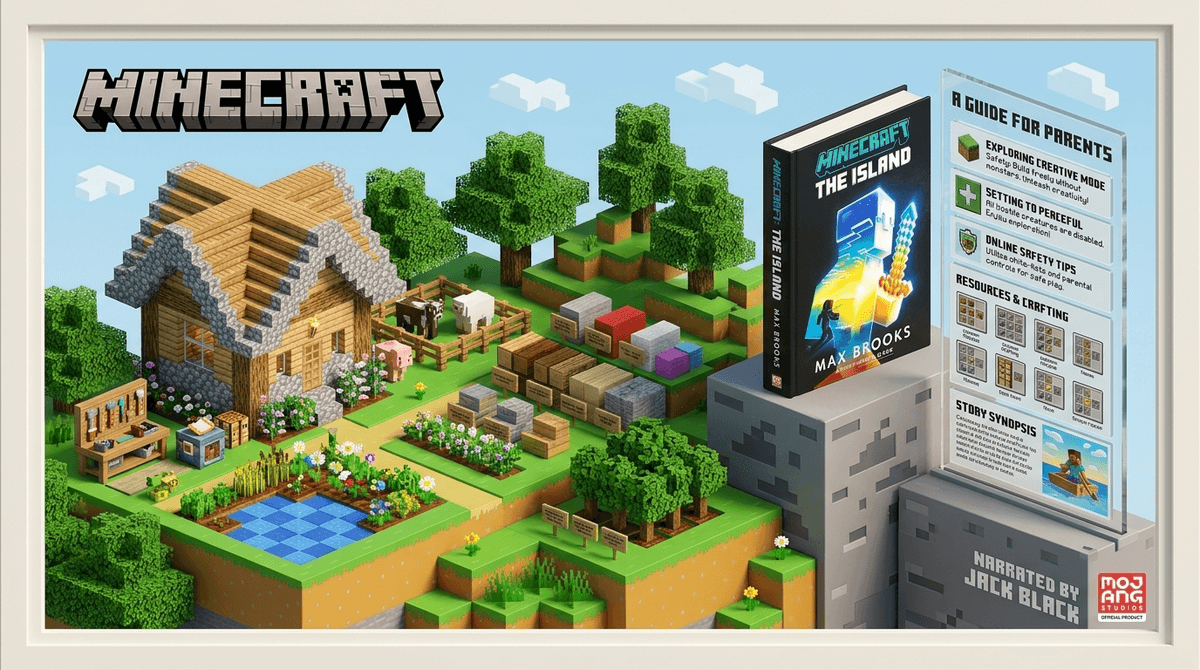
Minecraft: The Island by Max Brooks (Ages 8+)
If you want to move the obsession from the screen to the page, this book (written by the guy who wrote World War Z) is actually a fantastic survival novel that captures the logic of the game.
- Ages 4-6: Stick to Creative Mode on a tablet. Use it as a tool for color recognition and "digital block play." Play together!
- Ages 7-9: Introduce Survival Mode on Peaceful. This is a great time to talk about resource management (e.g., "If we use all our wood to make a giant tower, we won't have any left for tools").
- Ages 10+: They might start asking for mods or public servers. This is when you need to have the "internet safety" talk and perhaps move them to the Java Edition on a PC where they can learn basic file management and modding.
You’ve probably seen it: the slack-jawed, unblinking stare of a kid deep in a build. Minecraft is highly "flow-inducing." Transitioning out of the game is often the hardest part.
Pro-tip: Give them a 10-minute and 5-minute warning, but make it specific to the game. "Finish the roof on that house and then it's time for dinner" is much more effective than "5 minutes left," because it acknowledges the task they are trying to complete.
Minecraft is one of the few "big" games that actually deserves its popularity. It’s essentially an engineering and art tool disguised as a game. Unlike Roblox, which can feel like a chaotic strip mall, Minecraft feels like a private workshop.
If you set the boundaries early—Creative mode, no public servers, and a firm "No" on random Marketplace spends—it can be a truly rewarding part of their childhood.