

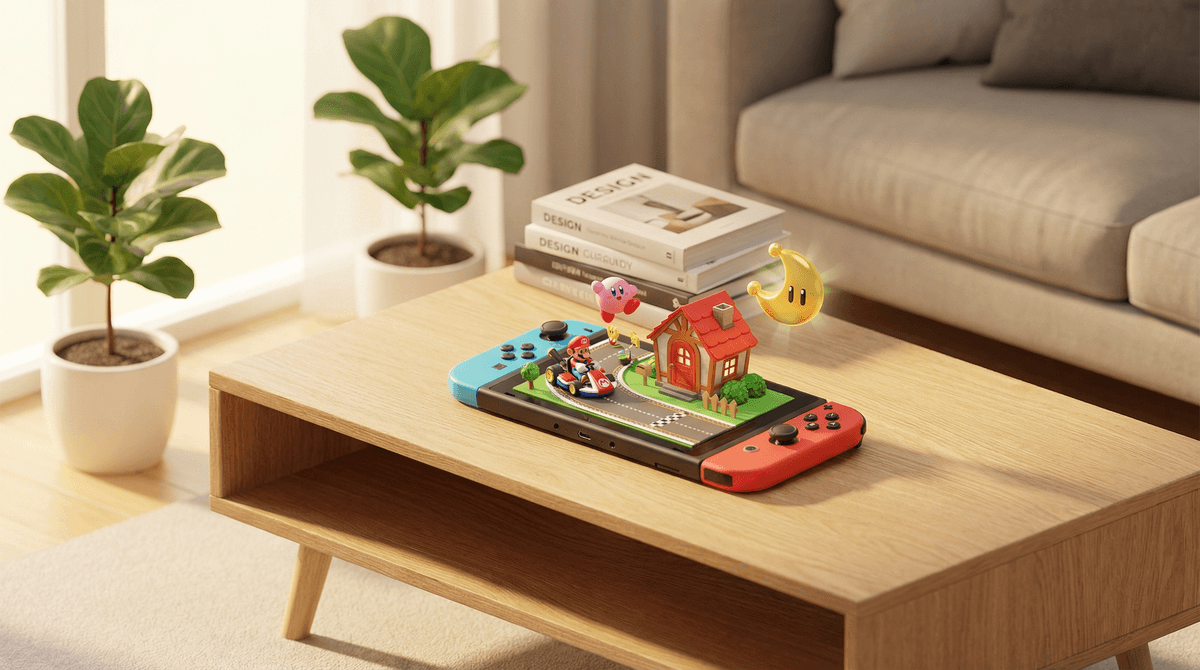
Best Nintendo Switch Games for Young Kids (Ages 3-8)
The Switch is genuinely perfect for young kids—handheld mode means they can play in the car, tabletop mode works for waiting rooms, and TV mode is great for family gaming nights. Here are the absolute best games that won't frustrate your 4-year-old or give your 6-year-old nightmares:
Top picks for the littlest gamers:
- Kirby and the Forgotten Land (ages 4+, co-op friendly)
- Super Mario Odyssey (ages 5+, assist mode is a game-changer)
- Mario Kart 8 Deluxe (ages 3+, steering assist means even toddlers can "win")
- Animal Crossing: New Horizons (ages 5+, reading required but pure wholesome vibes)
- Pokémon: Let's Go Pikachu/Eevee (ages 6+, co-op makes it perfect for parent-kid bonding)
Before we dive in, let's talk about what actually works for this age group. You need games with:
Simple, forgiving controls - If they're still working on fine motor skills, complex button combinations are just going to end in tears (theirs and yours).
Co-op options that actually help - Not the "player 2 just exists" kind, but games where you can genuinely assist without taking over completely.
No time pressure or fail states - Games where you can't really "lose" or get stuck permanently. Young kids don't need the stress of game overs.
Visual clarity - Bright, readable graphics where it's obvious what's happening on screen. Dark, muddy visuals are confusing for developing brains.
Zero scary stuff - No jump scares, no creepy music, no enemies that look genuinely threatening. We're trying to build confidence, not create bedtime anxiety.
Ages 4+ | Co-op: Yes | Reading required: Minimal
This is the perfect first 3D platformer. Kirby is inherently adorable and non-threatening—he's literally a pink puffball who defeats enemies by eating them and gaining their powers. The co-op mode lets a parent play as Bandana Waddle Dee, and here's the brilliant part: you can actually help without taking over. If your kid gets stuck, you can clear obstacles or defeat enemies while they focus on exploring.
The difficulty curve is incredibly gentle, there's no real penalty for falling off platforms (you just respawn), and the whole vibe is cheerful and encouraging. Plus, the "Mouthful Mode" where Kirby swallows giant objects like cars and vending machines is genuinely hilarious to watch.
Parent tip: This is one of the few games where the co-op player is actually useful but not overpowered. You're supporting, not carrying.
Ages 5+ | Co-op: Sort of | Reading required: Some
Mario Odyssey has an "Assist Mode" that's a total game-changer for young kids. It gives Mario arrows showing where to go, prevents him from falling into bottomless pits, and gives him extra health. Basically, it removes most of the frustration while keeping all the fun exploration and discovery.
The worlds are colorful and varied—from a realistic-looking city (New Donk City) to a food-themed kingdom to a beach resort. There are literally hundreds of moons to collect, and many are easy enough for young kids to find on their own, which builds that crucial sense of accomplishment.
The co-op is weird but works: player 2 controls Cappy (Mario's hat), which means they can't move independently but can help with attacks and capturing enemies. Some kids love it, some find it limiting—your mileage may vary.
Parent tip: Start with Assist Mode on. You can always turn it off later when they're ready for more challenge.
Ages 3+ | Co-op: Yes (competitive/cooperative) | Reading required: None
The steering assist and auto-accelerate features make this playable even for kids who can barely hold a controller. With steering assist on, the kart basically stays on the track automatically—they just need to steer left or right. It's not "real" racing, but it lets them participate and feel included in family game nights.
For slightly older kids (6+), you can gradually reduce the assists as their skills improve. The game supports up to 4 players locally, so it's genuinely great for families or playdates.
Real talk: Yes, Mario Kart can get competitive and lead to sibling meltdowns. The blue shell is still the most friendship-destroying item in gaming history. But the 50cc speed setting is gentle enough that even losses don't feel devastating.
Ages 5+ | Co-op: Sort of | Reading required: Yes (lots)
This is the ultimate chill game. You're on a deserted island, you catch bugs, fish, decorate your house, and befriend anthropomorphic animals. There's no combat, no time pressure, no way to fail. It's like a digital dollhouse meets life simulator.
The reading requirement is real—there's a lot of text dialogue with the animal villagers. But many 5-6 year olds enjoy this as a "reading practice" game, especially if a parent is nearby to help with trickier words. The context clues are strong (the animals' facial expressions match their dialogue), so kids can often figure out the gist even if they can't read every word.
Parent warning: This game runs on real-time. If you play at 3pm on Tuesday, it's 3pm on Tuesday in the game. Some kids find this magical, others get frustrated that certain shops are closed or events haven't started yet. Also, only one island per Switch console, which can cause sibling drama if you're not prepared for shared-world dynamics.
Ages 6+ | Co-op: Yes | Reading required: Yes
This is the most accessible Pokémon game ever made, designed specifically as a bridge between [Pokémon GO](https://screenwiseapp.com/media/pokemon-go-game and the main series games. The catching mechanic uses motion controls (you physically throw the Poké Ball), which young kids find intuitive and fun.
The co-op mode is brilliant: a second player can drop in anytime with a second Joy-Con, and you battle together with two Pokémon at once. It makes the game significantly easier and way more fun for families.
Combat is turn-based, so there's no twitch reflexes required. Kids can take their time deciding what move to use. And honestly, the dopamine hit of catching a new Pokémon never gets old, even for adults.
Parent tip: This game requires reading for the story and move descriptions. It's doable for strong first-grade readers, but you'll probably need to help younger kids.
Ages 3-6 | Co-op: Yes (competitive) | Reading required: None
Look, this isn't winning any awards for innovation. But if your 3-year-old is obsessed with Paw Patrol, this is actually a decent kart racer with familiar characters. It's basically Mario Kart with a Paw Patrol skin, and it has similar accessibility features like steering assist.
The tracks are colorful and themed around the show, and there's a "very easy" difficulty that's genuinely very easy. It's a good stepping stone before Mario Kart 8 Deluxe if your kid needs that extra layer of character familiarity to stay engaged.
Ages 6+ | Co-op: Yes | Reading required: Some
Minecraft on Switch is the full Minecraft experience, and in Creative Mode, it's perfect for young kids. No enemies, no death, just infinite blocks to build whatever they can imagine. It's digital LEGOs, basically.
The split-screen co-op works well for parent-kid building sessions. You can work together on projects, and it becomes this lovely collaborative experience. Survival Mode is probably too complex for most kids under 8, but Creative Mode has no age ceiling—I've seen 4-year-olds build elaborate houses (with help) and 8-year-olds recreate entire cities.
Parent note: The controls take some getting used to, especially the menu system. Expect to help with inventory management and crafting recipes. Also, check out our guide to Minecraft parental controls if you're planning to let them play online.
Ages 4+ | Co-op: Yes | Reading required: Minimal
This is adorable. Everything looks like it's made from cardboard and craft supplies—the aesthetic is like a preschool art project come to life. Yoshi is cute and non-threatening, the levels are creative, and the difficulty is pitched perfectly for young kids.
The co-op is great because both players are equally capable. You can help each other through tricky spots, and if one player is struggling, the other can literally eat them (as an egg) and carry them past difficult sections. It's weird but it works.
There's also a "Mellow Mode" that gives Yoshi wings for easier platforming and more health. Between that and the co-op, this is a very low-frustration experience.
Ages 5+ | Co-op: Yes | Reading required: Some
Pick your kid's favorite franchise—Star Wars, Harry Potter, Marvel, DC, Jurassic World, whatever—and there's probably a LEGO game for it. They're all fundamentally similar: you run around LEGO versions of famous scenes, smash stuff, collect studs (LEGO currency), and solve simple puzzles.
The co-op is drop-in/drop-out, so you can play together or let them solo it. Characters can't really die (they just respawn), and there's always something to collect or unlock, which keeps kids engaged.
The catch: These games are often glitchy on Switch, and the camera in co-op mode can be frustrating. Also, some of the humor and references go over young kids' heads if they haven't seen the source material. But for kids who love the franchise? Pure joy.
Ages 6+ | Co-op: Yes (up to 4 players!) | Reading required: Minimal
This is peak family gaming. Up to four players can play simultaneously, and the levels are designed for cooperative chaos. You can pick each other up and throw each other (which leads to both helpful teamwork and sibling trolling—you've been warned).
The difficulty ramps up more than some other games on this list, so it's better for kids who've already played some platformers. But the early levels are accessible, and there's genuine satisfaction in working together to get through tricky sections.
Bowser's Fury (included as a bonus) is a different experience—more open-world exploration with Bowser Jr. as your AI companion. It's slightly harder but really creative.
The Legend of Zelda: Breath of the Wild - This is an incredible game, but it's too complex for most kids under 8 — our Legend of Zelda guide breaks down which entry fits which age. The combat is real-time and requires strategy, the world is huge and easy to get lost in, and some enemies are genuinely intimidating. Save this for when they're older.
Splatoon 3 - It's a shooter (albeit with paint instead of bullets), and the online multiplayer is fast-paced and competitive. Most kids under 8 will get frustrated by the speed and complexity. Great for older elementary kids, though.
Luigi's Mansion 3 - The co-op is excellent, but some kids find the ghost enemies and spooky atmosphere genuinely scary. Know your kid's tolerance for mild spookiness before buying.
This is the part where I'm supposed to tell you the AAP recommends no more than one hour of screen time for kids aged 2-5, and I'm not going to pretend that guideline doesn't exist. But I'm also going to tell you that not all screen time is equal.
Playing Kirby cooperatively with a parent, working through problems together, celebrating victories, and learning how to handle frustration when you fall off a platform—that's fundamentally different from passively watching YouTube videos.
Gaming with young kids can teach:
- Problem-solving (how do I get past this obstacle?)
- Spatial reasoning (where am I in this 3D space?)
- Persistence (I failed but I'll try again)
- Reading (especially in text-heavy games like Animal Crossing)
- Cooperation (in co-op games)
- Taking turns (when sharing the controller)
That said, balance matters. If gaming is replacing outdoor play, reading, or creative play entirely, that's worth examining. But as one component of a varied childhood? The Switch can be genuinely wonderful.
Ages 3-4: Stick with games that have robust accessibility features like Mario Kart 8 Deluxe with full assists, or character-based games tied to shows they already love like Paw Patrol: Grand Prix. Expect to do a lot of co-playing. They're learning the controller, learning cause-and-effect, learning that their actions on the controller affect what happens on screen.
Ages 5-6: This is the sweet spot for games like Kirby and the Forgotten Land, Yoshi's Crafted World, and Super Mario Odyssey with Assist Mode. They're developing the motor skills for more complex controls and can handle simple puzzles. Co-op is still great, but they can also do meaningful solo play.
Ages 7-8: They're ready for more challenge. Games like Super Mario 3D World, Pokémon: Let's Go, and Minecraft in Survival Mode become accessible. They can read well enough to handle text-heavy games and have the patience for longer gaming sessions.
The Switch is expensive, and so are the games. First-party Nintendo games rarely go on sale, and they hold their value forever. Budget accordingly. The good news is that games like Mario Kart 8 and Animal Crossing have essentially infinite replayability.
You need extra controllers for co-op. The Switch comes with two Joy-Cons, which works for most 2-player games. But for games like Super Mario 3D World that support 4 players, you'll need to buy more controllers. Pro Controllers are more comfortable for adult hands but cost $70+.
Digital vs. physical games: Physical cartridges can be shared, traded, or resold. Digital games are convenient (no cartridge swapping) but tied to your account forever. With young kids, physical cartridges mean you can control access more easily—the game literally isn't available if the cartridge isn't in the Switch.
Parental controls are solid. The Nintendo Switch Parental Controls app (separate from the console settings) lets you set daily play limits, restrict games by rating, and see exactly what they've been playing. It's worth setting up.
One island/save file per console issues: Animal Crossing only allows one island per Switch, regardless of how many user profiles you have. This has caused countless sibling conflicts. Plan accordingly.
The Switch is genuinely one of the best consoles for young kids. The portability, the robust first-party library of age-appropriate games, the accessibility features, and the co-op options all add up to a system that can grow with your kid from age 3 to 13+.
Start with Mario Kart 8 Deluxe for immediate family fun, add Kirby and the Forgotten Land for cooperative adventure, and pick up Animal Crossing if your kid is a strong reader who loves creative play. Those three games will give you hundreds of hours of age-appropriate entertainment.
And here's the thing about gaming with young kids: it's genuinely fun. Watching them figure out a puzzle, celebrating when they beat a level they've been working on, building ridiculous structures together in Minecraft—these become core memories. Not every gaming session will be magical (there will be frustration and tears), but the good moments are really, really good.
The key is being involved. Play with them, especially at first. Talk about what's happening in the game. Help them when they're stuck. Celebrate their victories. Set reasonable limits. And don't stress about perfection—you're doing fine.
Want more guidance? Check out our guide to video game ratings or Find the best Switch games for your kid about what would work best for your specific kid.