

TL;DR: The Sci-Fi Shortlist
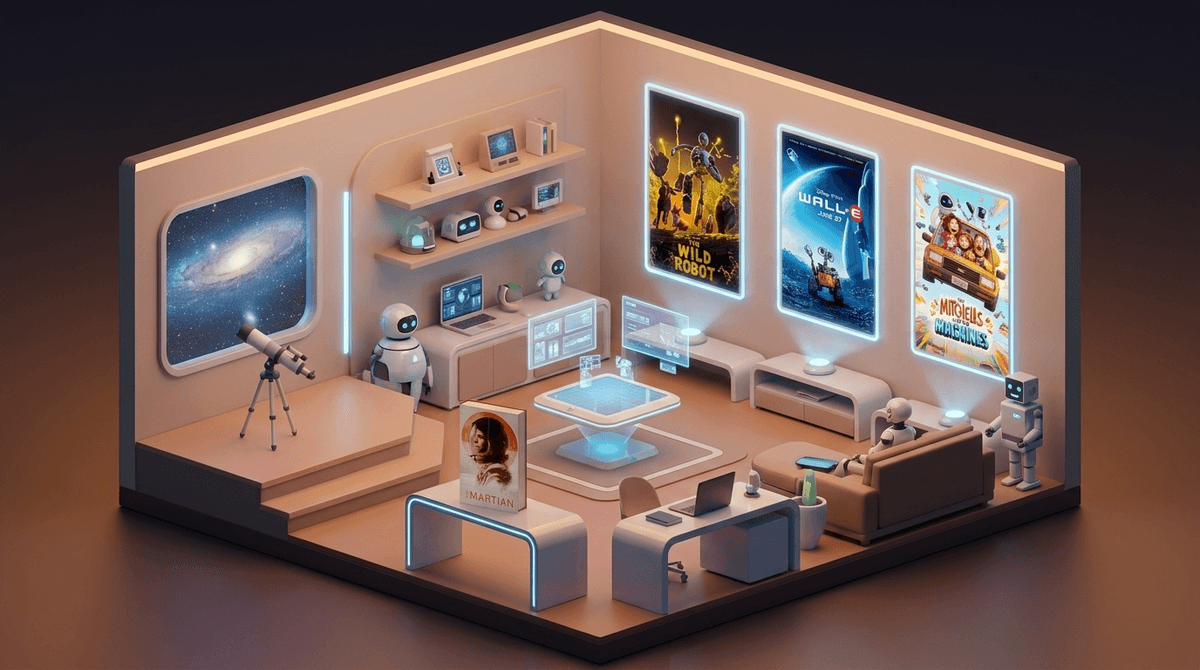
If you’re looking for a quick win for movie night, here are the top-tier picks that balance "cool tech" with "actually good storytelling" without the trauma:
- Best for Little Kids (Ages 5-7): Wall-E — A silent-film masterpiece about environmentalism and love.
- Best for Big Kids (Ages 8-12): The Mitchells vs. the Machines — Hilarious, chaotic, and hits the nail on the head regarding our phone obsessions.
- Best for Teens (Ages 13+): The Martian — The ultimate "science is cool" movie that proves problem-solving is a superpower.
- The Modern Classic: The Wild Robot — If you haven't seen it yet, grab the tissues. It’s the gold standard for 2024/2025.
Get sci-fi recommendations based on your kid's favorite games
We’ve all been there. You finish a movie like The Wild Robot or read the The Wild Robot by Peter Brown, and your kid is suddenly asking deep questions about whether robots have feelings or if AI is going to take over the world. It’s a parenting "win" because they’re thinking critically, but it’s also a trap. You go to Netflix, search "Sci-Fi," and suddenly you’re staring at Alien: Romulus or some bleak dystopian wasteland that will definitely result in a 2:00 AM visit to your bedside.
Sci-fi is the ultimate "What If?" genre. It’s what leads kids to experiment with Scratch or start asking why we haven't been back to the moon lately. But the line between "inspiring futurism" and "existential dread" is thin.
At Screenwise, we see the data: about 65% of parents with kids aged 8-12 are looking for "smart" alternatives to the usual superhero fatigue. They want movies that spark curiosity about technology without the nightmare-inducing space monsters or the "everything is doomed" vibe of adult sci-fi.
Sci-fi isn't just about spaceships; it’s about digital literacy. When kids watch a movie like Big Hero 6, they aren't just seeing a puffy robot; they’re seeing the intersection of healthcare, engineering, and ethics.
In a world where your kid might be using ChatGPT for homework or seeing "AI-generated" memes on YouTube, sci-fi gives them a framework to understand these tools. It moves them from being passive consumers of tech to intentional observers of it.
Ages 5+ This is the "gateway drug" to sci-fi. The first 30 minutes are basically a silent film, which is a great "brain reset" for kids used to the high-octane pacing of Skibidi Toilet or Cocomelon. It handles heavy themes—consumerism, environmental collapse, and physical atrophy—with so much heart that kids don’t even realize they’re learning a lesson.
Ages 7+ If your kid loved the "robot learning to be a person" arc in The Wild Robot, this is its spiritual ancestor. Set in the 1950s, it’s a beautiful story about choice: "You are who you choose to be." It deals with the fear of the "other" and the military-industrial complex in a way that is accessible but not preachy. Warning: the ending is a tear-jerker.
Ages 8+ This movie is essentially a documentary about modern parenting disguised as a robot apocalypse. It’s visually inventive—using a "scrapbook" animation style that feels very "Gen Alpha." It’s one of the few movies that mocks our tech addiction (the "kill all humans" plot is started by a jilted Siri-esque virtual assistant) without feeling like a lecture. It’s also genuinely hilarious.
Ages 7+ Baymax is the ultimate "soft" AI. This movie is great because it highlights STEM as a superpower. The "heroes" are just college students using chemistry, physics, and robotics to solve a problem. It does deal with grief (the protagonist's brother dies early on), so be ready for that conversation.
Ages 8+ A bit of a retro pick here. If you want to show your kids what sci-fi looked like when you were a kid, this holds up surprisingly well. It’s about a boy who travels 8 years into the future via an alien ship but hasn't aged a day. It captures that "kid-led adventure" vibe of Stranger Things without the demo-dogs.
Ages 12+ For the older kids who think they’re "too cool" for animation, Arrival is a masterclass. There are no space battles. Instead, it’s a movie about linguistics. How do we talk to someone (or something) if we have no common language? It’s a "thinking person’s" movie that respects the viewer's intelligence.
Check out our guide on how to talk to your teen about the ethics of AI
Not all sci-fi is created equal. Some movies are just "brain rot" with a metallic coat of paint.
- The Transformers Franchise: Honestly? Just a loud, 2-hour toy commercial. If your kid loves the toys, they’ll love the movies, but don't expect any "sparking of curiosity" here. It’s mostly just things hitting other things.
- Meg 2: The Trench: This isn't sci-fi; it's a disaster. It’s the cinematic equivalent of a Roblox "obby" that was made in five minutes. Skip it.
- Lightyear: This was a huge disappointment for many Screenwise families. It tried to be a "hard" sci-fi movie about time dilation and regret, but it ended up being too boring for kids and too convoluted for adults. If they want Buzz, stick to Toy Story.
When you're picking a sci-fi movie, the rating (PG vs. PG-13) often misses the point. Sci-fi tension is different from "slasher movie" tension.
- Existential Dread: Movies like Interstellar are "clean" (no gore), but the idea of a father leaving his daughter to age while he stays young is heavy. For a 10-year-old, that can be more upsetting than a laser fight.
- The "Uncanny Valley": Some kids are sensitive to robots that look too human. If your kid is creeped out by certain AI avatars, stick to stylized animation like The Mitchells vs. the Machines.
- Sensory Overload: Sci-fi loves loud noises and strobing lights. If you have a neurodivergent kid, Wall-E is a much safer bet than the chaotic energy of Spider-Man: Across the Spider-Verse.
After the credits roll, don't just ask "Did you like it?" Try these "Screenwise-approved" prompts to see if the movie actually stuck:
- The "Ethics" Question: "If you had a robot like Baymax or Roz, what’s the one thing you’d never let it do for you?" (This gets them thinking about autonomy).
- The "Tech" Question: "Which part of that tech do you think we’ll actually have in 10 years?"
- The "Problem-Solving" Question: "In The Martian, Mark Watney said he had to 'science the sh*t out of this.' What was the smartest thing he did?"
Sci-fi is a playground for the mind. While it’s easy to get caught up in the "screen time is bad" narrative, high-quality sci-fi is often the exception. It’s the genre that turns a kid from a consumer into a creator.
If they finish The Wild Robot and immediately want to go build something, you’ve won. If they finish The Martian and start asking how plants grow in space, you’ve won.
Next Steps:
- Pick a movie from the list above based on your kid's age.
- Check the "Parental Controls" on your streaming service—some "Sci-Fi" categories on Netflix include R-rated horror like Event Horizon.
- Follow up by checking out a related book, like The City of Ember or A Wrinkle in Time.
See our full list of the best sci-fi books for middle grade readers