

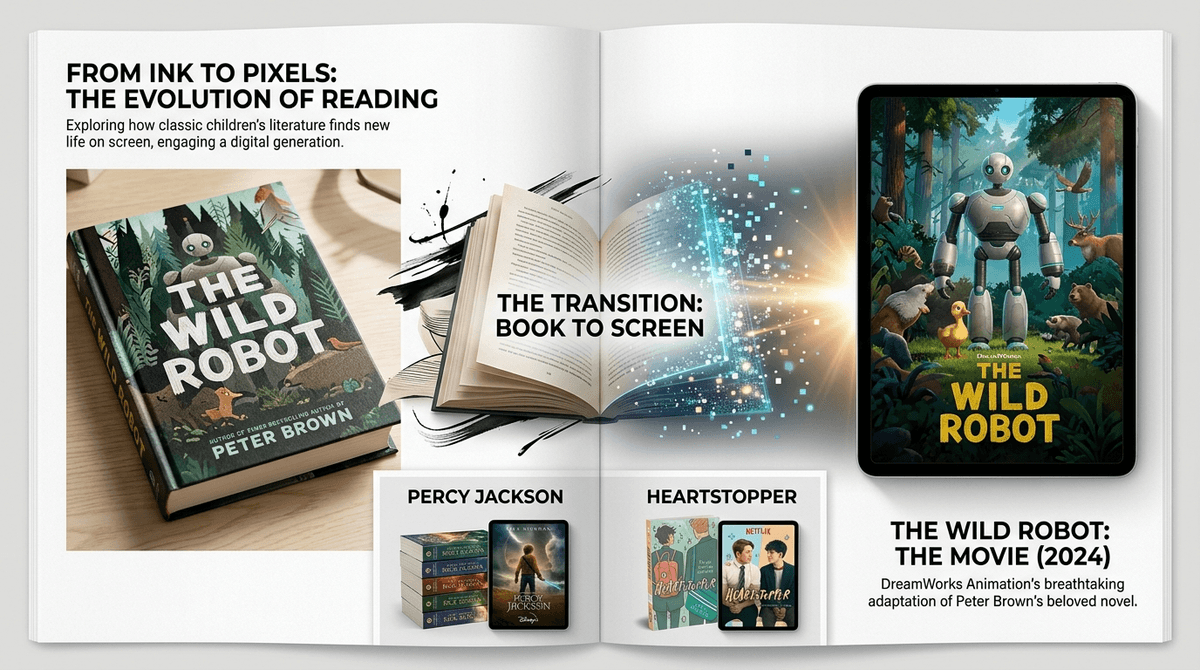
TL;DR: Adaptations aren't supposed to be carbon copies of books—they are "remixes." While we lose internal monologues and subplots, we gain world-class visuals, scores, and a shared family experience. Use the "The book was better" debate to teach your kids about creative choices and narrative perspective.
Top Adaptations to Watch (and Read) Right Now:
- For the Visuals: The Wild Robot (Movie) vs. The Wild Robot (Book)
- For the Redemption: Percy Jackson and the Olympians (Disney+ Show) vs. The Lightning Thief (Book)
- For the Emotional Punch: Wonder (Movie) vs. Wonder by R.J. Palacio (Book)
- For the Teens: Heartstopper (Netflix Show) vs. Heartstopper (Graphic Novel)
"The book was better."
It’s the ultimate flex for the "literary" kid and the default setting for most parents. We spent weeks reading Harry Potter to them at bedtime, only to have the movie fly by in two hours, leaving out S.P.E.W. and half the Quidditch matches. It feels like a betrayal.
But here’s a hot take: calling a movie "mid" just because it isn't a 1:1 replica of the book misses the point of storytelling.
In 2026, our kids are swimming in a sea of "transmedia." They don't just read a book; they play the Roblox tie-in, watch the YouTube "Easter egg" breakdowns, and then stream the adaptation on Netflix. When we talk about what gets "lost" or "gained" in translation, we’re actually helping them develop a high-level digital literacy. We’re moving them from passive consumers to critical thinkers who understand why a director might cut a character or change an ending.
The biggest hurdle in any adaptation is the "Internal vs. External" problem.
Books are incredible at internal monologue. In The Hunger Games, we spend the whole time inside Katniss’s head. We know she’s terrified, calculating, and skeptical. On screen, the Hunger Games movie has to show that. If Jennifer Lawrence just sat there thinking for two hours, it would be unwatchable.
To bridge that gap, movies have to add things—like the scenes with President Snow and the Gamemakers that weren't in the first book. That’s a "gain" for the viewer, giving us a wider view of the world that Katniss couldn't see.
What usually gets cut:
- Inner Dialogue: Unless there’s a heavy-handed narrator (which usually feels lazy), you lose the character's private thoughts.
- Subplots/Side Characters: In The Lord of the Rings, Tom Bombadil was cut. Why? Because he doesn't move the plot forward. In a 400-page book, you can meander. In a movie, if the plot stops, the audience pulls out their phones.
- Nuance and History: Books can afford 20 pages of "world-building" lore. Movies have to explain the world through production design and quick dialogue.

Sometimes, the screen version actually adds a layer that the book simply couldn't touch. Sound, color, and physical performance can turn a "good" story into a visceral experience.
The book is a modern masterpiece of simple, evocative prose. But the The Wild Robot movie is a masterclass in visual storytelling. There are stretches of the film with almost no dialogue where the animation conveys the isolation of the island and the burgeoning "motherhood" of Roz better than words ever could. It’s not "better" or "worse"—it’s a different language.
While based on Marvel Comics, this is a perfect example of "gaining" through the medium. The way the art style changes depending on which universe the characters are in is something a static comic page can struggle to convey with the same kinetic energy. It’s a sensory explosion that makes the source material feel like a blueprint for something much bigger.
If you want to talk to your kids about "bad" vs. "good" adaptations, look no further than Percy Jackson.
The 2010 movie is widely hated by fans (and the author, Rick Riordan) because it aged up the characters and stripped away the heart of the story to make a generic action flick. It’s the definition of "mid."
Fast forward to the Disney+ series. Because it’s a show, it has time. It can keep the characters at age 12, it can include the weird side-quests, and it can let the themes of neurodiversity and "finding your tribe" breathe.
Pro-tip: Use this as a conversation starter. Ask your kid: "Why do you think the show feels more like the book than the old movie did? Is it just the age of the actors, or is it the pacing?"
Ages 5-8: The "Visual Discovery" Phase
At this age, kids are still working on reading comprehension. Seeing The Bad Guys (Movie) after reading The Bad Guys (Books) helps them visualize the action.
- Focus on: "What looked different than you imagined?"
- Watch: The Sea Beast or Orion and the Dark.
Ages 9-12: The "Critical Fan" Phase
This is the peak "the book was better" age. They have strong opinions and deep loyalty to their favorite series.
- Focus on: "Why did they change that?" instead of "Why did they ruin it?" Talk about the constraints of a 2-hour movie.
- Watch/Read: The Mysterious Benedict Society or Wings of Fire.
Ages 13+: The "Thematic Analysis" Phase
Teens can handle the idea that an adaptation might intentionally change the message.
- Focus on: Artistic license. In The Ballad of Songbirds and Snakes, the movie has to make a villainous protagonist sympathetic enough to watch for three hours. How did they do that compared to the book?
- Watch/Read: Dune: Part Two or Heartstopper.
Check out our guide on the best book-to-screen adaptations for teens
There’s a common fear that watching the movie "replaces" the act of reading, or that it’s "brain rot" compared to the "intellectual" work of a book.
Let’s be real: some movies are brain rot. If an adaptation takes a thoughtful book and turns it into a loud, flashing, toy-commercial mess, call it out. But a good adaptation is a gateway drug.
Data shows that when a big adaptation hits Netflix or Disney+, library checkouts for those books skyrocket. Kids want to live in those worlds longer. If the movie is the "hook" that gets them to read a 400-page novel, that’s a massive win for digital wellness.
Next time you finish a movie based on a book, try these three questions instead of a lecture:
- The "Director" Question: "If you were the director and only had two hours, what’s the one scene from the book you must keep to make the story work?"
- The "Casting" Question: "Did [Actor Name] look like the version of the character in your head? If not, who would you have picked?"
- The "Vibe" Question: "The book felt [sad/scary/funny] to me while I was reading it. Did the movie feel the same way, or did the music and colors change the vibe?"
Adaptations are a bridge between the analog world of paper and the digital world our kids live in. When a movie "fails" to live up to the book, it’s an opportunity to talk about imagination. When it "succeeds," it’s a chance to appreciate the craft of filmmaking.
Don't sweat it if they want to watch the movie first. Sometimes, seeing the world brought to life gives them the "scaffolding" they need to tackle a difficult text. In the end, we want them to be lovers of stories, regardless of whether those stories are delivered via ink or pixels.
- Plan a "Book vs. Movie" Night: Pick a shorter book like The Wild Robot, read it over a week, and then have a big movie premiere night with popcorn.
- Compare the "Mid" Factors: Watch a famously bad adaptation (like the 2010 Percy Jackson movie) and have a "roast session" where everyone points out what the filmmakers got wrong.
- Check the WISE Scores: Before you dive into a new series, check the Screenwise Media Search to see if the adaptation is age-appropriate for your specific kid.