

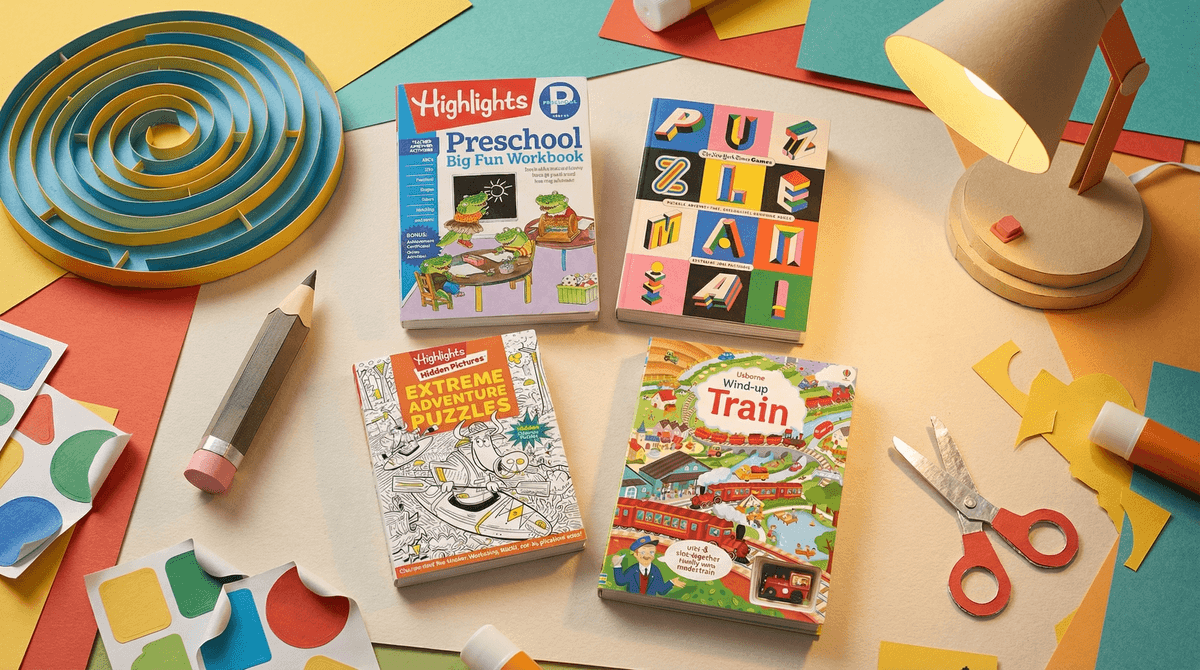
Activity books are exactly what they sound like—physical books filled with puzzles, mazes, coloring pages, word searches, dot-to-dots, sticker activities, and other hands-on challenges. Think of them as the analog equivalent of those "brain training" apps, except they won't send you notifications or accidentally lead your kid down a YouTube rabbit hole.
We're talking everything from the classic Highlights Hidden Pictures books to elaborate themed activity books about dinosaurs, space, or whatever your kid is currently obsessed with. Some are disposable workbooks you tear through in a week. Others are wipe-clean books you can use over and over (though let's be honest, the marker always ends up permanently marking something).
The category has exploded recently. You've got brain teaser books for tweens, elaborate sticker scene books for preschoolers, STEM activity books that sneak in actual learning, and even "would you rather" books that spark surprisingly deep conversations during car rides.
Here's the thing: parents are tired. We're tired of being the screen time police, tired of negotiating "just five more minutes," tired of wondering if our kids' brains are turning to mush from too much Roblox or YouTube.
Activity books offer something genuinely appealing—screen-free entertainment that doesn't require parental involvement. Your kid can grab one and disappear into their room for 30 minutes while you make dinner. No Wi-Fi needed. No in-app purchases. No risk they'll stumble onto something inappropriate.
But beyond the practical appeal, there's actual value here:
They're genuinely engaging. A well-designed activity book hits that sweet spot of challenging but achievable. Kids get the dopamine hit of completion without the algorithmic manipulation of digital content.
They build real skills. Fine motor control from coloring. Problem-solving from puzzles. Patience from working through something that can't be instantly skipped or fast-forwarded.
They're portable. Restaurant waits. Road trips. Doctor's offices. Activity books work anywhere without charging cables or worrying about data plans.
They create natural stopping points. Unlike apps designed to keep kids engaged indefinitely, activity books have endings. Kids finish a page and naturally move on to something else.
Ages 3-5: Look for books with large, simple activities. Sticker books are gold at this age—low frustration, high satisfaction. Coloring books with thick lines work better than detailed illustrations. Usborne makes excellent wipe-clean books that toddlers can't permanently destroy.
Ages 6-8: This is the sweet spot for classic activity books. Mazes, word searches, simple crosswords, dot-to-dots. They're reading well enough to follow instructions but still love the hands-on element. Look for themed books around their interests—space, animals, sports, whatever they're into.
Ages 9-12: Tweens need more challenge. Brain teasers, logic puzzles, more complex mazes, sudoku, cryptograms. Books like "Brain Quest" or puzzle compendiums work well. Also consider activity books that double as journals or creative writing prompts—they're at an age where self-expression matters.
Ages 13+: Honestly, teens often circle back to "adult" activity books. Detailed coloring books marketed for stress relief. Crossword puzzle books. Sudoku collections. The New York Times puzzle books are legitimately challenging and don't feel babyish.
Not all activity books are created equal. Some are genuinely engaging with varied, well-designed activities. Others are cheap cash-grabs with repetitive, poorly printed content. Check reviews before buying, especially for themed books tied to popular characters—licensed products are often lower quality.
They're not a screen replacement for everything. Activity books are great for quiet time, waiting rooms, and winding down. They're not going to replace social gaming with friends or the collaborative creativity kids experience in Minecraft. That's okay. They don't have to.
Some kids won't be into them. And that's fine. If your kid tries activity books and isn't interested, don't force it. There are plenty of other screen-free alternatives worth exploring.
They can be surprisingly expensive. A quality activity book might cost $8-15 and get completed in a few days. Budget for this or hit up library sales and thrift stores—gently used activity books are often barely touched.
Consider reusable options. Laminating pages or buying wipe-clean books can extend the life significantly, especially for younger kids who love repetition.
Here's what works in real households:
Keep a stash accessible. Don't hide them away for "special occasions." Let kids grab them whenever. Having a basket of activity books in the living room means they're more likely to reach for those instead of a screen during downtime.
Rotate them. Put some away for a few months, then bring them back out. They'll feel new again.
Pair them with good supplies. Cheap, dried-out markers kill the experience. Invest in decent colored pencils, fresh markers, and good erasers. It makes a difference.
Use them strategically. Keep one in the car. Pack them for travel. Have them ready for screen-free Sundays or whatever boundaries your family has set.
Don't make them homework. The moment activity books feel like an obligation, they lose their appeal. Let kids choose if and when they want to use them.
Activity books aren't going to solve all your screen time struggles. They're not going to magically make your kid stop asking for Fortnite time. But they're a solid tool in the toolkit—affordable, portable, genuinely engaging screen-free entertainment that works.
The best part? There's no algorithm trying to maximize engagement, no company collecting data on your kid's preferences, no surprise $99 charge because they accidentally clicked "buy" on some in-app currency. Just paper, puzzles, and the satisfying feeling of completing something with your own hands.
In a digital-first world, that's actually pretty valuable.
Start with one or two books matched to your kid's interests and see what lands. If you want personalized recommendations based on your kid's age and interests, Get specific suggestions . And if activity books aren't their thing, there are plenty of other screen-free activities worth exploring.