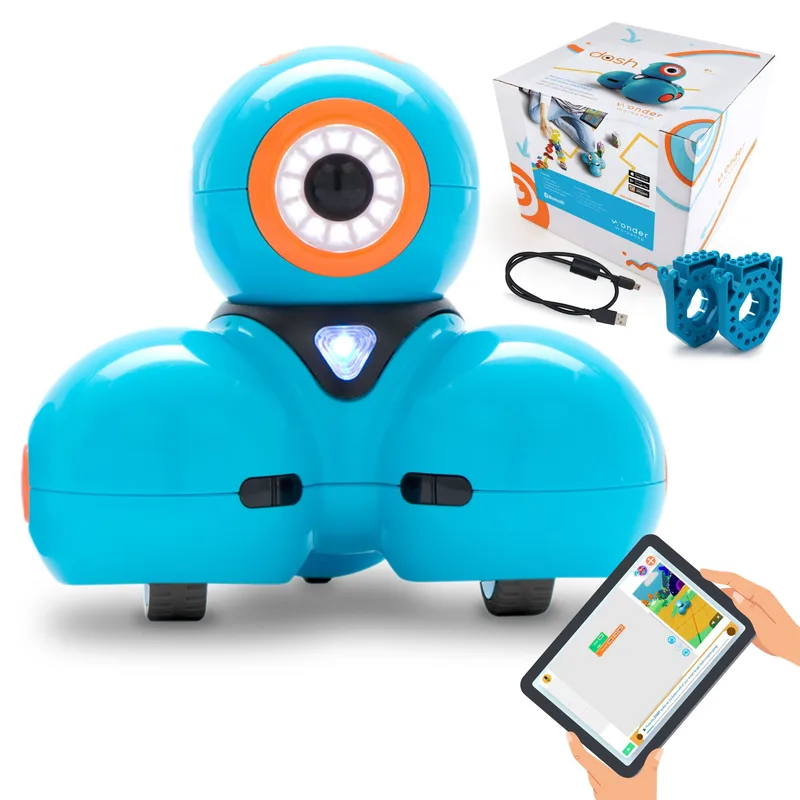
Wonder Workshop’s Dash is one of the few 'educational' toys that actually lives up to the marketing hype. It’s robust, genuinely fun, and provides a clear pathway from 'poking buttons' to 'thinking like a programmer.'
While the initial cost is high, the depth of the software ecosystem ensures it won't just sit in a toy box after three days. It’s a solid investment for parents who want to turn passive screen time into active, logic-based creation. Just be prepared to help with the initial Bluetooth pairing and the first few coding 'puzzles.'
Age Fit
Best for ages 6 to 12. Younger kids will enjoy the remote-control aspects, while the 9-12 bracket will get the most out of the logic and coding challenges.
WISE Breakdown
Wholesome
95
The robots are designed with a friendly, non-threatening aesthetic and focus entirely on cooperative learning and problem-solving. There is zero 'edgy' content here; it’s all about empowering kids to control their environment.
Imaginative
92
Unlike many 'smart' toys that just play pre-recorded sounds, Dash and its siblings are blank slates. Kids have to imagine the logic and the sequence to make the robot perform, effectively turning a physical object into a programmable character.
Safe
98
As a physical product from a reputable STEM company, physical safety is high (no sharp parts). The digital side is a closed ecosystem focused on Bluetooth connection to the robot, avoiding the 'open internet' pitfalls of social apps.
Enriching
96
This is top-tier educational tech. It bridges the gap between abstract code on a screen and physical action. The progression from block-based logic to actual JavaScript provides a legitimate path to computer science literacy.
Parent Info
✓
Why It Might Be Great
Tactile learning: It moves the 'screen time' into the real world as kids watch their code move a physical object.
Longevity: It scales from simple 'drive here' commands for 6-year-olds to complex JavaScript for middle schoolers.
Durability: Dash is built like a tank; it can handle the inevitable collisions with baseboards and furniture.
No 'dead end' play: The variety of sensors (sound, light, distance) means there is always a new 'if-then' scenario to test.
⚠
What to Watch For
The price tag: These aren't cheap, and you'll likely feel the itch to buy the various 'add-ons' like the launcher or xylophone.
Device dependency: The robot is a paperweight without a compatible tablet or smartphone to run the apps.
The 'Cue' robot is no longer in production, so if you find one used, support might be more limited than the flagship Dash.
Conversation Starters
"How would you program Dash to sneak into the kitchen without hitting any chairs?"
"If you could give Dash a new sensor, what should it be able to 'feel' or 'see'?"
"Why do you think the robot didn't do what you expected? Let's look at the code blocks again."
"Could we program a routine where Dash greets everyone who walks through the front door?"