Our reviews and ratings are 100% unbiased. As an Amazon Associate, Screenwise earns from qualifying purchases, so if you buy a book or game through one of our links, we may earn a commission. We don't get any credit if you just Google it instead :)
Screenwise Verdict
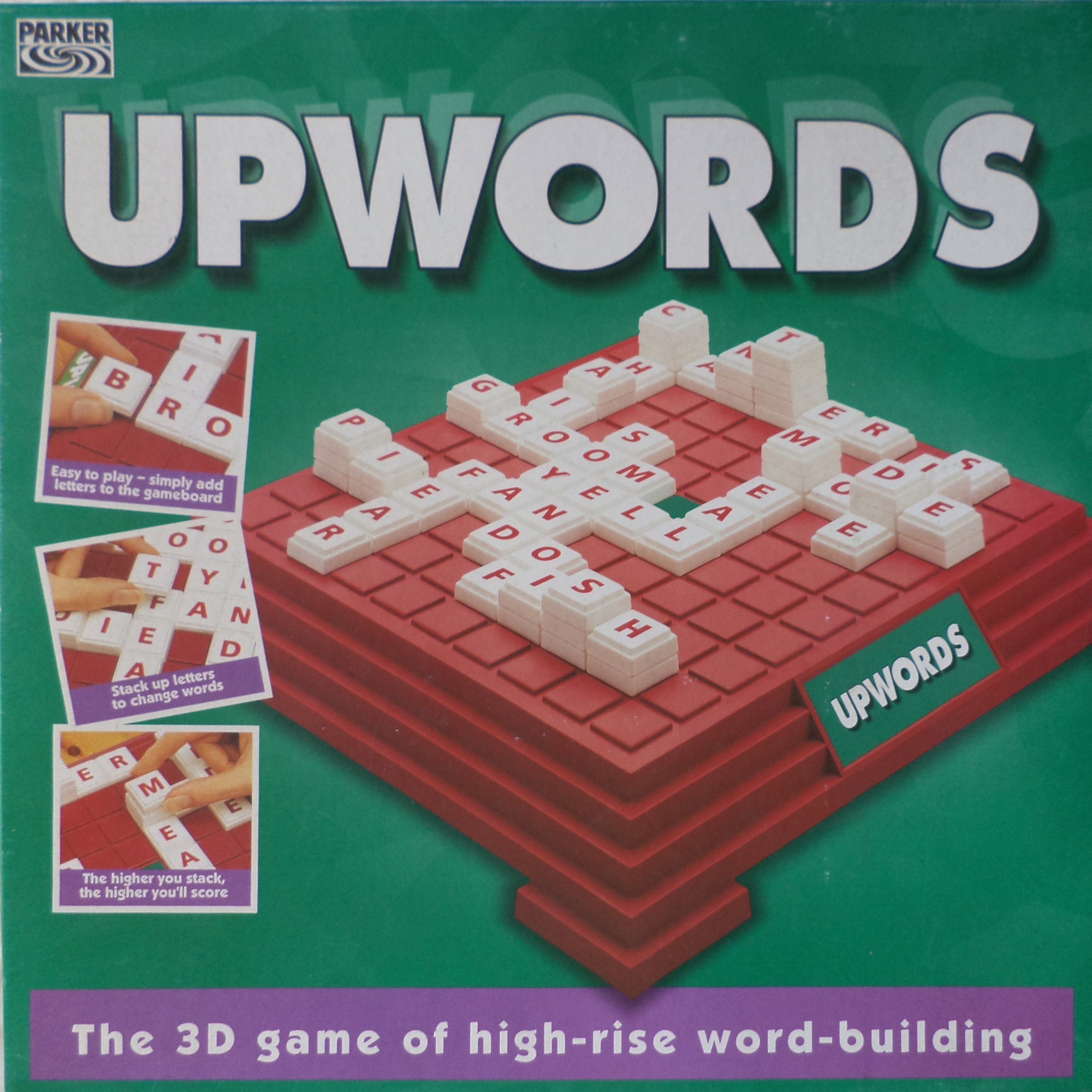
Upwords takes the core idea of Scrabble and strips out the most annoying parts: board choke-points and punishing tile math. Because you can stack letters up to five tiles high, existing words stay alive. Turning CARE into DARE into DARK keeps the grid tight, accessible, and constantly shifting.
It is an older title from 1982, and the beige plastic aesthetics reflect that era. But the core gameplay holds up significantly better for mixed-age family nights than most legacy word games. You spend less time memorizing obscure dictionary lists and more time playing with active word stems.
Age Fit
A strong fit for second graders through grandparents. As long as a kid can spell basic three-letter and four-letter words, the physical stacking lowers the barrier compared to traditional crossword games.
WISE Breakdown
Wholesome
90
Turn-based tabletop word play with low stakes and collaborative puzzle solving across generations.
Imaginative
75
Stacking letters vertically adds a 3D spatial puzzle to standard anagramming and spelling.
Safe
98
Standard physical board game with zero screen, predatory mechanics, or mature elements beyond whatever words players invent.
Enriching
88
Builds vocabulary, phonemic flexibility, and prefix/suffix recognition much faster than flat crossword games.
Parent Info
✓
Why It Might Be Great
Stacking mechanic fixes the Scrabble deadlock where the board runs out of playable room.
Flat tile scoring means kids do not need to memorize two-letter obscure dictionary words or triple-word score math.
High turnaround lets players repurpose a competitor's high-scoring term into their own with a single swapped vowel.
Phonics practice happens naturally as players experiment with letter substitutions and word families.
⚠
What to Watch For
Analysis paralysis hits hard when a player tries to scan both horizontal options and vertical stack possibilities.
Vocabulary disparity between an adult and an eight-year-old can still turn competitive games into a blowout unless you handicap tile counts.
Conversation Starters
"What is the shortest word on the board right now that we could change into something completely unrelated?"
"Would you rather keep a high-scoring spot safe or steal an opponent's stack for fewer points?"
"Which prefixes or suffixes do you notice popping up most often when the stacks get high?"
Deep Dive
Why stacking beats the Scrabble board
The fundamental flaw of classic Scrabble is real estate. By the midpoint of a game, players usually face an awkward, sprawling grid where premium squares are gone and only obscure two-letter words fit into tight corners. If your eight-year-old does not know that QI and ZA are legal plays, they end up staring blankly at a rack of consonants.
Upwords sidesteps that wall entirely with its z-axis. Designed by Elliot Rudell in 1982, the game uses an 8x8 or 10x10 grid where letters stack up to five layers high. If someone drops LATE, the next player does not need an open runway to build off the E. They can simply drop a C on the L and an R on the T to make CARE, scoring points for every letter in the stack underneath.
This simple shift changes the dynamic for developing readers in three specific ways:
Word families over vocabulary flexing: Young players naturally play with rhyming words, prefixes, and suffixes. Dropping an S on PIN to get SPIN, or capping CAT to create HAT, gives early decoders instant agency.
Simplified math: Instead of hunting for double-letter scores or multiplying tile values, Upwords awards two points per tile for flat words and one point per tile in the stack once layered. Kids can easily tally their own scores without a calculator.
Fluid board control: You are never permanently blocked out of an area. A sprawling stack can be repurposed two turns later.
House rules for mixed-age play
While Upwords is far friendlier than Scrabble, an adult playing at full throttle will still outmatch a third grader through sheer vocabulary volume. A few tweaks level the table without feeling condescending:
Open dictionaries: Keep a physical dictionary or phonics word list by the board for everyone to use freely between turns.
Handicap rack size: Give younger kids an extra tile on their rack (eight instead of seven) to expand their anagram options.
Co-op mode: Play in pairs where an older player handles board spotting while the younger player chooses which word to deploy.