Why a modern spin on Tic-Tac-Toe actually works
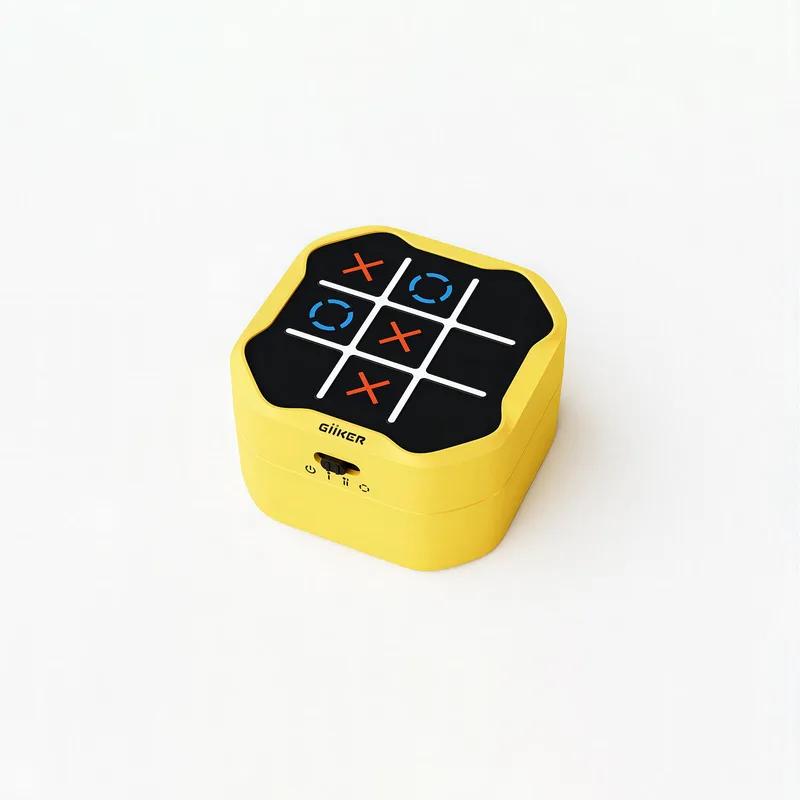
Standard tic-tac-toe is fundamentally broken once kids turn six or seven. Every match ends in a predictable draw unless someone completely checks out. The Tic-Tac-Toe Bolt fixes the underlying math by introducing rules that force dynamic thinking.
In Infinite Tic-Tac-Toe, each player can only keep three pieces on the board at a time. Placing a fourth piece causes your first piece to fade away. This simple twist eliminates tie games entirely and forces kids to hold spatial positions in their working memory while planning two steps ahead.
Three modes in one physical shell
Beyond the infinite grid, the device packs two other distinct formats:
- Cover-up Tic-Tac-Toe: Players use different sized pieces to cover up smaller opposing marks, bringing a spatial hierarchy layer similar to games like Gobblet Gobblers.
- Memory Flash: A sequence-recall game where the lights flash a pattern across the grid that the player has to repeat back, scaling up in speed and length.
Because the game features an integrated AI opponent alongside two-player head-to-head mode, a child can play independently in the backseat or pass it back and forth with a friend.
Practical travel realities
Unlike mobile apps, there are no software updates, loading screens, or hidden microtransactions. The physical ABS plastic casing withstands drops, and there are no small loose pieces to lose under car seats during a road trip.
Keep a pair of spare AA batteries in your bag, as the device doesn't use USB-C charging. Once you show your kid how to toggle the audio volume during the initial setup, it becomes one of the most reliable offline travel gadgets in the rotation.