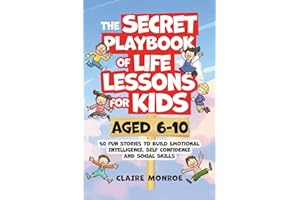
The Secret Playbook of Life Lessons for Kids Aged 6-10: 50 Fun Stories to Build Emotional Intelligence, Self Confidence and S – WISE Score & Parent Review | Screenwise
The Secret Playbook of Life Lessons for Kids Aged 6-10: 50 Fun Stories to Build Emotional Intelligence, Self Confidence and S
book
80%
WISE Score
Fifty bite-sized stories built to help elementary kids unpack playground drama, self-doubt, and big feelings without feeling like they are sitting in therapy.
Our reviews and ratings are 100% unbiased. Screenwise is a Bookshop.org affiliate and an Amazon Associate, so if you buy a book through one of our links, we may earn a commission. Bookshop.org purchases also support independent bookstores.
Screenwise Verdict
If you expect The Secret Playbook of Life Lessons to be an addictive narrative your kid begs to read at bedtime, you will be disappointed. It is not a page-turner—it is a practical toolkit disguised as a storybook.
Each of the 50 short stories targets a specific social-emotional challenge, like dealing with a sore loser, handling peer pressure, or speaking up when feeling left out. The stories themselves are plain and didactic, but the reflection questions attached to each one give you an easy entry point for real conversations.
Don't treat this like a daily reading assignment. Keep it on the shelf and pull out the specific story that matches whatever drama hit the playground that afternoon.
Age Fit
Best for ages 6 to 10. Kids ages 6 to 7 will get the most out of it as a parent read-aloud, while 8- to 10-year-olds can read independently to find solutions to specific friendship or school situations.
WISE Breakdown
Wholesome
90
The stories are explicitly written to teach positive character traits, self-regulation, empathy, and constructive communication without snark or harmful behavior.
Imaginative
60
The narratives are practical and scenario-driven rather than rich world-building or inventive fiction, focusing on recognizable real-world childhood situations.
Safe
98
It is a print and electronic book with zero inappropriate content, no violence, no mature themes, and no digital tracking.
Enriching
82
High tactical value for emotional intelligence, offer practical strategies for dealing with frustration, peer pressure, and self-doubt alongside reflection prompts.
Parent Info
✓
Why It Might Be Great
Short, targeted stories make it easy to pick a specific five-minute read when a real-world issue like losing gracefully or handling peer pressure comes up.
Built-in discussion prompts give parents an easy conversational on-ramp without having to invent questions on the fly.
Focuses on practical social scenarios that kids actually experience at school, from bossy group members to fear of making mistakes.
⚠
What to Watch For
Reads like a curriculum if you try to push through it cover-to-cover; it works best as a reference menu rather than bedtime entertainment.
Functional prose prioritizing the moral takeaway over literary style, so reluctant readers might find it a bit preachy if forced to read alone.
Conversation Starters
"Which character in tonight's story reacted the way you usually want to react when things go wrong?"
"If a friend acted like that at recess, what would you actually say to them in real life?"
"Which life lesson in this story sounds like it would be the hardest to actually do at school?"
Deep Dive
How to use a social-emotional storybook without sounding like a lecture
Books explicitly designed to teach character traits often fall into a predictable trap: they feel like moralizing homework. The Secret Playbook of Life Lessons does not completely escape that tone—the prose is standard functional writing—but its 50-story structure makes it useful if you treat it as a searchable tool rather than a traditional book.
When a kid encounters a real-world hurdle, like getting overly competitive during board games or feeling nervous about trying something new, giving a direct lecture often triggers defensive walls. A five-minute fictional story about someone else making that mistake creates enough distance for a kid to analyze the behavior without feeling put on the spot.
The best way to use it
Skip around by topic: Do not start at story 1 and push through to story 50. Use the contents page to target current issues.
Read aloud together: For 6- to 8-year-olds, the emotional concepts land much better when read together so you can pause mid-story.
Let them challenge the stories: If a resolution feels cheesy or unrealistic to your 9-year-old, lean into that. Asking 'What would actually happen if you tried that at school?' builds far better critical reasoning than automatic agreement.