Our reviews and ratings are 100% unbiased. As an Amazon Associate, Screenwise earns from qualifying purchases, so if you buy a book or game through one of our links, we may earn a commission. We don't get any credit if you just Google it instead :)
Screenwise Verdict
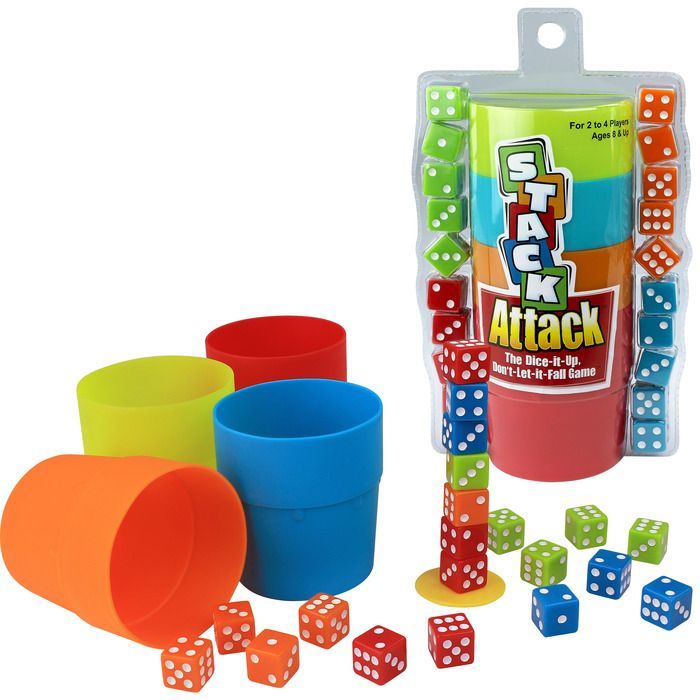
Stack Attack is essentially Jenga with standard six-sided dice and a gimmick base called the Quake Plate. You roll, match adjacent values, and stack your dice without toppling the column.
It works fine as a fifteen-minute rainy day diversion or a warm-up for early elementary kids working on number bonds. But the plastic hardware feels flimsy, the strategy runs out after three turns, and modern dexterity games like Rhino Hero execute this exact concept with far more charm.
Age Fit
The box says 8+, but the rule set is simple enough for a 5-year-old with decent motor control. Kids over 11 will likely find the novelty wears off after two rounds.
WISE Breakdown
Wholesome
88
Clean, low-stakes physical competition centered around rolling dice and not knocking over a wobbly plastic tower.
Imaginative
42
Pure mechanical dexterity with zero theme, storytelling, or creative problem-solving.
Safe
96
Physical tabletop components only. Standard choking-hazard caution for dice around toddlers, but no thematic or content risks.
Enriching
62
Reinforces basic number sequencing (+/- 1) and fine-motor coordination, but strategic depth is extremely shallow.
Parent Info
✓
Why It Might Be Great
Hands-on fine motor practice that forces kids to slow their breath, steady their wrists, and focus entirely on the table.
Rapid mental math disguised as physical play, requiring players to track neighboring numbers (+/- 1) under time pressure.
Fast resets keep the energy high; when the tower crashes, set up takes under twenty seconds.
⚠
What to Watch For
Cheap plastic friction: The spring-loaded Quake Plate base can trigger sudden collapses from table bumps, leading to unfair losses.
Meltdowns over dexterity gaps: Kids who lack refined fine-motor control will drop the stack repeatedly while older siblings breeze through.
Conversation Starters
"Did you decide to place that die because you thought you could balance it, or were you trying to make it harder for the next person?"
"When the tower starts leaning, what is your strategy for placing the next one?"
"How do you handle that spike of frustration when someone bumps the table by accident?"
Deep Dive
A Decent Gimmick That Runs Out of Gas
Tabletop dexterity games live or die on physical tension. At first glance, Stack Attack has the right ingredients: dice cups, color-coded components, and a springy platform meant to punish twitchy fingers. The core rule—you can only play a die whose value sits one above or one below the top die—adds a light layer of sequencing to what would otherwise be blind stacking.
In practice, the game runs into mechanical limitations quickly.
The luck-to-skill ratio is uneven. If your roll leaves you with numbers that force awkward placements, you take on massive physical risk through no fault of your own.
Table bumps rule the game. The Quake Plate is sensitive enough that an excited knee hitting the table leg often causes more collapses than actual die placement.
Depth evaporates after round two. Once kids realize the optimal way to center die weight, every turn feels identical.
If you want an analog dexterity test for kids under eight, games like Rhino Hero or classic Suspend offer significantly more creative physical balancing without relying on a plastic spring.