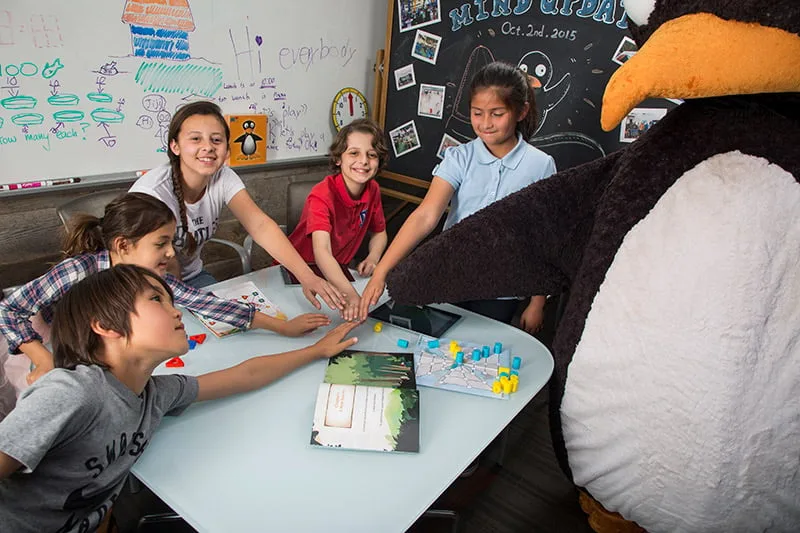
ST Math is the rare educational tool that actually respects how kids' brains work. Most 'math games' are just digital worksheets with a thin coat of neon paint, but this is a deep dive into spatial reasoning. By removing the text, it removes the 'I'm not a math person' barrier that trips up so many kids.
It isn't 'fun' in the way Roblox is fun—there are no skins to buy or friends to chat with—but it offers the deep satisfaction of solving a hard logic puzzle. If your school doesn't already provide it, it's one of the few educational subscriptions actually worth the personal investment.
Age Fit
Designed for PreK through 8th grade. It's a perfect fit for visual learners and kids who get 'math block' when looking at a page full of numbers and words.
WISE Breakdown
Wholesome
92
JiJi the penguin is a non-judgmental, low-stress guide. The platform prioritizes 'productive struggle' over anxiety-inducing timers or competitive leaderboards.
Imaginative
85
The patented visual approach to math is genuinely creative, turning abstract concepts like fractions and symmetry into tangible, spatial puzzles that feel like a logic game.
Safe
98
Non-profit status, zero ads, no social/chat features, and high student-data privacy standards make this one of the safest corners of the internet for kids.
Enriching
96
It builds deep conceptual understanding and spatial-temporal reasoning rather than rote memorization. It's one of the few tools that actually moves the needle on math literacy.
Parent Info
✓
Why It Might Be Great
Language-independent design means it works just as well for English language learners or kids with dyslexia as it does for everyone else.
Conceptual depth is the priority; kids learn why a math problem works by seeing the visual mechanics of the puzzle.
Productive struggle is built-in, teaching kids that getting stuck is a part of learning, not a sign of failure.
Mastery-based progression ensures your kid won't move on to harder stuff until they've actually nailed the current concept.
⚠
What to Watch For
The silence is intentional but can be maddening. There are no written instructions, so kids have to figure out the 'rules' of the puzzle by trial and error.
Frustration is a feature, not a bug. If your kid is used to being told exactly what to do, they might hit a wall in the first few sessions.
Supplement, not a replacement. It doesn't teach formal math vocabulary or standard algorithms (like long division), so they'll still need traditional instruction alongside it.
Conversation Starters
"Why do you think JiJi couldn't get across the screen that time?"
"Can you show me how you figured out the rule for this puzzle?"
"What's the hardest puzzle you've solved this week, and how did you finally crack it?"
"If you had to explain what a fraction is to JiJi without using words, how would you draw it?"