Our reviews and ratings are 100% unbiased. As an Amazon Associate, Screenwise earns from qualifying purchases, so if you buy a book or game through one of our links, we may earn a commission. We don't get any credit if you just Google it instead :)
Screenwise Verdict
If you need a tabletop starting point for a preschooler that doesn't involve the endless, mindless misery of Candy Land, this is one of Peaceable Kingdom's sharpest designs.
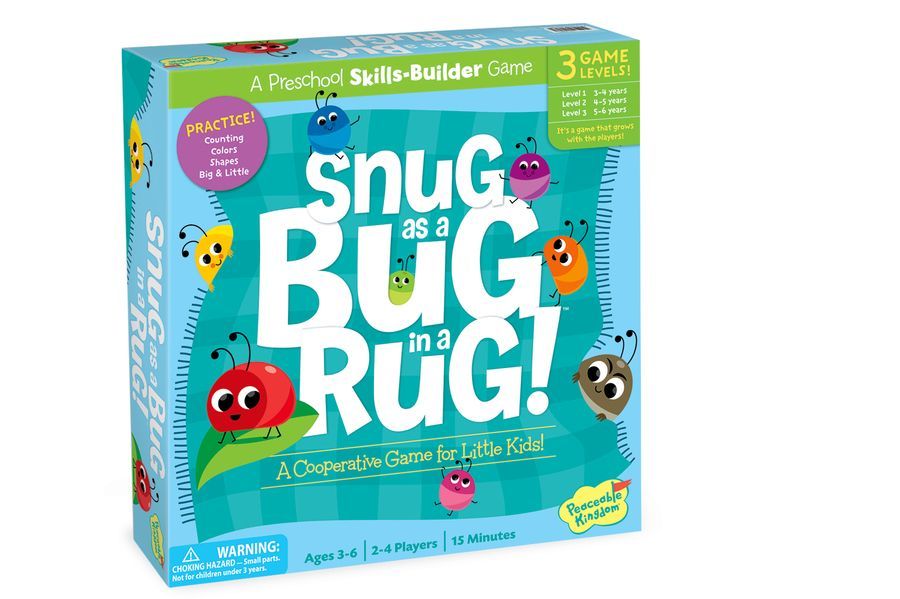
Players roll a die, spin a spinner, and work together to find bugs that match colors, numbers, or shapes before three stink bugs climb onto the rug. Slipping the bug tiles under the board edge gives tiny hands a satisfying mechanical payoff every single turn.
It won't keep a seven-year-old engaged, but as a low-friction introduction to turn-taking and visual sorting, it delivers exactly what it promises.
Age Fit
Spot-on for ages 3 to 5. Once a child turns six and enters early elementary school, the matching mechanic becomes trivial.
WISE Breakdown
Wholesome
95
Peaceable Kingdom delivers a cooperative, gentle preschool game where players work together against the game instead of each other, entirely eliminating early childhood sore-loser friction.
Imaginative
80
The physical gimmick of tucking colorful cardboard bugs literally under the rug (the raised game board) brings tactile delight to simple pattern matching.
Safe
98
Wholesome, low-stress theme about stink bugs. The only minor consideration is small cardboard bug pieces for curious toddlers under three.
Enriching
88
Builds foundational visual discrimination across multiple attributes (color, number, shape, eye state) while practicing turn-taking and collaborative problem solving.
Parent Info
✓
Why It Might Be Great
Three difficulty tiers ensure the game actually scales as your toddler moves from single-attribute color matching to tracking shapes, numbers, and open or closed bug eyes.
Zero cutthroat competition means everyone wins or loses together, sidestepping table-flipping meltdowns during game night.
Tactile board design lets kids physically slide pieces into slots beneath the raised board, which feels far more interactive than ordinary tile placement.
Fast 15-minute runtime keeps the session right inside typical preschool attention spans.
⚠
What to Watch For
Cardboard bugs can bend if stepped on or forced into the board slots clumsily by enthusiastic toddlers.
Very short shelf life beyond kindergarten; kids who master multi-attribute logic will outgrow the core puzzle quickly by age six.
Conversation Starters
"What details do you look at first on the bugs: their color, their spots, or their eyes?"
"How do you feel when we all win together versus when we play against each other?"
"If we don't find a match and get a stink bug, what should our plan be on the next turn?"
Deep Dive
Escaping the Candy Land Trap
Most mainstream games sold for preschoolers are mechanical nightmares. Candy Land requires zero player decisions and can drag on indefinitely. Chutes and Ladders punishes arbitrary bad luck with brutal setbacks that leave a three-year-old in tears.
Snug as a Bug in a Rug approaches early childhood gaming from a completely different angle: cooperative decision-making with scalable complexity.
How the Difficulty Scales
The game uses 24 bug tokens featuring varying colors, shapes, numbers of spots, and eye expressions (big/small, open/closed). Designer Peggy Brown built three rule variations directly into the box:
Level 1 (Simple Colors): Roll the die and match purely by color. Perfect for a three-year-old who is still locking down turn-taking and basic category recognition.
Level 2 (Two Attributes): Spin the spinner and match two attributes simultaneously, like finding a blue bug with three spots or a yellow bug with big eyes.
Level 3 (Attribute Elimination): Players use the spinner exclusively to deduce matches based on complex feature combinations.
Because the bugs slip directly under the board via perimeter slots, the cleanup and game progress have a clear physical visualizer. The tension stays light: three stink bugs atop the board means the rug gets stinky, but the game moves fast enough that a rematch is ready in under two minutes.