Our reviews and ratings are 100% unbiased. As an Amazon Associate, Screenwise earns from qualifying purchases, so if you buy a book or game through one of our links, we may earn a commission. We don't get any credit if you just Google it instead :)
Screenwise Verdict
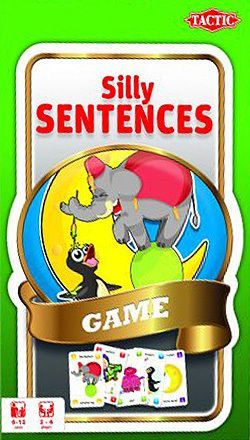
Silly Sentences is less of a competitive family board game and more of a clever literacy manipulative disguised as a hand-shedding game. The physical jigsaw tabs on each tile prevent kids from slotting an adjective where a verb belongs, making self-correction automatic for young readers.
The absurdity of making a crocodile jump over a school carries the game for a few rounds, but once the novelty wears off, the underlying game design feels thin. It works great as a ten-minute reading warm-up, but it is not something kids will drag to the table on weekend game night.
Age Fit
Best for ages 4 to 7 (pre-K through 2nd grade) who are building decoding skills and learning basic parts of speech. Anyone older than 8 will find the mechanical puzzle trivial.
WISE Breakdown
Wholesome
95
Pure educational play centered on goofy word construction and early reading skills with zero edgy content.
Imaginative
72
Sparks creative visualization by encouraging nonsense sentence creation, though constrained by physical puzzle pieces.
Safe
98
Physical tabletop tile game with no tech, no hidden content, and completely benign themes.
Enriching
82
Ingenious physical design where jigsaw shapes physically enforce sentence structure and parts of speech for early readers.
Parent Info
✓
Why It Might Be Great
Self-correcting mechanics use unique jigsaw tab shapes so verbs, nouns, and adjectives literally only fit where they grammatically belong.
Low-stakes humor keeps early decoders giggling as they piece together nonsensical sentences.
Tactile reading practice gives kinesthetic learners a physical handle on abstract parts of speech.
⚠
What to Watch For
Thin game structure means older kids will quickly spot that the shedding mechanic is secondary to the vocabulary gimmick.
Wear and tear on 1999 cardboard puzzle connectors can make pieces loose after heavy classroom or home use.
Conversation Starters
"What is the absolute weirdest sentence you can build with the pieces in your hand?"
"Why does 'The furry clock ate the princess' make sense as a sentence even if it sounds impossible?"
"If you could add three new nouns to this box, which words would make the sentences even sillier?"
Deep Dive
A Classroom Manipulative in a Game Box
Published by Dorling Kindersley in 1999, Silly Sentences relies on a smart physical trick: color-coded jigsaw tiles whose interlocking shapes enforce grammatical structure. A verb piece physically will not connect to an article. For kindergarteners and first-graders who are just grasping parts of speech, this turns sentence syntax into a tactile spatial puzzle.
How It Works at the Table
Players start with a hand of structural words (verbs, prepositions, adjectives, articles) and draw from a central stock of noun tiles. The official goal is to empty your hand first by attaching valid word tiles to open sentences, occasionally blocking opponents by forcing them to draw extra nouns. In practice, young kids completely ignore the blocking strategy and focus entirely on assembling the most ridiculous statement they can manage.
Limits and Alternatives
With 124 total tiles, the sentence variations eventually repeat themselves. It functions wonderfully as a supplementary tool at a desk or reading station. However, if you want long-term family game night staying power for early readers, titles like Apples to Apples Junior or classic Mad Libs offer significantly higher replay value once basic decoding is locked in.